Welcome.
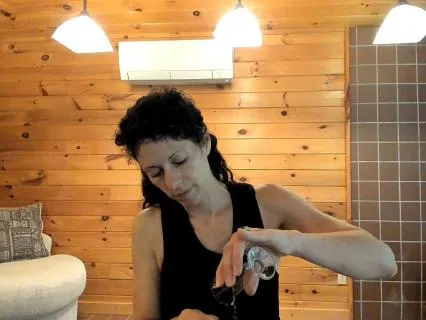
My name is Melissa Kleehammer and this is class two of making our own first aid kit.
Today we're making a bug spray to ward off mosquitoes and ticks.
So you need a few more supplies.
I'm using a one ounce spray bottle.
One ounce spray bottle,
I've got Citronella Java.
Lemongrass and now my lemongrass.
Bring it up to the camera.
Maybe you'll see it a little more clearly.
It's lemongrass CT or chemotype rodanol.
This is a more gentle on your skin lemongrass than the traditional.
So citronella java.
The lemongrass chemotype rodanol.
Geranium or peppermint.
And then cedar wood or any.
Any woodsy element and I had said in the first video that I was going to make this as simple as possible.
So the simplest is to use cedar wood that we used in the previous class.
Carry that over.
Now I've got some distilled water in a measuring cup.
And I have what's called soluble.
Soluble is something that you use in water-based blends.
It helps to mix with and disperse the essential oils.
More effectively than without it.
So it is not essential.
I made blends and just shook it up really well before every use.
I still do that with the soluble,
But the soluble does tend to keep the oils mixed up.
But my point is I used.
I didn't use soluble for years.
So if you don't have the money to buy it,
Do not worry.
You don't absolutely need it.
So.
With this is a one ounce bottle,
You can do any size.
Just know that my measurements are for one ounces.
If you have a two ounce bottle or a four ounce bottle,
You'll then double or quadruple the recipe.
Okay.
So we're starting with citronella java and the lemongrass,
10 drops of each.
Now,
As we.
.
.
As we blend here,
I will of course be silent while I'm counting,
So excuse that.
10 drops,
Satchinala java.
Now,
Bugs are attracted to us based on how we smell.
So these oils were picked specifically for their smells because they repel the bugs,
Especially the peppermint coming up later.
But also because of the components that exist within the oils.
And I'll talk about that after we make our blend.
So now I've got 10 of lemongrass.
Cap the bottles after each use.
Okay,
So you can use either peppermint or geranium.
Now the peppermint is a very strong oil that disorients the bugs.
The geranium has a component called geraniol that is a sighted tick repellent.
So I'm choosing to use geranium.
But I understand that that oil is less purchased,
Maybe less available than peppermint.
Either is good.
Whichever you have,
You're using five drops.
And cap it.
Okay,
Now any woodsy oil will is used to anchor the blend and to help hold it onto the skin.
In the previous class on pain relief,
We used cedarwood.
So that is the most accessible oil if you're limited on your oil resources.
Another great one would be frankincense.
Patchouli.
I'm going to use patchouli because I don't use it very often.
So I wanted to bring that into the mix.
It's a strong oil.
I'm going to only use three drops.
I would say the same if you're using frankincense and cedarwood.
They're also strong,
Earthy oils,
So three drops is plenty.
So now I have a very small measuring beaker.
That is very helpful for measuring.
Smaller amounts of liquid.
So I'm going to use my soluble.
If you choose to buy soluble,
The rule of thumb is that you quadruple or you multiply by four.
The number of essential oils you used.
So we used 28 drops of essential oils.
Multiply that by 4 and you get,
I wrote it down earlier,
112.
If you have a kind of dropper like this,
You could take your time and drop.
112 into the bottle.
Not going to do that.
I've been using it for a little while now so I've been able to measure or bring the equivalent into milliliters.
So 112 drops is roughly four and a half milliliters.
So I'm going to find that.
On my beaker and I'm gonna pour.
And that's good.
Okay.
And then,
Now this is one ounce bottle,
So I know that that's 30 milliliters.
So I'm going to.
.
.
Pour this distilled water.
You could certainly use regular water.
I just have distilled water,
So that's what I like to use.
And I'm going to fill it up to the 30 ml mark.
Maybe a little higher,
But maybe not higher because I don't want to overflow this black bottle that I cannot see through.
So.
However you're able to pour this in.
Okay.
So now we cap it with whatever spray top you have.
Okay,
And now.
We need to label.
So again,
I'm just going to put it on the top here.
You can certainly use masking tape or some kind of oval or bigger label along the side.
And I'm just going to write bugs.
All of the oils we used today were very strategic.
The citronella,
Has these components called citronellol and geranium.
All cited to repel insects.
The same is true for the lemongrass CT rodanol.
But it's also,
We're using that because it's gentler on the skin.
And it has a much higher component for the geraniol.
And then same for the geranium oil,
If you opted for that.
So I hope that you enjoyed making this.
I hope that you remember to spray it on yourself when you are going outside,
When you're going for a walk or a hike.
And I'd love to know.
How it works for you.
Our third class we're going to be making an itch relief roller so that if you end up with maybe forgetting your spray and you get bit,
Or sometimes the bugs just get through.
But I will say I have far fewer.
Very few when I use the spray,
But sometimes we still get bit.
So we're going to make an itch relief roller that also doubles for if you get a burn from hot oil from the stove.
You can use it for either.
So I hope you'll join me.
Again,
My name is Melissa Kleehammer,
And thank you for being here.