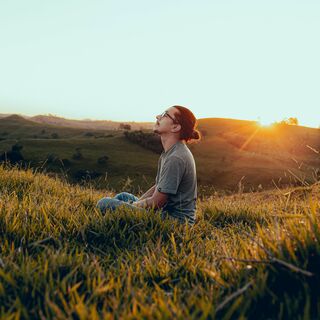
Welcome to this small teaching on meditation posture.
This is for beginners in their meditation practice,
But it's also a good reminder for anybody wanting to return to the foundations.
Meditation is something that people think of as.
.
.
Taking place only in the mind,
Only in the internal space.
But setting yourself up for longevity and comfort during your meditation is going to keep you from getting distracted by sensations in the body.
Everyone's body physicality is a little bit different.
So today we're going to talk about general ways that you can aid in your body's ease during meditation.
And if there are specific things that you would like to adjust personally,
Go ahead and do so on your own.
Most often,
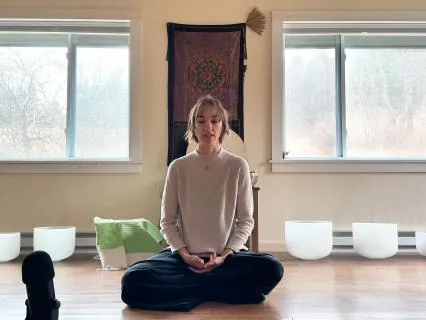
It's helpful to keep the knees below the hips in a meditation posture.
This helps with the position of the back,
The hips and the legs and is most usually assisted by a bolster or a pillow,
A rolled up towel or blanket,
Something like that to get your sits bones and your hips just a little bit elevated off the ground.
Go ahead and flex your spine a little bit as if you're doing a cat cow pose seated.
First rounding the spine.
And then flexing the spine and noticing the tilt.
Of the pelvis You can put your hands on your hip bones,
On your hips to notice.
How it shifts in each position and then see if you can find a center point so that it doesn't feel too far in either direction of the hips moving forward or backward.
Next,
You want to think of the alignment of the spine,
Generally thinking of the hips.
And then stacking shoulders over the top of the hips.
Followed by the head over the shoulders.
Often that means moving the head back in space a little bit and tucking the chin slightly more than you normally would.
You can choose to gaze at the floor about three feet in front of you or out directly in front of you.
To keep the chin tucked,
Gazing at the floor is easiest.
You can also envision this gaze once the eyes are closed and your inner drishti,
Your inner gaze,
Is still focused out and down.
Next is the leg and feet position.
Depending on your body,
Your hips,
Your anatomy,
How you sit with your legs is gonna be a little bit different.
The most traditional posture,
That you see maybe in different books or videos of yogis and other meditators is the full lotus position,
Meaning both of your feet facing the ceiling crossed over each other,
Crisscross applesauce.
This is more of an advanced posture.
And depending on how long you want to sit in meditation,
It can be conducive or not conducive for pain in the ankles,
Pain in the knee,
Things like that.
Again,
If you have the flexibility,
Try this position out and notice.
How the difference with your knees below your hips feels.
Notice slightly different positioning of the feet and the ankles.
You can try crossing your legs in one direction with one foot on top and then adjust it.
The other direction.
See which one feels more natural for you.
This can be very tightly bound,
Or it can be more.
.
.
Loosely configured.
With your feet either more towards the outside of the hips or closer to each other.
The next option.
Is either a half lotus with just one foot crossed on top of the other,
Or you can place one foot in front of the other shin so that they're stacked together but one isn't elevated higher than the other.
And again,
You can play with which foot is in front and which one is in back.
Notice how your hips throughout this process change and maybe tilt forward or backward.
And again,
Realign those hips into a neutral position,
Shoulders over the hips,
Head over the shoulders.
Next thing we're going to talk about is the hand placement in a meditation posture.
Now,
We're not going to go fully into different mudras.
Mudras are different hand placements that have different meanings,
Different energetic signatures,
Different symbolic meanings as well.
But for now,
We're just going to practice a very easy posture for beginners.
And that is just having the hands.
Over the knees or the thighs,
Whichever is most comfortable for you,
Hands open facing the ceiling if you can.
Usually this is seen as a more receptive posture,
More open posture.
You can also have the hands facing down on the knees.
Notice if you like to have your hands further away from your body,
Extending your arms,
Or if you like to have them tighter in and just play with that position as well.
If it helps to bring your hands into a mudra,
You can try different things.
You can put your index finger and your thumb together in that mudra.
Some people like to extend the three additional fingers.
Some people like to bring up the elbows toward the ceiling.
This is the classic meditation posture that you'll see.
And you can look up different mudras and see if there are specific ones with different fingers touching the thumb,
Et cetera,
That you feel most drawn to in your practice.
To begin with,
Though,
I would just say open hands.
Next,
We'll discuss the breath.
The breath is the thing that usually carries you through a meditation.
As a beginner,
It can be helpful to place one hand over the chest and one hand over the abdomen to just begin to notice your own natural rhythm of breathing and where you breathe into.
Do you breathe into your chest?
Do you breathe into your abdomen?
Or is your breath in a different rhythm,
A different system?
And just observe that first.
Do you most naturally breathe through your nose or through your mouth?
And can you track the inhale as it moves through the nasal passage down into the throat?
Into the lungs and maybe even down into the stomach.
And then trace it all the way back as you exhale,
Noticing the sensation of the air passing through the airways and out.
As many rounds of breath as you would like to in this moment to begin to really notice and sink into your breathing pattern.
Often breath is associated with controlling the mind and becoming more still and present.
So see if there is a rate of breathing which feels most natural to you.
And then play with breathing a little bit slower.
Notice how that changes and shifts the body.
And then play with breathing a little faster.
What does that do to your energy and to your body and to your mind?
And then once again,
Find that middle path.
And observe the breath.
We'll also talk about mantras in a moment.
And often those can follow the rhythm of the breathing,
A mantra being used on an inhale or an exhale or part of the mantra on the inhale,
Part of the mantra on the exhale.
And this helps to control the body and the mind.
During meditation.
Next,
We'll focus on the drishti or the eye gaze.
If you're choosing to meditate eyes open,
It's really helpful to choose one fixed point.
Like I mentioned before,
Usually somewhere on the floor in front of you,
Maybe two feet out,
Three feet out,
You can play with how far.
That feels good.
You want to imagine that you're looking down the bridge of your nose at the ground.
Alternatively,
You can look at the tip of your nose.
And focus both eyes at that central point.
Or if you'd like to try,
You can gaze at your third eye center,
The space right between your eyebrows.
Usually this space is more reserved for eyes closed,
So we'll go into those options next.
Close your eyes and notice what it would be like to look at the floor in front of you,
But keeping your eyes closed.
And then notice what it would look like to gaze at the tip of your nose with your eyes closed.
And then try that gaze at the third eye in between the eyebrows with the eyes closed.
These drishtis help to focus the mind.
And remind us where to place our attention.
There are also drishtis that you can use an inner gaze for.
So you can harness your awareness into the heart space,
For example.
It's not that you're going to be physically moving your eyeballs to look down at your heart space,
But instead.
You gaze your eyes in one direction and place your inner awareness,
Your attention,
At The Heart Space.
As you're doing these different drishtis,
You want to make sure that the.
.
.
Eyes and the eyelids stay fairly relaxed.
You don't want to be forcing yourself to look in one direction so hard that the eyes are straining or they're pushing together cross-eyed too much.
Being able to maintain posture and breathing and the eye gaze all in a soft way.
And then next we'll talk about mantras.
There are many different paths of meditation and different mantras or affirmations or phrases are used in different forms of meditation.
Transcendental meditation,
For example,
Uses specific mantras different from.
An affirmation mantra that you might be using.
Your mantra is up to you.
If you want to go down the route of finding a lineage and finding a specific mantra for your purposes,
That's great.
You can find Sanskrit mantras.
You can repeat simple words,
Phrases,
Anything like that that you want.
The purpose is just to.
.
.
Bring you back into focus and to know where you're placing your energy.
So we're just going to use an example of.
I am as a mantra.
You can repeat this as often as you want.
Bringing your mind back to this contemplation of I am.
And you also can use it in tandem with your breath.
So on the inhale,
You can say I.
Inwardly,
And on the exhale,
You say M.
Right?
And this is usually all done within the mind.
You can say a mantra out loud if you would like to,
But if you're in a meditation phase,
It's usually good to try to do the mantra inwardly.
Sometimes you can say it a couple times out loud,
Whisper it a couple times,
And then say it inwardly.
So we'll do that now.
We'll say it out loud twice,
Whisper it twice,
And then say the mantra inwardly twice,
And then again,
Whisper it twice,
Say it out loud twice.
And you can follow along,
Practice with me.
So get your position ready.
Your body position,
Your hand position.
Your drishti gaze of choice.
Notice your breath.
And then beginning saying I.
Am.
I.
.
.
And.
.
.
Whispering.
Silently.
Whispering.
Out loud.
Bye.
And.
.
.
I.
.
.
You can also use phrases like inhaling,
Exhaling.
Inhaling.
Exhaling.
Or you can use single word affirmations.
Peace.
Or,
Of course,
You can use longer phrases as well.
Whatever fits into your practice the best.
And then let's talk about longevity of your practice.
Usually it's going to be pretty hard to just jump right into a 20 minute meditation or an hour long meditation.
So starting small and building up is a great way to go.
Starting with five minutes is a good beginner length of meditation.
Moving to 10 minutes,
15 minutes,
And knowing that the beginning part of the meditation,
No matter how long you've been meditating for,
It's going to be challenging.
So sometimes the five-minute meditation is going to be all.
.
.
Challenging to the mind to find stillness.
And then maybe you start doing the 10 minute meditation and the mind is active for nine minutes and you get one minute of stillness.
Then you move into the 15 minute meditation and there's 14 minutes of activation in the mind and one minute of meditation again.
It's not that you're always going to get more and more stillness.
It's that you are returning to the practice time and time again.
And over time,
That will build the muscle of stillness within you.
There are.
.
.
Hundreds,
Thousands,
Millions of ways to meditate.
Every individual is going to do it differently.
These are just some of the things that might help you at the beginning of your practice.
There are many more,
And there are many great teachers to help you along the way.
If you would like more information,
You can always reach out to me directly.
You can always find more of my meditations if you like my teaching style.
And I hope that wherever you start in your meditation journey or wherever you are currently as a meditator,
That this helps you to settle into a practice that should feel.
Generally easy.
We should feel at ease in our meditation practice,
And the meditation practice should help you feel more at ease in your life.
Yes,
There are difficulties in meditation.
It's hard to show up time and time again.
And the mind becomes very active when we start to meditate.
That's all really normal and part of the process.
So go ahead and practice your meditation.
Thank you for being here with me.
And I hope that this is helpful.
Have a beautiful day.