Hello and welcome to Five Minutes in Nature with me,
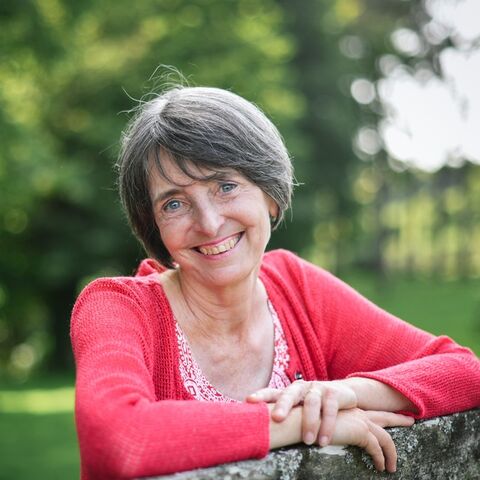
Liz Scott,
Out quite late in the evening up on Dartmoor.
The sun has dipped and it really is getting very dark.
I can see on the hillside opposite the lights of houses lighting up as darkness falls.
Above me is a herd of cows.
I've just passed some sheep who have settled down on the grass for the night,
So I gave them a wide berth.
I didn't want them to get up.
Grass,
Grey clouds,
A sense of rain is in the air.
And I'm with you today because I just wanted to get out before I go home and go to bed.
And today's reflection is following a conversation I've had about thought with some friends.
And I've talked about thought and I talk about thought a lot with you because it's really underestimated how powerful thought is.
When somebody says to you,
Oh,
It's just your thinking,
There is a cultural assumption that because it's just your thinking,
You should quite easily be able to get over it.
Nothing could be further from the truth.
That's why I'm really interested in the power of thought,
The principle of thought,
Because thought is a creative agent that makes things look and feel real.
Sometimes thought gives you a really accurate portrayal of what's going on.
So at the moment I'm looking out,
I can see the cows,
I can see a stream,
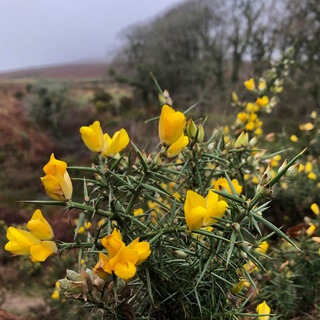
I can see a gorse bush ahead of me.
My sense is this is a pretty accurate portrayal of what I can see in my world at the moment.
It all comes to me via thought.
So I'm seeing it with my senses,
But it's translated through thought.
The thing with thought though is that it can make things look real and frightening even though they aren't real,
They don't exist and they probably won't ever happen.
And that too is the power of thought.
Thought has the power to create really frightening images of things that might come in the future.
It has a way of conjuring up things that have happened in the past and playing them out repeatedly again and again.
Thought does that.
But one of the things I find really helpful with thought is that it's not about trying to get rid of thoughts or thinking.
It's not about trying to think more positively or kind of armour yourself or defend yourself against particular thoughts.
What's really helpful is to notice when you have a thought and then to give it a full stop.
Somebody once described it to me as more full stops and fewer commas.
What do I mean by that?
Well,
I was talking to someone today and she was just expressing a bit of concern that she'd had maybe a bit of a choppy meeting with her boss.
And she was like,
You know,
It didn't go very well.
I think I messed up.
I'm pretty sure they're going to fire me.
That's like,
And then if I get fired,
What am I going to do?
I'm supporting my family.
We're going to,
If you know,
My husband's going to have to get another job.
I don't know what I'm going to do.
My children won't be able to do all the things that they're doing in their lives at the moment.
Now she had a thought,
Which was,
I've had a meeting and it was a little bit choppy and I messed up.
That's fine,
But everything after that,
All the things that she then imagined about her future,
All the things she imagined about she might lose her job and how they might get poor and how their lives are going to change to the detriment of her children,
All of that was made up by thought.
So saying the line or recognizing that,
Yes,
I've had a bit of a choppy meeting and I made a mistake,
Full stop.
Is very simple to acknowledge.
Trying to live in a world where you are without a job and your children are destitute and you can't afford the bills,
When that's not happening.
Well,
That's not what we're designed to deal with.
And we do it in everyday situations as well.
Maybe I send a message to someone and they don't get back to me.
So I think,
Oh,
I must have offended them,
Or what did I say that was wrong?
Maybe they don't like me anymore.
Whereas actually all that's happened is I've sent a message and they haven't responded,
Full stop.
Can you see the difference?
And so today is a reflection on that,
Is introducing more full stops in your life when it comes to stories that you might tell yourself.
Just notice thought and then give it a full stop.
You don't have to create a story,
Particularly a catastrophic story,
To link up that thought with a future that doesn't exist.
More full stops,
Fewer commas.
That's what we're talking about today.
Let me know your reflections.
And of course,
Don't forget to join me again tomorrow for another five minutes in nature.