Hello and welcome.
My name is Ish.
It's currently Halloween right now and I'm wearing my kangaroo costume.
And today I'm going to be going over a beginner's guide to meditation.
So specifically I'll be giving you some information on how to sit and conduct your posture as well as what you might need.
And then I'll be going over a meditation which includes a seated meditation as well as a portion where you'll be doing a walking meditation as well.
So I hope you will enjoy this.
So the first thing is that for your seated meditation you'd want to sit on a kind of cushion that will support you.
And the one I'm sitting on right now is a buckwheat cushion known as a zafu.
So this is traditionally used in a Zen setting.
And the idea or theory behind this is that when you sit on a zafu your legs will form a triangular base.
So you notice how my knees are touching the ground.
And this will allow my spine to be supported,
My lower back supported as well.
And you keep an upright posture when you do this.
You can also sit in a chair as well although that's not recommended because when you sit in a chair your back is not supported.
So if you do have any issues you can certainly sit in a chair if you're not able to sit for whatever reason.
But just try to make sure that your back is upright and not supported by anything behind you as well.
And another alternative is you can also sit in a kneeling bench as well.
This is known as a Seiza kneeling bench.
And this will also allow you to keep your knees on the mat and the ground and then also keep your back upright as well.
And speaking of your back,
So you want your spine to be upright and in one line.
And specifically you want your ears to be in line with your shoulders.
So you'll find that as you jut your chin forward your back will start to round and you'll hunch over.
And you'll also get very lost in your thoughts as well.
So people report being very sleepy and getting very tired,
Groggy.
And likewise if you tilt your chin all the way back and you're just like I don't care and your ears go back then you'll start to relax in your posture as well.
So you do want to keep an even balance of your ears in line with your shoulders.
Now as far as the seated pose you can sit in a cross-legged position with the left or right leg on top.
Doesn't matter really which one.
Or if you have a bit more flexibility you can come into half lotus and this is where you bring your left or right foot on top of the hip.
Now if you're a bit more advanced and certainly don't do this if you have tricky knees or ankles you can start to come into full lotus and this is where you bring your bottom leg on top of the other leg.
But certainly this is a bit more advanced so for now just you can sit in a cross-legged or half lotus.
Alternatively you can always just sit back on your heels.
So you place your knees down and then sit back onto your cushion as well and that also works.
So you can find what's comfortable with you.
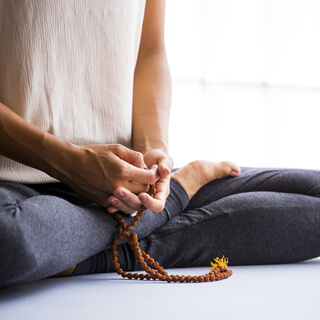
And with your hand posture there's a lot of different types of mudras out there but the one I like using is cosmic mudra borrowed from the Zen tradition.
And the way to do that is you bring your right palm face up an inch below your navel and your left hand on top and your thumbs are lightly touching.
So there's some wiggle room here so you could either keep your thumbs kind of close to your navel area or bring the fingers to your navel area.
But in either case this posture is important because what it does is that it keeps your shoulders back,
Chest straight and you'll start to notice that as you drop your hands to your lap and that happens naturally your shoulders around forward.
So you don't want to do that.
So you want to keep your hands up here.
And then what you'll be doing is that you'll be gazing 45 degrees downwards and typically people will either meditate with their eyes open or they'll meditate with their eyes closed.
I personally like meditating with my eyes open and this is done in the Zen tradition.
And the reason why is that in your life you'll be going about your day with your eyes open you know most of the day right like you're driving or doing groceries.
So the theory behind this is that if you keep your eyes open in meditation the same benefits that you'll enjoy through meditation such as calm and focus will eventually spill over in your daily life.
And that's something we're gonna try to achieve.
Now what we're gonna be focusing on in meditation is a one singular point of focus.
So there's a lot of different things out there.
You can focus on your breath.
You can focus on you know different sounds.
You can look at a candle right.
There's a lot of different things.
But to keep things simple just focus here on your breath.
And the reason why most traditions will focus on their breath is because this is the most neutral thing you can focus on.
It doesn't you know produce any different states of being or any adverse effects and anyone can really do this.
And we'll borrow from the Vipassana style of training where we just focus on the breath as it hits our nose.
So just in and out and we'll just go from there.
So let's get started.
First find a comfortable seat and take a moment to just bring your gaze about 45 degrees downwards and your eyes open.
Just start to notice your natural inhales and exhales.
So at this point you're not trying to consciously control your breath at all.
But rather just observing the natural inhales and exhales and the quality associated with it.
Is your breath a bit more shallow in this present moment?
Or is a bit deeper?
Are you breathing more from your chest or lower belly?
Just start to observe.
And now with the same inward focus start to bring your attention to your breath.
Specifically just at the nose area.
So specifically you'll just notice that the air will hit your nostril linings as you inhale.
And you'll notice the air leave your nostrils as you exhale.
So you're not following your breath all the way down or focusing on anything other than just the breath in your nose area.
So specifically what you'll notice is that the more you focus on your breath at this point,
You'll notice subtler and subtler sensations start to arise.
So for example,
You'll notice that as you inhale that the air coming through your nostrils feels slightly cooler temperature wise.
And as you exhale the air leaving your nostrils feels slightly warmer.
The more you start to focus on these particular sensations and very subtle sensations,
The deeper you'll start to get into your meditation.
And you'll also notice even deeper subtleties.
So keep your focus here.
So if you find that your mind has started to wander,
Gently guide your attention back to your breath.
So now starting to sharpen your attention and awareness a bit more,
Start to notice whether you can feel the airflow more.
So from the right nostril or the left nostril,
Or notice whether there's an even sensation of noticing the breath.
So if for example you can feel the right nostril very strongly and you can feel the breath there,
But nothing in the left nostril,
Try to bring your awareness now to the left nostril and see if you can notice any kind of sensations there.
So so so And once again if your mind wanders,
You'll just simply notice that your attention has moved and then simply just shift it back to watching the breath.
So this is a very simple process and what this does is that it strengthens the muscles of concentration.
This is a valuable skill not just for meditation but outside your cushion as well.
So so And we'll now start to enter the walking meditation portion of this class.
So first place your palms face down on your knees and before we start just slowly just warm our bodies up.
So I like to take some small circles with the spine going in a circular fashion while you're seated.
So if you're new to sitting in meditation what you'll probably feel is your lower back is pretty sore just because we're just not used to sitting bolt upright for extended periods of time.
But this becomes easier the longer we sit.
And if you went in a circular fashion in one way,
Go the other direction and take a neutral spine and we'll start our walking meditation.
So the first thing to keep in mind is our hand posture.
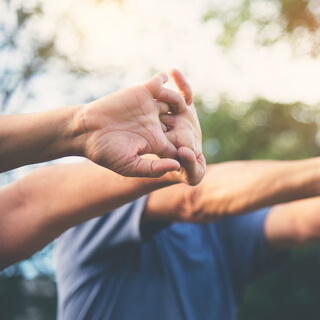
So it's a slight variation but what we'll do is you'll place your right palm out so the palm is facing out from you and then you'll take your left hand and grab your right thumb.
So again the right palm is faced out towards away from you and then you'll take your left hand and grab the right thumb.
And then from here you'll close the right hand so you're making a fist.
And then what you would do is you would just pull your hands in towards you.
So you kind of have like a closed fist with your left hand grabbing the right thumb.
And again your hands will be at your lower navel area.
That's where you want to keep it.
And then you can come to a standing position.
So if you have space in your room you should be able to do this.
So it really depends on your setup.
So if you have a larger space you can walk for a bit longer.
If you have a smaller room or area then it'll just be a shorter route.
But essentially what you'll be doing is you'll be walking very slowly.
So just placing one foot in front of the other at a very slow pace.
And as I'm doing this I'm noticing the heel press against the floor.
The balls of the feet and then the toes and then the other foot.
In a slow fashion.
So this is borrowed from the Zen tradition.
This is known as Kinhin or walking meditation.
And I'm feeling the sensations associated with walking.
So I can feel the temperature of the ground whether it's cooler or warmer.
And then I'm feeling the sensation of the feet.
And the various sensations of walking against my feet.
And we're basically just integrating the seated meditation through our walking meditation.
So it transfers over.
And while you're doing this you can keep a light touch to your breath.
So you're still paying attention to your breath.
Just noticing the natural inhales and exhales and any sensations associated with this.
And just start to notice whether you feel the sensations of walking more in one foot compared to the other.
So so so And if you get a bit too focused on the sensations of walking and you lose your connection to your breath you can start to slow down just a bit and focus back on your breath again.
Likewise if you're a bit too focused on the breath as well and you forgot the sensations of walking then you can start to switch it up a bit.
So we'll just take one more round.
So you'll just go up to the end of your space wherever you're at and then go back again.
And then make your way back to your cushion.
And then have a seat.
So now what you can do is when you're coming to a seated posture if you were sitting in a cross-legged position or a half lotus position you can switch the cross of your feet.
So for example if your right leg was on top last time then you could now bring your left leg on top.
If your left leg was on top now you can bring your right leg on top.
So just switch it up.
And once again just taking cosmic mudra so your right hand an inch below your navel left hand on top thumbs lightly touching.
And as you start to check in now you can start to observe some unique changes since the last compared to a few minutes ago right.
So you can see that your right leg is last compared to a few minutes ago right.
So since we did incorporated a bit of walking meditation you'll notice that you get a bit more circulation in your feet a bit more warmth right.
So you can actually use that as a tangible thing you can focus on in your meditation.
So first observe your breath so again just noticing the natural inhales and exhales at the tip of the nose.
And then while you're doing this now notice your feet the sensations such as warmth or a tingling sensation.
Noticing a bit more of the blood circulation we're starting to observe.
So so if you may be having a hard time focusing on the inner body sensations associated with your feet one thing you can do practically is notice the points of the feet that are pressed against the ground beneath you.
So if you are for example sitting in a chair you can focus on the soles of the feet against the floor and that tangible contact.
If you're sitting in a cross-legged position you'll notice that the one of the feet will be pressing against the ground.
So you can observe whether there is a certain temperature or feeling associated with that moment while at the same time focusing on your breath.
So just a few more moments here in this meditation.
Start to observe if you have shifted your body.
So for example if your hands have dropped to your lap at this point you can start to bring it back up to your navel area.
If your shoulders have hunched over you can start to bring them back.
Same with your hunching of your spine as well.
And also notice whether you've either shifted or tilted your head forward or whether you've tilted it backwards.
So you want to keep it in line.
So now from here start to bring your hands to heart center.
Bring it up to your chest so your hands are at a prayer position.
And slowly just close your eyes just for a moment.
Just take a natural noticing.
Noticing the quality of your mind.
Noticing the quality of your breath.
And the quality of your attention.
So notice how you feel in this present moment compared to the beginning of this meditation.
And if you like you can take a very quick bow or small bow and just honor and thank yourself for taking the time to meditate and really take care of yourself today.
This concludes this meditation.
I hope you enjoyed this tip and this hopefully encourages you to start practicing a bit more and you really find that meditation is a truly amazing gift that will enrich all aspects of your life.
So thank you again.
Namaste.