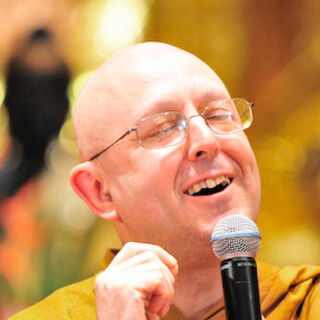
Welcome everybody to this afternoon's meditation class.
And as usual to give the instructions that those people who are coming to the Introduction to Meditation class,
Which are the series of four lectures for those who haven't meditated before,
That class is being held in a small room to my right.
And this is the class for the ongoing meditators.
So if you think you can meditate for 40,
45 minutes,
This is the class for you.
But if you haven't meditated that long,
It's probably best to go to the other class.
Otherwise during the middle of the meditation,
You tend to sort of fidget and disturb others.
So this is a class for those who have meditated quite a long time before,
So they can sit still for quite a long time.
And at the beginning of this class for 15 minutes,
I usually talk about some aspect of meditation.
And just one of the long-term friends was asking me about the teaching which I've given,
About putting one's attention in between yourself and the meditation object.
And that was a bit of a coincidence because last week I was in Melbourne and teaching meditation there and somebody also asked the same question,
Picking up from something I've given on the recorded talks.
And it is a useful,
Skillful means.
We call them skillful means because it's just not the only way to meditate,
But one way to meditate which solves a lot of problems and gives you deeper peace in your meditation.
So what many people do when they're meditating,
They either look at themselves and see what you're doing,
So the attention's on the observer.
Or other times they put their attention on what they're supposed to be watching.
And if you're lucky you can be watching the breath,
But many times you're wandering off or you're down in the sleep and that's what you put your attention on.
And sometimes that causes a lot of problems.
And it also misses that meditation,
It is not really important what you are aware of,
The object is not crucial.
What really is important is the way you are meditating,
What you are doing with what you are experiencing,
Whether whatever experience is with you at that moment,
Are you trying to hold on to that,
Are you trying to reject it,
Are you wanting it to develop,
Are you wanting to be somewhere else,
Are you content,
Are you opening the door of your heart to that moment,
Are you trying to get rid of it,
Are you embarrassed by it.
These are the important parts of the meditation.
You might call it your reaction to what's happening right now because it's in that reaction,
In softening that,
In abandoning the negative reactions and in their place developing the positive ones,
The ones which will cause deeper meditation in the future.
And by that I mean making peace,
Being kind,
Being gentle,
Being patient.
And a skillful way to emphasize that it's not what you are experiencing but how you are experiencing it is the skillful means of putting your attention in that space between you and the object of your awareness.
Obviously this does take a bit of visualization but not strong visualization,
Just a framework for experiencing whatever is me,
The observed and space in between.
Because once you put your attention,
The space in between,
You are taking away the attention from the self,
From the me who is doing this meditation.
So straight away it takes away all this,
I'm good,
I'm terrible,
I can do this,
I can't do this,
Because your attention is not in the self anymore,
It's not about me anymore.
And also it's not so much in the object,
It means you're not really so caught up whether you have got the breath,
The beautiful breath,
The present moment,
Nimittas or whatever,
That's not sort of your focus.
Your focus is what's in between this.
And for one it takes you away from this sense of self or worry about where you are in the meditation.
In other words,
What is the surroundings around you?
Just like driving a car,
You're not really concerned about sort of the landmarks around you and where you are in the journey.
Nor are you really aware of you sitting in the car,
The person,
But you're aware of how you're driving,
Making sure you're driving well,
Making sure the process is happening.
And by putting the attention between you and the object,
You take away from me and from the object,
You put it into the place where the meditation is really important in the process of meditation.
And once you put your object in that space in between,
Then you see that is where the action is,
That is where meditation happens.
And in that space between you and that object of awareness,
In that space in between,
You find that you can adjust that space.
Sometimes you look in that space between you and the object and there can be ill will between you and the object.
You know,
It might be,
Say,
Dullness.
I don't want to be dull,
I'm always dull,
I hate this dullness.
And it's as if you're putting that ill will in a space between you and the dullness.
And if that's what you see,
Literally you just take that ill will out and put in some contentment.
If you're dull,
It's because you've been working hard.
Maybe you didn't sleep much last night.
There's all sorts of reasons,
Maybe you're just sick.
So putting ill will between you and the object,
You can replace that by just kindness,
Acceptance,
All these positive,
Good meditation emotions.
And if you put contentment,
Peace,
Kindness,
Gentleness,
Patience between you and that meditation object,
Say,
Dullness,
You will find that dullness doesn't last very long.
And at the same time,
Because you're making peace,
Because you're being kind,
Because you're being gentle,
The meditation will be progressing incredibly fast,
Much faster than you'd ever imagined.
Why?
Because you're putting your attention where the action is,
The place where you can really tweak the meditation to make it work.
And if you are meditating and maybe you get another nice breath,
Breathing in and breathing out,
But yeah,
You want it to go a bit further,
You want to get into the nimitta realms.
And then you actually can see that in the space between you and the object,
Yeah,
You've got beautiful breath,
Delightful breath,
That's wonderful.
But then you're putting this wanting and desire between you and that object.
And you can notice that even though you're going very deep and things are going well,
Still you're making the mistake there because what's between you and the object is a negative.
So very often if people say they've got sort of a delightful breath,
Yes,
But what was between you and that object when that was happening?
And you'll find that because you've got a negative quality between you and the meditation object,
In this case the delightful breath,
That's why it doesn't develop any further.
That's where you've lost the attention,
The place where you should have been watching to take it even deeper.
So that gives a much better way of,
A very skillful way of developing the meditation because you're putting your attention onto the process of meditation,
Not on the agency who's meditating you,
Not on actually how far you've got,
The object of meditation,
But actually what you're doing about it.
Not so much where you are or who's the driver,
But how you're travelling.
As long as that way how you're travelling is well,
Then you're going to make great progress.
It's the same if you've got like pain in the body,
You don't watch the pain,
You don't watch me who's experiencing the pain,
You're watching what's between me and that pain.
And again when you sort of put the attention there,
It's amazing what you find.
Because there you can find the negativity,
You can find the fear,
You can find the lack of patience,
I've been experiencing this for too long,
I can't stand it any longer.
That's actually where you find the source of the problems.
So you can,
Once you see what the source of the problems are,
You can't change the pain,
This is you,
But certainly you can do something in that space between you and what you're experiencing.
There is if it were you have full charge of what you put between you and that object.
And it's very similar,
Just you can make different frameworks and understanding this principle,
It's different like changing your glasses.
You have your black glasses,
Your red glasses,
Your green glasses.
If I put my green glasses on,
You all look green.
If I put my black glasses on,
You all look black.
If I put my gold glasses on,
You all look gold.
So whatever I put between my eyes and you,
The objects,
It actually affects you.
So it's as if I put my peaceful glasses,
Making peace glasses on,
I put my being kind glasses on.
So when I'm looking you,
I'm looking with kindness and I see you with a kind eye.
And that idea of putting something between you and the object also does alter the way you look at things.
And that's again what we really mean.
And last but not least,
As one person just reminded me,
And it's a very,
Very good point,
It also makes it very clear that this whole dharma of meditation,
This whole thing about you,
That life is a process,
Not a thing.
There's not a self inside.
You don't exist out there.
This life is a process and by observing this process in the proper way,
It's not what you're experiencing,
It's not where you are,
It's not who you are.
But it's the process,
How this thing is travelling,
How this thing is flowing.
And so it doesn't matter what the river is,
Whether it's clean or dark,
It depends on where it's going,
How it's flowing.
And if you can sort of adjust the way this stream of consciousness is flowing,
This is how one does it.
It doesn't matter where it is,
Where it happens to be right now,
It's where it's going,
How it's moving.
The process is the most important part.
By putting that attention between you and the object,
Wherever you happen to be,
You're really affecting this process.
And also you understand that life is a process.
Life is a relationship between you and the object.
This is where life happens.
It's not about the self,
It's not about a me.
It's nothing to do with you,
It's always about us.
And us,
I don't mean you and somebody else,
I mean you and life.
The process of the relationship between you and life,
Between you and happiness and you and disappointment,
Between you and getting old,
You and death,
You and sort of eagles losing or winning,
Whatever you get into in your life.
So this is actually where the action of life is.
And so by putting the attention in the space between you and the object in meditation,
Not only does it give you direct access to the action in meditation,
A way you can actually do something,
But it's also a great way of learning how to live a very beautiful and wonderful life.
For those of you who know traditional Buddhism,
The enemies,
The defilements,
The hindrances,
Where do they live?
They say greed,
Hatred and delusion are three defilements.
You've got the five hindrances.
They don't live in the object which you're watching.
They don't live in the breath,
They don't live in the mindfulness.
Their mind is supposed to be pure.
But they live in the space in between.
That's where defilements happen to be.
It's not that you make me angry,
It's not that I am angry.
This anger appears in the space between us from now and again.
Just fear appears in the space between you and whatever you have to experience.
So that's where all the defilements,
That's where all the hindrances,
That's where all the bad guys live.
So if you want to get the bad guys or the bad girls,
Let's not be gender specific,
This is actually where the action is.
So you put your attention there and then you can make the space between you and whatever you're watching,
Pure,
Beautiful and kind and lovely.
You know all the positive stuff.
Put it between you and the object and you'll find the meditation takes off.
So there we go.
Now if you'd like to get yourself in a comfortable position,
You can start meditating.
And with your eyes closed,
By keeping the theme of this particular meditation,
Just the observer and the first object,
Your body.
What have you got between you and your body right now?
What's in the space between the observer and the observed?
In this particular case,
Your body.
Is it control?
Is it fear?
Usually those two go together.
Or is it trust and kindness?
See if you can put kindness between you and your body.
Put patience to allow this body time to find its optimum posture.
If you put patience and kindness between you and this object called your body,
You will by nature,
You will move when you need to move,
You will adjust,
You will scratch,
You will relax.
You find the relationship you have between your body becomes less dysfunctional,
Less one of master and slave,
And more of equals of mutual respect,
Which means things get easier and more in harmony.
And keep the patience up between you and this object called your body.
Sometimes people rush body awareness,
Which means that later on in the meditation they have to move and fidget,
Simply because they never cared enough.
They took their body for granted,
Put it in a posture and left it and find it hurts later on.
And now comes a time when the body is as relaxed as you're going to get it.
It's a time just to let the body fade away.
And what is your relationship with this present moment called now?
Is there wanting between you and this moment?
Are you trying to get somewhere?
Is there ill will because you don't like me talking?
What's between you and this moment?
That's where the action is.
Throughout the whole of this meditation,
And I'm going to be quiet now,
Throughout the whole of this meditation,
Focus on the space between you and whatever your way of.
WHEW!
.
.
.
.
.
.
.
.
.
.
.
.
.
.
.
.
.
.
.
.
.
.
.
.
.
.
.
.
.
.
.
.
.
.
.
.
.
.
.
.
.
.
.
.
.
.
.
.
.
.
.
.
.
.
.
.
.
.
.
.
.
.
.
.
.
.
.
.
.
.
.
.
.
.
.
.
.
.
.
.
.
.
.
.
.
.
.
.
.
.
.
.
.
.
.
.
.
.
.
.
.
.
.
.
.
.
.
.
.
.
.
.
Before we stop,
Yes?
Chris?
You could change,
But sometimes it's better just to realize the mind's being scrambled,
That's old karma,
Old meditation karma,
That you have to deal with the scrambled mind.
And if you understand the law of karma,
It means the best thing to do is just to make peace with it,
Be kind,
Be gentle.
And that's the best thing you can do,
Which means that you're making now good karma for peacefulness,
For unscrambledness.
But doing something,
Trying to get rid of things,
Sometimes just makes things worse.
It's not as efficient as just stopping and leaving it alone.
Okay,
We've gone past the time,
So maybe you can ask the question.
Oh yeah,
I was going to announce that,
Yes.
There is a sutta class on Sunday at three o'clock.
I might be ten or fifteen minutes late,
Because there's also a committee meeting on that day.
The sutta class is on number thirty,
The Chula Saropa Masuta.
So that one.
Okay,
Have to be done.
We have to do it next week because we're out of time.
Okay,
So for those of you who put a question in the basket,
We had too many questions here already,
So we'll be dealt with next week I hope.
So let's all now pay respects to Buddha,
Dhamma,
Sangha.