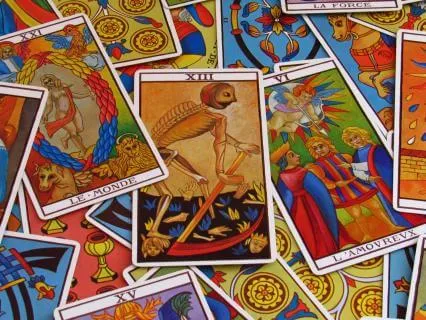
What do you already understand about tarot?
And have you ever wondered where tarot cards come from?
Are you drawn to them as a source of ancient wisdom,
A mystical gateway,
A psychological mirror?
Or a practical reflection tool for daily use.
Many people,
Still,
Somewhere in the backs of their minds,
Think that Taro came from wandering Romani travellers,
Or even from the sands of ancient Egypt.
But history tells us a different tale,
And the real story of their origins and evolution up to the present day is even more intriguing than the myths.
To understand why it still holds such power for us,
We will visit significant points in its evolution,
And we will bring the story alive by imaginatively stepping into each of these turning points.
Make yourself comfortable.
And be prepared to be amazed.
Let's go back to the very beginning.
The sun is beating down on the road to Sforza Castle in Milan.
It is 1450.
Above the clatter of hooves on cobblestones you hear aristocratic laughter,
Sharp and sudden.
But you aren't here for a reading.
You're here for the party.
Inside the great hall,
Torchlight flickers against heavy hunting tapestries.
A servant brushes past you with a silver platter of honeyed figs.
Through a doorway,
You glimpse a candlelit parlor,
Where nobles in heavy silks and velvet cluster around a table.
At the head of that table.
Sit,
Duke.
Francesco Sforza and Duchess Bianca Maria Visconti.
Between them lies a deck unlike any you have ever seen.
It is the Visconti Savoza Cards.
At first,
They seem to be an ordinary card game.
The illustrations are cups overflowing with wine,
Swords sharp enough to draw blood,
Coins like real currency,
Staves carved from knotted wood.
You recognize them.
They are the minor arcana.
But then comes the fifth suit,
The artist Bonifacio Bembo.
Finished them only weeks ago.
They are 21 hand-painted cards shimmering with actual gold leaf,
Plus a wild card called Ilmato.
The Fool Nobody calls them the Major Arcana yet.
They just operate as trumps in the game.
Tarocchi.
A trick-taking cousin to bridge.
But lean in.
Smell the fresh gesso and egg tempera still clinging to the surface.
Each one is a miniature masterpiece.
The fool is a ragged street performer with feathers in his hair.
And look at death,
A grinning skeleton mirroring the memento mori from chapel walls nearby.
A stark reminder that we will all die one day.
These cards are the heartbeat of the Renaissance,
The archetypes of the day.
A noblewoman snaps down the chariot to take a trick.
Her eyes gleam with competitive fire.
The scene fades and our story moves on.
Fifty years later,
The wine has dried on the Duke's table.
Step through the mist to a workshop in Venice.
The year is 1491.
The air here is different.
Shop.
Metallic charcoal,
The vinegar tang of copper plate engraving.
You are witnessing the birth of the first complete 78 card deck,
The solar busker.
Every number,
Every suit now carries a character and a story.
For 500 years,
The artist of this deck was unknown.
But recently,
Scholars have identified him,
Nicola de Maestro Antonio,
A Florentine painter.
Whether he invented these figures himself or followed a patron's commission,
We may never know.
But his hand is undeniable.
It is precise contours,
Expressive faces,
Alchemical detail.
Unlock.
Of what he chose to depict.
The trump cards don't follow the familiar Visconti pattern.
Instead,
They now trace the rise and fall of the Roman Empire.
Roman numerals march across the trumps and Arabic numerals mark the minor arcana,
The pips.
This is the bridge,
The moment Taro stopped being a game and became a system.
A narrative,
A mirror where every card,
Even the lowly pips,
The minor arcana,
Might hold meaning.
The story continues and we move forward in our timeline to when the tarot became reinvented and mythologized with the tales of ancient Egypt,
Gypsies and mysticism.
This is why and how it all came about.
So step through the mist again.
Three centuries have passed.
The year is 1781.
Find yourself in a wood-panelled salon in Paris.
Outside,
The first distant rumblings of revolution stir in the streets.
Inside,
The air hangs thick with beeswax candles and snuff.
A circle of aristocrats leans forward,
Breath held.
At their centre stands Antoine Court de Gébelin,
Protestant pastor,
Freemason,
Scholar with hungry eyes.
He leans over a table scattered with the Tarot de Marseille cards.
To the room's occupants,
These are just gambling tools.
Common.
Forgettable.
But De Gebelin whispers a different story.
He points to the card in his hand,
The high priestess perhaps,
Or the magician.
His voice drops.
You are looking,
He says,
At the only surviving book of ancient Egypt,
The legendary book of Thoth.
The room exhales.
Someone laughs nervously.
No one leaves.
He continues to spin his tail.
These cars did not come from Italy at all,
He insists.
They were carried out of the Nile Valley by nomadic Romani travellers,
Those the Parisians now called gypsies,
A corruption of the word Egyptians.
Foreign-tongued,
Mysterious,
In the European imagination,
They were already halfway to legend.
And the Gébelin continues.
The ancient priests knew their sacred texts would burn,
But in the form of a game?
That would survive anything.
And so they distilled their wisdom,
Their ta-ro,
Their royal road,
Into painted images,
Handed them to the Romani,
And sent them westward,
As secret guardians of a lost priesthood.
It is complete fiction,
Completely made up.
The Romani people originated in India,
Not Egypt.
And the cards are demonstrably Italian,
Always have been.
There is zero evidence for anything he is saying.
A new figure enters the story at this point,
Jean-Baptiste Alliette,
A former seed merchant and another bridge,
This time between de Gébelin's high-minded theories and the velvet-covered table.
You follow him to his own parlour.
The cards here are different.
Rough-hewn,
Bold,
Accessible to common people.
The era of hand-painted gold has given way to the woodblock print.
But Aliette is already looking further.
He is the first to redesign the deck specifically for divination.
He strips away the game's rules.
He prints upright and reversed meanings directly on the cards.
Instructions for reading,
Not playing.
Watch him lay out a spread.
The first professional tarot reader in history.
Egyptian fantasy into a working practice.
For just a few coins,
He will tell you your fortune.
For a few more,
He will teach you his method.
So the tarot has crossed another threshold.
From Italian game,
To Renaissance narrative,
To Egyptian myth,
And now to divination tool.
The spiral turns again and we move to the next part of our story.
The smell of Parisian ink fades.
Step onto a rain-slicked pavement in Chelsea,
London.
The year is 1909.
Coal smoke hangs heavy,
The underground rumbles somewhere below,
But push open the heavy oak door of a small studio and the grey world falls away.
You have entered the sanctum of Pamela Coleman Smith.
Pixie,
To everyone who knows her well.
She doesn't look like a traditional Edwardian artist,
More like a bohemian sprite with dark hair escaping its pins.
Theatrical costumes drape over her chairs,
Japanese prints cover her walls,
A kettle hums on the stove,
And there,
On a small wooden table,
She hunches over her latest commission.
You Arthur Edward Waite stands behind her like a shadow.
Scholarly,
Rigid.
He wants a map of the heavens,
A mathematical puzzle where every crown and hand gesture follows a strict occult code inherited from their days in the hermetic order of the golden dawn.
To Pixie.
The Order was a place of robes,
Dramatic rituals,
And the poetic magic of W.
B.
Yeats.
But Waite spent years fighting bitter temple wars against rivals like Alistair Crowley.
Eventually shattering the secret society to form his own serious mystical faction.
He wants this deck to be the ultimate textbook for his new order.
He mutters about Hebrew letters and Kabbalistic pathways,
Expecting her to paint rigid,
Abstract equations.
But Pix's brush defies his mathematical coldness.
She's taking the Golden Dawn's secret philosophies and breathing human life into them,
His heavy doctrines into vibrant living stories.
Watch Pixie Work.
She's listening to a scratchy gramophone,
Bach perhaps.
And she doesn't just hear it,
She sees it.
Colors flood her vision,
Shapes bloom behind her eyes.
Her synesthesia transforms music into movement and her pen follows.
Pixie has studied photographs of the 15th century Soller-Busker deck in the British Museum.
Waite insists on directing the designs of the major arcana,
Demanding that the architecture reflects his beliefs,
But he leaves the minor arcana to Pixie,
And she paints her own world into these cards.
Ellen Terry,
The legendary actress who mentored her,
Appears as the Queen of Wands,
Fierce,
Independent,
With her cat.
Bram Stoker,
Uncle Bram to Pixie,
Lends steady paternal presence to the King of Copse.
The work consumes her.
78 cards in six months,
A fever of creation,
Gouache and watercolor drying on every surface,
Theater friends dropping by becoming her artist models between cups of tea.
But here's the truth.
For this monumental work,
The deck that will guide millions for over a century,
That will define modern tarot,
Pixie receives a pittance,
A small flat fee.
No royalties,
No recognition.
But this is the birth of the Rider-Waite-Smith deck,
Which remains the gold standard deck to the present day.
Her story fades.
The spiral,
Or the wheel of fortune,
Turns again and our story moves on.
We've gone forward about another 40 years.
The year is 1947.
Find yourself in a study lined with books in Bollingen,
Switzerland.
Smells of pipe tobacco and old paper.
Through the window,
Lake Zurich stretches blue and infinite.
Carl Gustav Jung sits at his desk,
80 years old.
He is not looking at tarot cards.
He has never written about them directly.
But the concepts emerging from his pen will transform how the world understands them.
Jung speaks of the energy of archetypes directly.
Universal patterns embedded in our human psyche.
Mother,
Father The shadow.
The anima.
He speaks of the collective unconscious,
A shared inheritance of symbols that transcend culture and time.
Look at the cards through his eyes.
The fool is the archetype of the innocent wanderer.
Beginning a journey on faith alone.
The hermit is the introspective seeker,
Withdrawing from the world in order to find inner light.
The Tower.
Sudden,
Unpredictable change or flashes of insight like lightning.
The structures we build falling down so we can build something new.
The devil,
The shadow made visible,
Our denied desires,
And all the ways in which we chain ourselves to restrictive patterns or addictive behaviors.
Every human being experiences these states in their lifetime,
At one time or another.
Jung also speaks of synchronicity.
The connection between inner and outer events,
Of meaningful coincidence,
Of the card that falls at exactly the right moment,
When we most need it.
And projection.
Research into tarot is still limited,
But growing.
And modern studies suggest it functions as a projective technique,
Allowing the mind to externalize and examine its own patterns.
We see our situation reflected and the reflection grants us insight.
Through the lens of Jung and his way of seeing things,
The cards become a language of correspondences,
Connections between the inner and outer,
A web that ties the universe together,
A living mirror of the psyche.
The subconscious becomes able to recognize itself,
To bypass analysis and pull truth to the surface.
Jung gave the tarot a new language,
Structured introspection.
The spiral turns again,
And for the very final time,
We come to the tarot in the present day.
The mist clears.
You are here,
Now.
Walk into any bookstore,
Any metaphysical shop,
Scroll any online marketplace,
And you will see there are quite literally dozens of tarot and oracle decks on every theme and style.
Imaginable,
Cats,
Plants,
Science fiction,
Trauma recovery,
Celtic,
Nature,
Steampunk,
Motherpiece,
Circular feminist cards,
Minimalist,
Ink wash,
Photographic realism.
The Rider-Waite-Smith deck persists.
With the visual grammar Pixie created,
It remains the gold standard.
And what also remains is the practice itself and the map.
Of our own minds.
Tarot doesn't tell you what your future will be.
It helps you understand who you are right now,
In this present moment,
So that you can make conscious,
Authentic choices to build a future you actually want.
It is not about Will I get back with my ex?
But.
.
.
What energy should I embody today?
Not,
Will I win the lottery,
But.
.
.
What is there that I'm ignoring that needs attention?
This is the magic of deliberate,
Mindful living,
Using ancient,
Culturally refined symbols to curate focus and emotional resilience.
You are part of this story now and the energy field of tarot as a whole.
The great,
Beautiful unfolding continues.