To get started today,
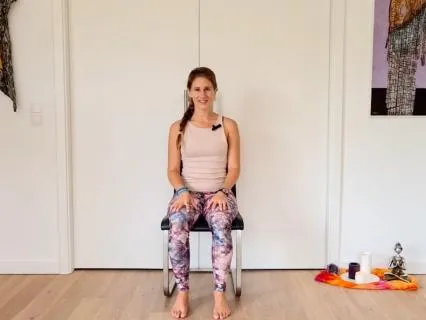
We're going to work with the fundamentals of finding your chair yoga posture,
Plus also releasing out through the head,
The neck,
And the jaw.
That's common areas that we hold on to stress.
So to begin,
Take a quick look down at your feet.
And make sure you're sitting on the chair.
In a way that you can plant both of your feet firmly on the floor.
Now with this connection with your feet and your ankles stacked beneath your knees,
You'll be able to press into the floor.
Activate your core.
Find a slight tuck of the hip.
And then really feel that you're drawing the belly button back toward the spine.
Now with this strong base posture,
You'll be able to lift the chest up nice and tall.
Then just shoulders slightly up.
And then back release your arms bringing your palms to rest on your thighs And for this first moment close your eyes.
Invite a deep breath in through your nose.
And then open the mouth and let that breath go.
Wonderful.
And again,
Take a deep breath in through your nose.
Open the mouth and let the breath fall out.
Good,
One last time here,
A nice deep breath.
Perhaps the deepest breath you've taken today,
Filling up your entire body.
Feel the expansion in your lungs.
And then exhale and let it go.
Keep the eyes closed just for a moment or two longer.
As you find a steady,
Constant,
Rhythmic pace for your breath.
Feel the rise and fall of your belly and chest.
The expansion and contraction with each inhale and exhale.
And if you feel comfortable as you are,
You're welcome to keep the eyes closed.
Otherwise,
If you prefer to open the eyes,
Then do so gently,
Keeping the gaze soft at a point either on the floor or the wall or the space in front of you.
And then drop your left ear to your left shoulder.
Keep that right shoulder down and away from you,
Feeling the length in the right side of your neck.
From here look down toward the left shoulder.
Feel that stretch slightly change.
Then inhale to come back facing the front,
Left ear to left shoulder.
On the exhale turn your head looking at the left shoulder.
And then inhale to look forward once again.
One more breath here.
Exhale to breathe out and look down.
Inhale take the gaze forward From here on,
Your last exhale,
Look down this time.
Stay with your chin toward your left shoulder and then draw a half circle with the chin.
So take the chin down to your chest.
Imagine that the chin can touch down in the center of your chest.
And then take the chin all the way over to the right.
Then turn your head to face the front.
Bringing that stretch onto the other side,
Let's hold it here for the first few moments.
Keep that left shoulder down and away now,
Feeling the stretch down the left side of the neck.
Take a deep breath in.
And stay for a deep breath out.
Good take a final breath in here.
And then as you breathe out look down to your right shoulder.
Try to keep the left shoulder still.
In how to bring the gaze forward And exhale to look down.
Good.
Keep moving with your breath as you get into those muscles that run either side of your neck.
Last breath in.
Last breath out.
Come back to look at the front hold it here for a moment And then turn your chin to look back down toward that right shoulder.
And then slowly bring the chin back to the center of your chest.
So bring the head down,
Down,
Down.
Into the center And then from here,
Bring your gaze forward,
Looking up.
Wonderful.
Bring the shoulders up to the ears and then roll the shoulders down the back of your spine.
Keep that space between the shoulders and the ears as you keep pressing them down,
Feeling a gentle stretch,
Maybe even feeling a release in the side of your neck.
Now turn your chin to the left side.
And then inhale to the center.
And exhale to the right.
Keep the shoulders as they are.
Inhale to the center.
Exhale to the right.
Inhale to the center.
Exhale to the.
.
.
Nice,
Coming back to the center here,
Look up toward the sky now,
Letting the head drop slightly back.
If you've got any neck issues,
Be careful here not to go too far back,
But just looking up to a place that you feel is comfortable.
And then as you do this,
Clench the jaw,
So bring the teeth together.
And feel the stretch down the front side of your throat.
Then release the jaw.
And then bring the teeth back together.
So take a little open and closing of your mouth here.
May look a little funny,
But nobody's looking.
And feel that stretch change down the front side of your throat and your neck area.
Good,
And then come back to the center.
And then bring your chin to your chest.
And this time,
If you want to increase the stretch,
Bring your hands behind your head,
Interlace the fingers.
And then bring the elbows together.
The closer the elbows come together,
The deeper the stretch this will be.
If you want to make it more gentle,
Open up the elbows.
You might feel this start to go down the back a little bit as well.
And on your next breath in,
Inhale to reach up,
Looking forward,
Reaching the hands out way.
And then releasing them back onto your lap.
Wonderful now bringing your right two fingers To the outside edge of your right neck,
You're going to slowly walk the fingers up the neck.
To the base of your skull,
The occipital bone.
And then you'll move the fingers back down to the top of the shoulder.
Good.
Now walking those fingers as you feel this massage.
If you feel a tender spot or a painful place,
Hold it there.
Press on that muscle and then look to the left.
And then look back to the center.
Good,
Let's do this two more times.
Looking left.
Back to the center.
Last time you might want to move the fingers.
And then back to the center.
Good.
Then release that right hand and let's take the stretch or the massage on the other side.
So bring your two fingers to the length on the left side of the neck.
And slowly wandering the fingers up and down the neck.
Wonderful and once you find that little tender place Then hold it there.
Keep your fingers pressing into that trigger point and then look over to the right.
And back to the left.
To the right.
Back to the center.
And one more time looking over that right shoulder.
Then coming back to the sentence.
Wonderful from here release that left hand down And then we'll bring both fingers,
Both hands,
To the outside of the jaw.
So just here on the mandible where the lower jaw connects to the top,
You'll feel this muscle here,
Which is quite a big muscle.
It works all day when we're chewing,
When we're talking.
Anytime our mouth moves.
And what you want to do is start to just move the fingers around this area.
Because often when we feel stressed,
Whether we're at home,
At work,
Or just out on the street,
You notice that the jaw starts to clench.
And if you clench the jaw now,
You'll feel that this muscle gets really tight.
It starts to activate.
So what we want to do is find some of those.
Sore spots or trigger points And then pressing onto them,
Slowly open and release the jaw.
Good.
And again,
You can take a few moments here to open and close them out.
Feeling the muscles starting to release as you hold on there.
Good.
And then maybe if it feels good,
Even walking your fingers down.
All the way to your chin.
And then bringing them back up.
Finish with a few circles here.
Massaging out any tension or pain.
And then on your next exhale,
Gently release your hands,
Bringing the hands into the lap.
Softening the shoulders,
Closing down the eyes.
Feel if there's any points of tension that have been released or changed or shifted.
Just in the last 10 minutes.
Hopefully you feel a little more freedom in the neck.
In the jaw.
And in that upper part of your body.
So taking a deep breath in here.
Then open the mouth,
Let a deep breath go.
Wonderful.
Whenever you're ready,
You can slowly open the eyes back up.
Coming back to the space,
Back to your body.
And just knowing that some of these really simple exercises you can invite into your life at any time throughout the day to keep the neck mobile and to keep it pain free.