Hi,
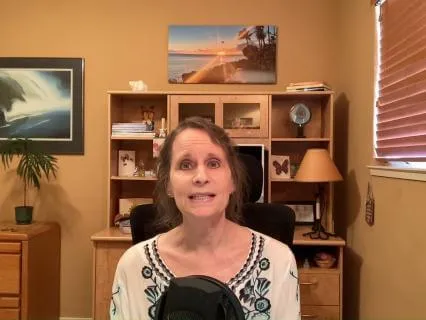
I'm Andrea Wachter and I want to talk to you today about overeating.
This is a topic that is really close to my heart because I spent decades on what I call the diet riot roller coaster,
Where I restricted my food.
I went on fad diets.
Then of course my body naturally rebelled from all the restrictions and I overate out of control and I binged out of control and I lived on that roller coaster for a very long time.
And when I finally found my way out I became really passionate about helping others and that's what I've been doing for the past 30 or so years.
So if you're struggling with overeating or binge eating,
This video is for you.
I want to start out with a little definition.
You might already know exactly what overeating is.
If you struggle with it,
You know how it feels,
Certainly.
But overeating is by definition when we eat more than our body needs.
For nutrition and comfort.
Now,
Most people who.
.
.
Are fortunate enough to have access to abundant food,
Will overeat sometimes.
That's not always a problem.
Maybe they go to a potluck or they go to a buffet.
They eat more than their body needs or even more than they're comfortable with.
But they don't feel horrible afterwards,
They don't go on a diet the next day,
They just resume their natural way of eating.
Sometimes people will have a meal and their body feels completely comfortable,
But then they really want dessert.
Not a problem.
The kind of overeating that I'm talking about here is the problematic kind.
The kind that feels out of control.
The kind where you hate yourself afterwards,
Where you feel ashamed,
Where you restrict or you think you should afterwards.
And it causes pain in your body,
In your mind,
In your emotions,
And even socially.
So that's the overeating I'm referring to.
Then there's binge eating.
Everybody who binge eats also overeats,
But not everybody who overeats struggles with binge eating.
Binge eating is when somebody eats a large amount of food in a short amount of time.
There's a feeling of out of control-ness.
There's usually no connection to physical hunger,
And there's usually a lot of shame and isolation involved.
So whether someone struggles with overeating or binge eating,
Both deserve help,
And there is help.
So I want to talk briefly,
Wish me luck,
Because I could talk about this topic for hours,
And I often do,
But I want to talk briefly about a framework that I use.
To understand.
The roots of overeating and what helps overcome an overeating or binge eating problem.
So imagine a four-legged table.
I'll call it a stable table because I love a good rhyme.
So we have our stable table.
And the four legs of the table are physical,
Emotional,
Mental.
And spiritual.
And each of those legs need to be addressed,
Need to be stable and strong and sturdy in order for our table to be stable.
And that's what is entailed to deal with and to heal from an overeating or a binge eating problem.
So I'll say just a little bit about each one.
With a physical leg of our table.
We need to learn how to let go of restrictive diets,
Restrictive thinking around food,
And learn how to restore a natural,
Enjoyable,
Nutritious,
Delicious.
Relationship with food.
Now,
When someone has an overeating problem,
They usually think the problem is the overeating.
And the restricting would be the solution,
But it's actually.
.
.
The opposite.
Usually the restriction is part of the problem.
Because of course we want what we don't give ourselves.
If we're telling ourselves we should be eating less,
We shouldn't be eating that food group.
We should look different.
Our bodies are just naturally going to want to rebel and eat everything in sight.
So that's part of the physical leg of our stable table.
There's also movement and sleep and rest and just how you take care of your body in general.
But the physical piece is learning how to let go of restrictive diets.
Learning how to release the belief that diets are the solution to overeating problems.
And learning that in many,
Many cases,
They're part of the cause.
The next leg of our stable table is emotional.
This is where we learn how to deal with our feelings.
We learn how to identify feelings and how to express them in healthy ways,
How to soothe them,
How to offer ourselves compassion,
How to connect with people who can offer our emotions compassion.
So learning how to tend to our emotions so we don't need to stuff them down with food.
That's the second aspect.
The third leg of our table is mental,
And this is all about our thinking.
Many people who struggle with overeating or binge eating have what I call a very unkind mind.
Their mind is self-critical.
Their mind is telling them unkind things.
All the time and of course that would lead to overeating to try to soothe themselves,
To try to get a break,
To try to get numb,
To try to quiet that unkind mind.
So learning how to question your thoughts.
Learning to be on the lookout for thoughts that are not kind,
Not true,
Not helpful.
And how to change our thoughts,
Replace them,
Upgrade them.
That's a big piece of healing from an overeating or binge eating problem.
And then the fourth leg of our table is spiritual.
And this is learning how to connect with something or some things that are bigger than our minds and the material world.
Learning how to connect with things that you're passionate about,
Things that are truly fulfilling to you,
Things that have meaning to you.
And there's so many ways to do that.
I could talk about,
Again,
Just that for hours.
So.
.
.
These all four legs don't need to be addressed all at once,
Certainly,
Or perfectly.
But over time,
To be working with your relationship with how you're feeding yourself.
And shifting from restricting and or rebelling.
Into a loving non-restrictive nutritious,
Delicious,
Satisfying,
Peaceful relationship with food.
Learning how to identify and soothe painful emotions so you don't have to stuff them down with food or the promise of ineffective diets.
Learning how to be on the lookout for what your mind is up to and work with it as thoughts need working with,
And then learning how to tap into deeper aspects of life.
Deeper,
Fulfilling,
Meaningful,
Passionate,
Connecting aspects of life.
So I hope there's something helpful here for you.
I do have a course named Getting Over Overeating if you want to join me there.
Filled with all the tools and all the practices that helped me get over overeating.
I struggled severely with my eating,
My relationship to food,
With diets,
With binging for a really long time.
I'm honored to help anyone that wants to join me in my courses,
My free talks,
Meditations,
However I can be of support.
I know there's a way out.
So thanks for joining me.
Take good care.