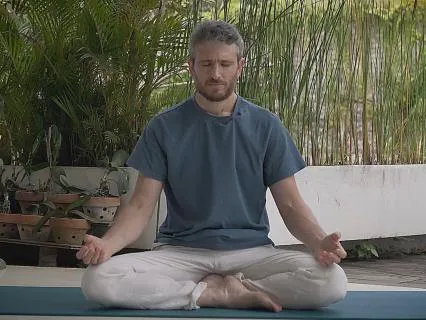
Let's do a kind of meditation slash pranayama of an alternate nostril breathing,
A type of nadishodhana,
But one which is done purely internally,
Purely in the mind.
Now,
Normally when we do nadishodhana,
We use our hand to change the nostril through which we are inhaling and exhaling.
So we'll use either the Vishnu mudra or the Shiva mudra,
The Nasigara mudra,
And we will close one nostril,
Inhale,
Change the hand position to exhale through the other nostril.
Inhale again.
Change the mudra again.
Exhale and that will be one round.
But now what we're going to do is we're going to do this as a meditation.
We're going to use our imagination,
Our willpower to will ourselves to inhale through one nostril and then exhale through the other and then inhale through the other and exhale through the first.
Now this type of imagination where it's somewhere between imagination and feeling that it is so is called bhavana.
Cholesterol.
And then I'm going to imagine,
And it's not just imagine,
It's imagine feel that the air is going out through the right nostril.
And then I'm going to reverse this.
I'm going to imagine that the air is coming in through the right nostril.
And out through the left nostril.
And,
Of course,
One nostril is more open than the other,
So in one,
I'm going to have it more perceptible.
It's really important to pay attention to the sensations,
The feeling of the air going through the nostrils.
Now sometimes this technique is called Nadishodhana,
Sometimes it's called Anuloma Viloma Kriya.
There's multiple names for it.
I like to call it Nadishodhana Level Zero.
So let's do it together.
You can do it for five minutes.
You can do it for 15 minutes.
You can even do this as a meditation for half an hour,
45 minutes,
And you will see the effects of this meditation.
But see how it brings the shift,
The awareness and the control over this breath and the two halves of our being.
Don't try to control the breath.
Just observe it.
Don't try to control how deep you inhale.
Just inhale as naturally as it goes.
Observe the breath.
But make sure that it is inhaled in the left nostril.
And then exhale through the right.
And then inhale from the right and exhale from the left.
In the beginning,
It might be easy to lean a little bit against the side that you're inhaling.
So when I'm inhaling through the left,
I'm leaning a little bit to the right and I'm turning my head a little bit.
And then when I'm exhaling to the right,
I'm leaning a little bit to the left.
This tilt of the head is going to help me,
But this is only a beginning.
Another thing you can do to feel it in the beginning is to turn the palm upwards when you are trying to use that nostril.
So when you inhale through the left,
You turn the left hand up.
And when you want to exhale through the right.
You turn the right hand up.
Now I'm going to keep my hand upright,
My right hand upright,
Because I'm inhaling through the right.
And now I'm shifting to the left.
And again,
This is useful only in the beginning.
Eventually,
We want to keep our hands in place.
You can have them in chin mudra,
Jnana mudra,
Or just have them on the knees,
Palms upwards or downwards.
Just inhale and exhale.
Now once you have the basic movement,
You can add to this doing a kind of complete yogic breath.
So we breathe into the abdomen first.
Then the thorax.
And then the clavicles.
Through one side and then we exhale through the other one.
So I start,
Of course,
Always inhaling through the left and exhaling through the right.
Then I inhale through the right.
Abdominal thoracic clavicular and then I exhale through the left clavicular thoracic and abdominal.
This is a very gentle breath.
I don't inhale 100%.
I don't fill my lungs in completely.
A very gentle breath.
As you are doing this breathing.
You can start to feel how the sensations enter into one side of the body and then the other side of the body.
You can feel how the sensations Go all the way down.
To the ovary for women or the testicle for men how they follow the ida and pingala going into the nose then to the back of the head down to the perineum and up to the gonads When you inhale through the left,
It fills the left.
When you exhale through the right,
It empties the left.
When you inhale through the right,
It fills the right.
When you exhale through the left,
It empties the right.
You can notice the difference between the left side of the body and the right side of the body as you do one breath and the other.
If you want,
You can incorporate placing the tongue on the roof of the mouth,
A kind of Khechri mudra.
And you can also incorporate a mantra.
You can either inhale with so and exhale with ham.
Or you can,
As you are inhaling through the left,
You use the mantra VAM.
And as you are exhaling through the right,
The mantra Vam leaves you.
And as you are inhaling through the right,
You inhale with the mantra,
RAM.
And as you exhale through the left,
The mantra Ram leaves you.
Now of course,
Don't do all the variations.
Once you incorporate one of the mantras,
You use one of them and one of them only.
And that's enough.
Conclude the round you are on without starting a new one.
The round concludes with the exhalation with the left nostril.
Once you have done that,
You can inhale through the nose,
Imagining that you're inhaling through both nostrils.
And exhale through the mouth.
So let's do a few rounds like this,
Inhaling,
Imagining that we're inhaling through both nostrils.
Abdominal.
Thoracic.
Clavicular and then exhaling through the mouth for clavicular thoracic abdominal And that's enough.
Just notice the effects of this technique on your body,
Sensations,
Emotions and thoughts.
And on your awareness itself.
Okay.
So let's review now as a conclusion all the variations that we learned in this practice and then when you go home you can practice them so first we learned how we can use the body movement to do this by shifting left and right then how to do this with turning one palm up and one palm down then we had two versions in which we can do this the first is just a regular breathing almost like a breath awareness we're not trying to get the breath deeper And the second was a breath which included abdominal thoracic clavicular.
So while these were the preparation,
These two are our main practice,
Either regular breathing,
Almost just awareness,
Or doing this with abdominal,
Thoracic,
Clavicular.
And that is the basic practice upon which we can add two more things.
We can add touching the tip of the tongue to the roof of the mouth in a kind of semi-kechri mudra.
You can do it a bit more profound by really bringing the tongue back and if you are able to perform the kechri mudra by doing the kechri mudra.
And we can do this with mantras.
Either on the inhale,
We do so,
And on the exhale,
Ham.
And this is the same for right and left.
Just always inhale with so,
Exhale with ham.
Inhale with sow,
Exhale with hum.
Inhale with so exhale with hum inhale with so exhale with hum or we can imagine that as we are inhaling through the left the mantra vom manifests inside of us and as we are exhaling through the right the mantra vom dissipates or leaves us and then as we are inhaling through the right we are pronouncing we are manifesting we are absorbing the mantra And when we are exhaling through the left,
We are releasing the mantra Ram.
We allow the mantra to dissipate.
Then we have the awareness where we can feel the difference between left and right,
Or we can feel the sensations as they are entering,
Going through our idanadi on the left inhalation,
All the way down from the nostrils to the gonads,
The testicles for men and the ovaries for women.
And then in the exhalation through the right,
This vibration goes up and comes out.
And then we inhale through the right.
Into the Ida Nadi all the way down to the right and then we exhale through the left.
The sensation,
The breath goes out.
Now in this variation we imagine that the ida nadi is always on the left side of the body and that the pingala nadi is always on the right side of the body.
So this was our Nadishodhana level.
Oh.
Minus one this is anuloma viloma kriya because the nadi shodhana level zero we said it's just breath awareness with the uh nostrils I hope you enjoy this practice.
I love it.
I usually apply it.
Without doing abdominal thoracic,
Clavicular.
Just when i feel i want to balance myself i imagine that i inhale through the left exhale through the right inhale through the right and exhale to the left you can all also use the Power that we gain from this technique to shift the nostrils and the the breath in the nostrils and the way that we do this is that if you're breathing through the left and you want to breathe through the right Then you just imagine you feel you do this bhavana that you're inhaling through the right and exhaling through the left and in the next one we do again only inhaling through the right and exhaling through the left or just inhaling through the right exhaling through the right inhaling through the right exhaling through the right and when we just focus on one side either like this inhaling through that side exhaling through the same side or inhaling through that side and exhaling through the other side that we begin to shift the actual nasal cycle from one side to the other and that brings gives us the capacity to just by will our breathing from the left to the right,
And therefore from the parasympathetic to the sympathetic,
From the sympathetic to the parasympathetic,
Activating the two brain hemispheres by will.
I wish you a wonderful,
Happy and pleasant day.