Let's do a meditation on Dvadashanta.
Dvadashanta is a point twelve finger-breaths above the head.
This will take the form of a breath awareness meditation that will activate this point.
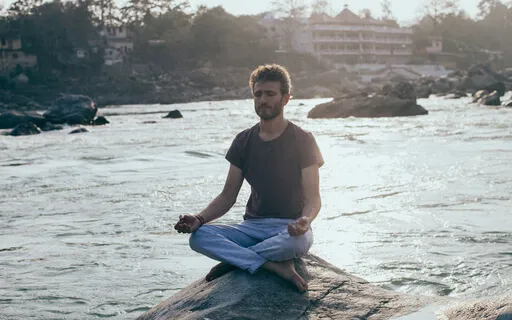
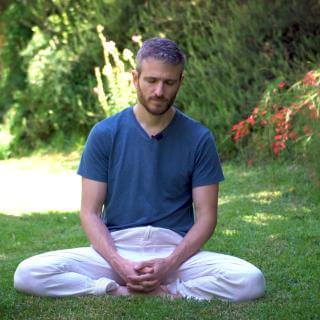
Sitting in a comfortable meditation position,
Become aware of your breath.
Become aware of your breath as it comes in and goes out naturally through your body.
Don't try to control the breath.
Don't try to modify the breath.
Simply observe the breath as it happens naturally.
As you inhale,
Feel that the air is coming in through the nose,
Going down the neck,
And settles into the center of your chest.
And then as you exhale,
Feel the air as it goes up from the center of your chest through your neck,
Out your nose,
And then down approximately twenty-four centimeters in front of your nose.
When you inhale,
It's as if we pull the air from this whole area extending up to twenty-four centimeters in front of our nose,
Diagonally down.
We inhale that air into the nose and then down the throat,
Down the neck,
Into the center of the chest.
With each breath,
It's as if the air is coming in and out.
Try to feel this movement.
More than a physical sensation of the movement of air,
There is a feeling that something is moving.
This something is the breath itself.
Don't try to control the breath,
Just observe it as it happens.
Keep following the breath.
In inhalation,
It moves from the location twenty-four centimeters outside of the body,
Diagonally down from the nose,
Into the nose,
Down the neck,
And into the center of the chest.
And then in exhalation,
It goes up from the center of the chest,
Up the neck,
Through the nose,
And diagonally down to this point twenty-four centimeters outside of the body.
Keep watching the breath as it comes in and goes out naturally.
Feel the movement of the breath.
Don't try to change anything.
If you find that you're distracted by thoughts,
Simply bring your awareness back to the breath when you notice it.
Thank you for watching.
.
.
.
In the next exhalation,
We are going to do something slightly different.
When the breath reaches the back of the throat,
We are going to exert a little bit of pressure with our will to separate the sensation of breathing from the air itself.
And while the air is going to leave our body through the nose,
We are going to push the sensation ever so gently up,
Up through the center of our skull,
Through the top of our head,
And up until it reaches a point located twenty-four centimeters above the top of the head at the end of exhalation.
In inhalation,
We will let the breath come down through the top of the head,
Through the neck,
And into the center of the chest.
Then we will continue to push the air a few more times until we feel that naturally the sensation of breath goes up through the top of the head.
So now,
In the upcoming exhalation,
Gently push the sensation of breath up through the top of the head until it reaches a point twenty-four centimeters above the top of the head.
This point is called the Dvadashanta.
On the inhalation,
Allow the breath to drop down through the top of your head,
Through the neck,
And into the center of your chest.
Continue exerting a force to push the air through the top of the head a few more times until you feel that this has become natural.
This is the end of the Dvadashanta.
Thank you for watching.
.
Now,
Don't try to change the breath itself.
Simply observe how naturally,
As you inhale,
The sensation of breath enters through the top of your head and descends into the center of your chest,
And how in every exhalation,
It goes up through the neck,
Through the top of the head to the point of Dvadashanta,
Located twenty-four centimeters above the top of your head.
.
.
.
Keep observing the breath.
Don't try to control it.
Just allow it to be.
.
If you find yourself distracted by thoughts,
Simply guide your attention back to the breath.
You may notice now that small pauses occur at the end of inhalation and at the end of exhalation.
.
The points in the center of our chest and twenty-four centimeters above the top of our head are resting points.
They are points of Shunya,
A void of nothingness.
.
Feel if your breath wants to pause in these two locations,
And allow it to be so.
If you notice that your breath pauses at the end of inhalation or at the end of exhalation,
Simply remain in awareness in these locations.
.
Allow everything to happen naturally.
Let the breath be.
.
Continue observing your breath until the gong,
Signaling the end of our meditation.
.
.
.
.
.
.
.
.
.
.
.
.
.
.
.
.
.
.
.
.
.
.
.
.
.
.
.
.
.
.
.