Welcome to the Hamsa breath meditation.
In this practice,
We'll be focusing on the rhythmic pattern of your breath,
Incorporating the ancient mantra Hamsa.
Hamsa is a Sanskrit word that represents the natural sound of the breath.
There are in fact two ways of doing this meditation.
We have the way in which most schools teach this.
This is the common way of performing this meditation,
Where the inhalation is connected with the sound Ham and the exhalation with the sound Sa in this manner.
This spells out the word Hamsa,
Which means swan.
The swan is the symbol of the soul,
That which connects our consciousness to the body,
In the same way that the breath connects life to the body,
For it is only with the breath that we have life.
According to yogic teachings,
The breath at rest flows in and out naturally at a rate of 15 breaths per minute,
Or 4 seconds per breath,
Which brings to a magical number of 21,
600 breaths every day.
The yogis consider that each breath utters this mantra Hamsa,
Hamsa,
And that this utterance of this mantra is what promotes human consciousness to evolve.
It's as if our body keeps saying,
My soul,
My soul,
When shall you wake up,
My soul,
My soul.
This ajapa japa,
Or spontaneous practice of japa,
Of mantra meditation,
Is considered to be the basis of human evolution.
However,
Done consciously,
It is said to be much,
Much more effective,
Which brings us to our meditation of today.
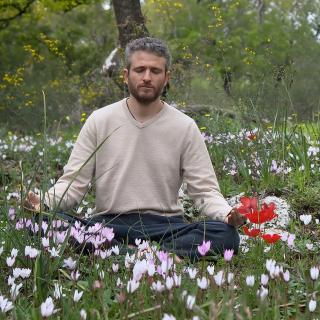
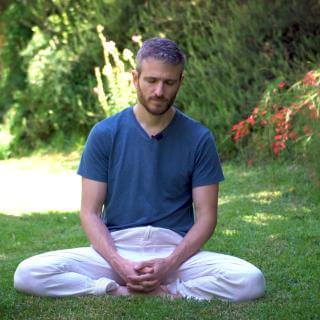
Let's begin by finding a comfortable sitting position with the spine erect,
Hands either on the knees or in your lap,
Palms facing upwards.
You can apply any kind of mudra that you like,
Or none.
Let's begin by bringing our attention to the breath.
Feel the gentle rise and fall of your chest and abdomen with each breath.
Even though,
For the sake of demonstration,
I breathe in and out through the mouth,
In our meditation we will keep the mouth closed,
The tongue slightly pressed against the roof of the mouth,
As we allow the breath to come in and out naturally through the nose.
Allow your breath to flow naturally,
Without forcing it.
Simply watch your breath as it comes in and goes out naturally.
Now,
As you inhale,
Feel that your inhale is producing the sound hum.
It's as if you silently say the word hum to yourself.
Feel the vibration of this sound filling your chest and abdomen.
Then,
As you exhale,
Hear inside of the sound of exhalation the sound sa.
It's like you imagine a superimposed sound sa on your exhale,
And you allow your body to resonate with this sound.
With the next inhale,
Again hear the sound hum,
And on the exhale,
Hear in your breath the sound sa.
Don't manipulate the breath.
Don't make it longer or shorter.
This is an awareness meditation.
We allow the breath to be as it is,
Simply hearing the sound hum in inhalation and the sound sa in exhalation.
In fact,
The original breath awareness meditation in the Indian yogic traditions was not vipassana or anapanasati,
But this hamsa breath awareness.
Continuing in this rhythmic pattern,
Allow the hamsa mantra to synchronize with your breath.
Allow the mantra to become a natural and effortless part of your breathing cycle.
If at any point you realize you have lost contact with the breath,
Don't worry.
Simply bring your attention back to the breath.
Notice as it comes in and out,
In and out.
And then,
After noticing a few breaths come in and go out,
Try again to hear the mantra hamsa,
Hamsa carried on the breath.
As your meditation deepens,
You will notice that your breath becomes slower and slower,
Slower and slower.
Rest in the natural rhythm of your breath,
Naturally enunciating the hamsa mantra.
Release now the hamsa mantra and return to a silent observation of your breath.
Notice any changes in your breath,
Your body,
Or your state of mind.
Allow yourself to rest in this stillness for a moment.
Gently bring your awareness back to the present moment,
And when you feel ready,
Slowly open your eyes.
Congratulations,
You have completed the hamsa breath meditation.
But while this meditation has ended,
The hamsa breath will continue,
And you can bring your awareness to it at any point during the day.
By bringing your attention to the hamsa mantra naturally emitted by the breath,
You become more connected with your soul.
I invite you to continue bringing your attention to the sound hamsa in your breath.
And if you want to go deeper in this meditation and see other versions of it,
Some of them more ancient even than this one,
I invite you to check my profile and see the other versions of this mantra.
Until our next meeting,
Namaste.