So.
.
.
A little bit about my journey with Qigong.
I started studying Qigong about 15 years ago.
And I was trained in medical qigong.
Which is a very specific branch of Qigong.
And then I was trained in different types of Qigong through the lineage of Master Wu,
Through Master Teresa,
And then through Teo Semco,
Who is one of my core teachers in Qigong also.
So I have a lot,
I've had a lot of different experiences with Qigong.
And then most recently,
I also trained in a polyvagal informed type of Qigong.
Which is still the science or the art of Qigong.
It's both a science and an art.
It's just with the lens of polyvagal theory.
Which is what we'll be focusing on today because it allows us not just to work on our chi,
On our energy,
And being able to release the flow of that energy inside of our bodies and clear any blocks that we may have,
It's also a way of actually activating our vagus nerve.
And activating our parasympathetic nervous system,
Which is our rest and digest centrally nervous system,
That branch of the autonomic nervous system.
So I look forward to blending all of that and teaching you my own practice.
So what I'm going to teach you today is basically what I do every day.
And one of the beautiful things.
.
.
About what I'm going to teach you today is that you If you don't have much time,
It can be done in a shortened version.
And also for those of you who want to move your bodies,
Like for me for instance,
Some of this I actually practice while I'm taking a walk in nature.
So I'm co-regulating in nature and I'm doing some of those things that I'm going to teach you while I'm walking.
And the reason why I do that is,
First of all,
Because of limited amount of time.
There's a lot of things that I like to do,
And there's a lot of things I'm involved in.
So I don't have the time to have like a one-hour practice of Qigong.
And I make the time to have a one hour walk with my Qigong practice that I take with me.
Doing it also in nature,
Like I was saying,
There's a co-regulating aspect to that.
And also,
While I'm not going to focus on that today,
When you're in nature,
You can also focus on the different colors that correspond to different organs and pull that the colors and the vibrancy and the frequency,
The energy of each different,
Like a tree,
A plant,
Things in nature,
And just draw that energy.
And just allow yourself to be replenished and to be restored by doing that.
So that's also another benefit of doing it in nature.
And one more thing.
Is that when we're walking,
Or running that said,
I don't think you can run and do Qigong at the same time.
Maybe the healing sounds,
For instance,
That will do,
Yes.
That said,
Other than that,
What I'm going to teach you would be difficult to run.
That said walking and walking slowly.
Allows you to bring on the parasympathetic nervous system.
And also its bilateral stimulation.
For those of you who have been on some of my lives recently,
I have been teaching you about bilateral stimulation like this or like this or with your eyes or on your legs So when you're walking,
Bye.
One foot,
The other foot,
One foot,
The other foot,
That in itself is bilateral stimulation.
And it's very regulating to the nervous system.
And it also integrates the two hemispheres of your brain.
By the way,
I love all the hearts.
Thank you so much.
It allows me to know that,
You know,
You are here,
You are engaged,
You're enjoying the content.
So thank you.
And I'm seeing a message from Rebecca who says,
Rebecca,
Rebecca,
Um,
She's from Florida and she's doing an infusion treatment so she can only watch But we'll learn,
Okay.
Wonderful.
Just so you know,
Rebecca,
There's a lot of content online where you can find some Qigong practices that you can apply.
So whatever you learn from me,
You can research it and then maybe you can find a video that shows someone doing it.
So at least you'll get some of the insights and also some of maybe my unique knowledge because of the blend that I bring into Qigong.
Okay,
So we're going to start.
With a simple practice that you can do standing or sitting.
And the reason I'm saying standing,
Usually it's sitting.
It can also be done lying down.
So you can also lie down actually.
That said,
Some people,
Their nervous system is more active and they like to be standing.
They like to be moving around,
Right?
So it's okay.
You can do it standing,
You can do it laying down,
You can do it sitting,
Whatever works for you.
Works for you and your nervous system state in this moment.
So I'm going to sit just so that I'm relaxed and present with you and there's going to be more movements where I'm standing up anyway.
This practice is a practice that uses a sound and the sound is a Chinese syllable,
A Chinese sound that sounds like song almost like a song but it's more like a you That's it.
There's my French accent in there,
So.
.
.
That said it's a prolonged it's almost like there were like many o's in the song like a song or many u's in the song so i'm gonna write it in the chat so song or song.
And you're going to feel like it's kind of like it's similar to humming,
Right?
You really feel it in your throat.
That say we're going to resonate that sound throughout the entire body.
And that sound is basically an invitation to release and to relax.
It means actually release or relaxed openness in Chinese.
Soon.
What we're going to do is we're going to begin by scanning our entire body.
From head to toe.
And fingertips.
And just tune into areas of the body that are tense.
So,
For instance,
For me,
I can sense right now my shoulders are a bit,
Like,
Tense.
I'm having some gut issues at the moment.
So I like it's like it pulls like my on my diaphragm it limits my breathing and my solar plexus gets tight when I have those gut issues and then my shoulders also start to to rise up so I can sense that already so do the same just do a general scan and and just with openness,
Just sense into any areas where there's tension.
And then we're going to begin to resound the sound Song.
On the Excel.
So what we'll do is we'll go from body part to body part.
Or body,
You know,
Kind of like different sections of the body.
And we'll inhale through the nose and then as we exhale we'll make the sound SONG song.
And you really want to feel the vibration of the sound.
And at the same time,
You want to be connected to the part of the body that you're focusing on in that moment so that you feel most of the vibration in that area of your body,
Or at least you intend to feel it in that area.
And then just relax.
Don't push yourself.
Don't force yourself.
If you're not feeling it resonating in that part of your body,
Of your body,
Just do the sound.
Place your attention in that area and just let go.
As your attention is there and you're making the sound.
Let it relax.
It's almost like you're telling that part,
Okay,
Relax.
Okay,
So let's begin.
So you start at your head.
And you inhale.
And then as you relax and release,
Song.
And then we're going to move to the neck.
Inhale.
Relax and release.
Now moving to your shoulders,
Inhale.
Relax and release the tension in your shoulders.
Moving to your arms,
Your hands,
Your fingers,
Inhale.
Release and relax in your arms and hands and fingers.
Moving to your chest,
Inhale,
Relax and release any tension SONG your belly.
Inhale.
Relax and release.
Now moving to your back,
Upper,
Middle,
And lower back.
Inhale.
Relax and release the back.
Song.
Moving down into your sacrum.
Your pelvis this whole area,
The sacral ball Inhale.
Relax and release.
Song.
Now moving down into your legs,
Your feet,
Your toes.
Inhale.
Relax and release.
Your whole body.
Inhale.
Relax and release any remaining tension and just take a moment.
To be with the vibration.
To be with the effect of your attention.
And the sound.
As it was resounding and you were moving it through.
All different parts of your body,
Pulse.
Rest.
And knowledge.
Paying attention to the difference between how you arrived and how you felt.
And how you feel now.
Noticing if some of the tension that you were experiencing before has released.
Syllable song extended yeah it really has this effect it's kind of like a blend between you know the vibration and also humming in many ways it feels like humming too.
So yawning for those of you who are not as familiar with nervous system regulation that's a sign that your vagus nerve is relaxing and that you're getting into parasympathetic nervous system function.
So the next thing we're going to do Um.
.
.
Is we're going to,
Oh,
So just one thing about this.
So this is very relaxing.
This helps release tension and it helps the chi,
You know,
Start to flow better.
So it's a good thing to start with,
Which is why I wanted to start with that.
Cells light up and tingle.
I love that.
And that reminds me of mitochondrial,
You know,
Like activation,
Which when the chi is moving,
Mitochondria is going to come online more.
So we're going to feel the cells also lighting up and tingling through that mitochondrial activation.
Okay.
So right before we go into the next practice,
Um,
Yes,
Before sleep is great.
It actually helps you clear the stuff that you've accumulated through the day.
So yes,
Absolutely.
It's not like,
It's activating your vagus nerve,
But that's for rest and digest.
So it's well suited for sleep time.
So just quickly,
The practices.
So if you see me looking up and to the left,
It's my external monitor where I have the plan of what I have for today.
So in addition to what we just did,
I have planned skeletal shaking,
My own variation of that,
With some Qigong activation of some specific points that activate certain meridians,
Which I'll talk about.
We're going to do some facial massage and acupressure points that are going to connect to the vagus nerve and be able to access it,
Our face.
And our ears and our neck are the some of the best and easiest way to access our vagus nerve,
It's where it's closest to the skin.
And at the same time will be also.
Tuning into and activating certain meridians that are linked to certain organs.
So we'll be clearing energy that's stuck in certain organs by doing the facial massage.
And then the internal organ massage that we'll do.
Um.
.
.
That's the next thing that's to help the flow of the qi in the body and release stagnation in the organs.
We'll do the six healing sounds,
Which you can kind of couple with the massage if you want.
I tend to do them separately but it's entirely up to you.
And then if we have time.
.
.
Well,
We'll definitely do the Chi ball practice I want to teach you that because that's such a simple and effective way of getting in touch with the Chi and activating it and and for I think it was break Drake,
Sorry.
For Drake,
That's also a way of actually.
.
.
Activating also the Reiki energy.
And then if we have time,
We'll do pulling down the heavens,
Yin-wei breathing,
And six-directional breathing.
That said,
Knowing myself,
And knowing that I really like to interact,
It's very unlikely we'll get through all the practices,
But.
.
.
If we get through the first five,
You'll be getting so much out.
Simple and effective so many simple and effective techniques that will help you so much and will start you on a simple yet really powerful Qigong practice Okay,
So the next one I'm going to get up.
If you can get up get up if you can't it's okay.
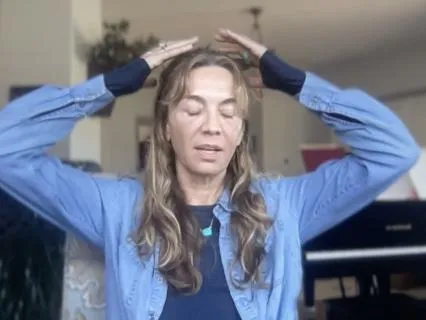
You don't have to do it Standing up but standing up is also really good because it helps to to activate more of the body so skeletal shaking is a form of shaking and if you were there in my past lives and even if you were not I'm gonna give context animals shake as a way to complete the stress cycle so when an animal and ourselves are faced with a threat We start,
We tense,
We contract,
We also go into fight or flight,
And then there's all this activation in the sympathetic nervous system that is,
You know,
That is just going to stay there until we release it.
Animals,
What they do when there's a threat,
And then the threat ends,
They shake.
You know,
You see dogs shaking,
You see cats shaking,
You see,
You know,
In the wild animals that are chased by a predator and then they escape successfully,
They shake.
So the shaking is a natural way of releasing the stress from the nervous system and helping to clear the hormones,
The stress hormones that have accumulated in our body to help us to go into fight or flight.
So the skeletal shaking is basically The same but you're gonna be focusing on your bones.
You're gonna get you know,
You're instead of just shaking You're gonna feel your bones.
So you're shaking.
So just so you know for a lot of people and Hopefully you're by yourself.
So you're you don't have that but for a lot of people when I've taught them qigong moves especially skeletal shaking There's like self-consciousness,
Especially for a woman.
We look a little bit like monkeys.
I mean,
We're monkeys.
In many ways so it's like okay you know it doesn't feel very elegant or anything like that but it's so so effective so you want to be gentle on your knees but you also want to feel the bounce and you want to feel your feet grounded in the floor.
And you want to feel like little by little everything is engaged in the shaking so first maybe it's your legs that are bouncing and then you want to feel your belly bouncing and your chest And your shoulders and your arms,
You want to feel everything bouncing.
Your neck,
Let your neck be supple and bounce and let your head bounce.
And so you're shaking,
Going side to side.
We're going to add in a moment the activation of some meridians.
And you're shaking downward,
So that's really important.
Feel the the density of your bones you're actually by the way you're doing micro micro micro traumas to your bones when you're shaking or when you're bouncing so that's another one that's really good when you bounce when you have a rebounder or a plate a vibrating plate And by doing that,
You're actually strengthening your bones.
So I really encourage you to do that,
Especially as we age.
I don't know what your age is.
That said,
As we age,
It's really important so that we don't get osteoroposis.
And our bones remain really strong.
So those microtraumas are actually helping our bones be stronger.
And they help with bone marrow production.
So keeping us healthy,
So shaking,
Shaking,
Shaking.
Thinking about things that you want to let go of,
Throw them into the floor,
Shake them into the floor,
Free yourself,
Shake your arms.
And then we're going to start to mix.
So just so you see I'm hitting the side of my arms,
Which is the long meridians and my kidneys.
So by doing that,
I'm helping release fear,
The organ,
So the different organs in Chinese medicine Oh.
Traditionally,
They carry different vibrations,
Different energies,
So that certain emotions get stored in our organs.
So the kidneys are the organs when it's out of balance.
That basically are storing fear and you can think about it like when you get afraid like everything pulls up and you can even feel your your kidneys tightening and pulling up so when you're Gently doesn't have to be hard Gently hitting the side of your arms,
You're activating your lungs,
The meridians of the lungs,
So you're helping release grief.
The lungs are where we store grief.
And as we do the six healing sounds,
I'll also be talking about complementary organs.
So in Chinese medicine,
The different organs,
There's a yin organ and there's a yang organ.
And one is for storage,
The yin organ,
And yang is for the expression of the energy.
So when we're doing,
For instance,
When we'll do the healing sounds or when we're activating one organ that's connected to another organ,
Basically having an impact and effect on both.
So the NAMS is also connected to the The column.
And so when we're activating the lungs like this,
The meridians,
We're also helping release the grief,
Not just from the lungs,
But also.
From the comments.
And then the kidneys are associated with the bladder.
So we're also helping the bladder when we're doing this and then shake,
Shake,
Shake.
Let everything go,
Let whatever is ready to go,
Go.
Any stress,
Any tension,
Anything that you've been holding on to,
Just letting it go.
Do pulling down the heavens.
So we're going to ground ourselves and release any excess energy that's still there.
So you're going to inhale.
Arms out,
Palms up.
All the way up.
And then exhale through the center line.
And feel like you're pushing down anything.
That is still in your body that is still.
Just creating some kind of block.
And again,
Inhale.
Center line.
All the way down.
So you're pulling energy.
Right?
You're gathering tea.
And then you bring it down through your crown and through your central channel and slowly bringing it down and as new Qi comes down,
It basically clears the old Qi that was accumulated.
So this is a good way to finish this practice.
We're going to now start with doing the facial massage and the acupressure.
So if you were here at the beginning of this live,
I was explaining that the facial massage is going to activate your vagus nerve.
And also certain meridians that correspond to certain organs.
So then it rebalances the chi of these organs and it leads to better functioning of these organs.
This is the practice while I'm walking.
So while I'm walking,
I'm doing shaking.
While I'm walking,
I'm doing song.
And also while I'm walking.
.
.
In nature,
I'm also doing facial massage.
Super simple.
The first one you're gonna bring both the index finger and middle finger to your temples.
And you're going to start to massage.
So for those of you who have been on my lives before,
I often say,
Be the giver and the receiver when you're doing acupressure.
And anything really,
When you're listening to a meditation.
Be the giver,
The one who hears and gives to yourself and be the receiver of the words,
Be the receiver of the energy.
Thank you for all the hearts.
And just massage gently.
And receive.
That gentle massage.
And then reverse the circles.
You can close your eyes and just relax,
Settle into your breath.
Feel the nurturing the nourishment So you're accessing your vagus nerve.
Also working on your liver here.
And just release for a moment and feel.
And now we're going to move to right here at the center.
Of your eyebrows.
Upward.
So this is really effective.
First,
It brings relaxation,
As you know,
Like when we're tense,
You know,
We tend to like bring,
You know,
The eyebrows in and like we're kind of squinting.
So you're relaxing this area.
And right here is also the master gland,
The pituitary gland,
That is the one that's in control of hormonal secretions.
So when you're doing that,
You're helping balance that master gland.
And you're also relaxing your vagus nerve.
And I think it's also an access point.
I could be wrong about that with the triple warmer,
Which is like.
It's not really an organ,
But it's a system in Chinese medicine.
That includes your heart and your gut.
So.
Just try to relax there.
Be the receiver Try to stay relaxed in your shoulders too.
When we're doing this,
You know,
Sometimes we can like kind of bring the shoulders up.
Then you're gonna use your little fingers and you're gonna come right at the corner of the eyes but kind of like corner of the eye and also where the nose almost like where the nose is.
And you're gonna press there.
You can bring your head down when you're doing that.
This is really good for your eyes.
For releasing stress.
And it's interesting because if you think about it.
Sometimes when we're stressed,
We do these things naturally.
Because we know like our body's wisdom is always available to us so like some people will be like kind of like this you know like just trying to release the stress.
And attention.
And again,
You're helping eyesight.
So the eyes are also connected to the liver.
So you're also working on your liver here.
Then we're going to move,
We're going to use now our index fingers,
And you're going to go right here,
Like right at the junction,
You know,
Where your nose and the skin on your face is,
And make circles.
And then bring out.
So that opens your sinuses that helps you breathe better.
So that's really good before you do any pranayama,
Any breathing techniques.
It's really going to help you to have both nostrils open.
Which is also both of your right and left side of your body.
Is becoming more active.
Usually the left side is the more mental.
Side and the right side is more physical.
So you're balancing both sides and you're also opening You're breathing.
And just notice.
Notice if one nostril is more open than another.
Or if they've both come into balance.
If you are doing any breathing technique for instance if one nostril was blocked and you know not the flow of breath was not moving as smoothly.
You could do some alternate nostril breathing.
Or just focus on that nostril that's a little more blocked and just open that one by letting the breath move in and out of the same nostril.
And then returning to that until you find that it's pretty that both nostrils are pretty open and you're able to breathe well.
Okay we're going to do one more on the face And that's really good for the,
I think you say in English,
Intestines,
Your intestines and for digestion.
And that also is a great place to access the vagus nerve.
So between the index and the middle finger,
The corner of your mouth.
And massaging.
And again be the receiver not just a giver.
And then switch.
So I'm shortening this a little bit just for time so you would spend as much time as you would like.
Rebecca said she thought it was ending.
She's continuing in her car and it's really opening her sinuses.
I'm so glad to hear that.
And Rebecca,
I'm so sorry to hear about,
If you're still here,
About the lupus.
I hope the infusions are helping you a lot.
Okay,
So.
This is where we'll stop with the facial massage.
Now we're going to add the neck,
Which is also another area.
As you know,
There's a lot of vagus nerve stimulation devices.
They're great and you can also access it with your hands.
There's a point here,
If you've done my meditation called Forgive and Forget,
That practice,
There's a point right here.
Which is the forgive and forget point in Ayurveda.
They call them marmas instead of acupressure points.
In Chinese medicine also,
Which also corresponds to in the middle of your forearm.
Right in the center of it.
That's the yin-wei axis.
The yin-wei axis is where we process and metabolize emotions.
So when you touch this point here,
And you massage it in circles.
You're actually helping emotions clear and flow.
And you're metabolizing them just by doing that.
So if you haven't tried the Forgive and Forget,
Oh.
Yet.
Meditation you may want to try that because it engages that and it's called the forgive and forget point because it's This point helps you to let go like whatever emotional charge you have.
That you're holding on to something.
Forgiveness is not just about forgiving someone,
It's about letting go of things,
Being able to release things and moving on,
Letting life move forward by doing that.
So this is really helpful.
And the reason I'm bringing this up is that you activate that first and then you're going to massage with that point so you're still going to be activating that you're going to massage your neck downward And you're basically massaging your vagus nerve,
Activating your vagus nerve and also releasing tension.
So Rebecca says she holds a lot of tension in her neck.
And right side yeah so right side might be Liver related,
You know,
If there's some stuff going on with the liver sometimes that can Just kind of pull everything together on the right side you know like tense everything and pull everything and then you might feel it on your on on the right side of your neck so then we're going to do the same with the other hand And again,
Be the receiver.
And then we're going to move right before we do pause,
Rest,
Notice and integrate.
We're going to now actually rub your hands a little bit.
Activating the qi You're also stimulating,
There's a lot of chakras in your hands.
There's fingertip chakras.
There's the palm chakras.
So you're also activating that,
So a little bit of the.
.
.
The Reiki here.
And then.
.
.
So we're massaging like this.
We're going back.
And coming forward.
And we're really helping the vagus nerve here.
And then you can do the other side.
And just go back and forth.
So,
Antonia,
Yes,
That's a great question.
Yes,
It could be spleen-related.
Now,
There could be other,
You know,
Tension patterns in the body that are creating that.
You know,
Sometimes it's tension held in the psoas muscle,
And sometimes it's on one side or the other side.
Sometimes it can be structural.
You know,
Like,
For instance,
You may want to get an assessment with a Feldenkrais therapist.
I work with a Feldenkrais therapist every week.
And it really helps you to kind of sense if there's any part of your body that's out of balance or compensating.
And then that would create more tension.
On one side of the neck or the other.
So what I said was a bit generic,
Right,
To Rebecca.
I know that for me,
For instance,
When I have gut issues and my liver gets involved in the process,
I went to India and got MRSA,
So after that my gut got wiped out.
By antibiotics and I'm still recovering from that and I know for me as soon as my liver gets kind of pissed,
Not happy,
The right side of my neck is immediately tense.
Another thing is that there's more access to the vagus nerve on the right side.
Also for Rebecca,
Maybe the vagus nerve is trapped on that side and maybe you're more sympathetically activated.
And Antonia,
Yeah,
I think maybe it could be structural but it could be the spleen because the spleen is on the left Okay.
And then just take a moment and feel.
I hope you can hear the birdsong.
I left the windows open so that we would get some of that in the background.
Get some of that beautiful co-regulation.
So I'd love to hear how that was for you.
So for those of you,
By the way,
Who have to leave at the hour,
We'll probably get to do the internal organ massage,
Which means we'll have at least four of the practices.
For those of you who can stay,
We might get to do,
I don't know,
Two,
Three more practices.
I'm glad you can hear the birdsong.
Am I taking individual requests?
Please tell me what you mean Trish Yes,
If you mean like for specific questions or specific lives,
Topics and things like that,
Absolutely.
If you mean something else,
Please let me know.
Robin,
Thank you.
Peg,
Thank you.
I'm glad you're enjoying the birdsong.
Really enjoy the back of the neck massage.
Karen,
I hold some tension between the left side of my neck.
And the top left of my shoulders.
So yeah that should be helpful.
Another thing that could be helpful for you is to also Grab here,
Pull gently.
Right,
So this is,
By the way,
This is the gallbladder meridian.
That's frustration.
When this hurts.
On either side it's frustration that's building up so you can't just Grab.
Pool.
Breathe in… and then intend to release the frustration and release.
And let your shoulders drop.
Okay.
Rebecca says it was It hurts.
Yeah Yeah,
So that means there's like some stuff that wants to move so you can massage there.
It's really helpful.
You can include that.
During the practice.
Yes,
Sophia,
That can happen.
So what I would say is slow down if your heart rate is is starting to go up and and then You can.
Om.
You can look downward towards your navel and lengthen your exhale.
So just intend to lengthen your exhale.
Just lengthening the exhale is going to bring the heart rate down,
Right?
When we inhale and we focus on the inhale.
We're actually bringing the heart rate up and when we want to calm down the heart rate we want to exhale and look down.
Kind of like sending the signal to the body that we can rest.
Everything is okay.
Okay.
So I don't want to miss,
Uh,
Let me see.
Please,
If I missed any of your messages,
Will you put it back because the chat is moving fast?
Ummm.
.
.
Lovely sounds from Kira.
Oana,
Send me a private message on the platform,
Please,
And I'll tell you more about tinnitus.
There's actually a lot of studies being done right now.
There's some supplements,
Natural supplements,
That are coming out.
I'm actually studying the gut-brain axis right now,
And there are things that are super helpful for tinnitus.
I'm probably saying it wrong.
Um.
.
.
So Rebecca says it was helpful.
For now,
Best to address pain between shoulder blades on back area.
That was from Trish.
Thank you so much.
That feels good from Karen.
Typically use foam rollers or tennis balls for that area.
Great.
That's a good idea too.
Our Trish.
Liver problems causing problems of right side caused by meds,
No liver problem before.
Yeah,
I get it,
Debbie.
So that takes us into our next practice,
Which is the internal organ massage.
And six pegs.
If we don't get to six directional breathing,
Out.
Quickly talk about it it's it's pretty simple so I'm gonna stand up just so that you see me more and you see what I'm doing but you can stay sitting so I also do that on my walk Happen to right now.
We live in a remote area So there's no you know,
Like there's not really many people and I don't really care to be honest Even if they see me doing organ massage or healing cells or whatever.
It's fine with me.
So Right side is the liver also goes on the left side,
But mostly on the right side So you're gonna start by massaging the liver on the right side And I'm not merging the healing sounds here because I want us to be focused.
And for beginners in Qigong,
It might feel like it's too much.
Thank you,
By the way,
For all the gratitude.
And if it's feasible for you and you feel like this is benefiting you,
Donations are also greatly appreciated.
And hearts and love.
So,
Massaging the right side.
You can go at the pace that feels right for you.
You can go a little bit to the side like that and wrap around.
Send love to your liver smile at your liver if you know some of my meditations the inner Alchemical work so the inner smile for instance in some of my alchemy alchemical meditations It's like you're smiling to the organs and by doing that you're bringing a certain Quality in that space because your brain is listening and your brain is sending signals then to that area and as you're smiling and you're relaxing and you're focusing on that area it's going to create a feedback loop between the organ and the brain saying hey let's bring some energy here let's bring some some some clearing here.
Let's Let's bring some blood flow here,
Some oxygen here.
So we're doing that.
And then we're going to go to the spleen.
And of course the stomach is there too.
And our liver is also connected to our gallbladder.
So I was talking about the yin and the yang organs.
So the liver is the yin organ,
The gallbladder is the yang organ.
Then the spleen is the yin organ and the stomach is the yang organ.
So here we're massaging the spleen,
But we're also helping our stomach Smiling to our spleen.
When the spleen is balanced,
We like more nurturing to ourselves.
So the spleen is all about nourishment.
And the stomach and the spleen,
When they're out of balance,
It's like worry,
Right?
We're worrying.
So we're helping the community.
Spleen right now,
Not worry so much.
Trust and then you can do both at the same time.
And breathe.
And just feel like everything is settling.
One way or back and forth?
Back and forth,
Kira.
Great question.
So I'm going back and forth.
The main movement is more like forward like that,
But I'm also rubbing the other way.
You're just massaging that area,
Bringing chi,
Reiki.
Okay,
So we're not gonna do all the organs.
For people,
If you ever get constipated,
You can also do a massage from the left,
Sorry,
The right side.
Right,
Your colon goes like this.
On the ribcage and then downward all the way to the anus.
You would massage like that.
We're not going to include that today but that's one way if you're constipated and you would want to start actually on the left side so that if there's any blockage there before you pull things.
To the part where there is a blockage,
You first clear that And then.
You move all across.
Like this,
Okay?
Next.
Once again,
Activate the forgive and forget point on both sides because we're going to use that to massage our kidneys and our adrenal glands that are sitting on top of our kidneys.
And now we're gonna make circles.
We're going to start in one direction.
And then we'll rehearse.
And then just like relax relax your kidneys let go of fear if you're you know if there's any fear if you're feeling yourself kind of like pulling up root your feet into the earth and give yourself a nice massage.
Give it and receive it.
Feel the warmth in your kidneys.
They're saying thank you.
Smile into your kidneys let them know everything is okay you're here Breathe,
Relax.
And then change direction.
And you might feel as you do that there's more spaciousness also that's being created in your torso in your belly,
Your diaphragm begins to release,
And maybe you feel energy moving down your legs,
You know,
Like things are releasing,
And it just feels good.
And then finally,
The last one we'll do today is the heart.
So you're going to start with your right palm.
You're going to put it at the center of your heart.
So there's a point here about four finger width apart.
Up from where the end of the ribcage is.
The xiphoid process I think is what it's called.
And right there,
You'll feel it because there's a little indentation at the center of your chest here.
And that's called the Sea of Tranquility point.
And in Qigong.
And the Sea of Tranquility point is a major reservoir of energy that allows you to calm down.
It accesses the lungs and your heart and it allows you to really settle.
So you're gonna bring the right palm and the left palm on top and you're gonna massage in circle.
This is also really good for women.
For drainage of the lymph nodes associated with the breast tissue.
So it helps you,
If there's any accumulation in the breast tissue,
It helps also clear some of that when you do that.
Can you say again where it is exactly?
So it's four fingers.
So if you think,
Let's say you have your four fingertips like that from the xiphoid process,
You know,
Right where,
Like the end of the rib cage.
Like.
Ends here,
Right before your solar plexus.
Four fingertips.
So it's kind of,
It's actually where the nipple is.
It's at the same level as the nipple for men and women.
So then.
.
.
Massage and bring warmth to your heart,
Smile to your heart.
Let your heart feel joy.
Open this.
Give and receive your welcome,
Beatrice.
Kidney rub was so nice,
Kira.
So glad.
Thanks,
Aang.
Much appreciated.
Great questions,
And I love how active the chat is.
Thank you,
Everyone,
Really.
You're helping make this super interactive,
Which is what I like most.
Also,
I can serve you because you're letting me know what's going on with you with your body and your experience and I can make this Just more relevant and helpful for you,
And then you're gonna bring the left palm and you're gonna go counterclockwise maybe you feel your diaphragm releasing a little bit too Everything softening,
Your heart relaxing.
Keep smiling to your heart and to your lungs.
Amanda is saying,
First time,
Very interested.
Did you have an answer for tinnitus?
I said that I would answer that privately because it's out of the scope and there's actually a lot of things that are Okay,
So I will say one thing.
There is a program called the Safe and Sound Protocol that was developed by Dr.
Steven Porges.
And it is a program that helps with autism and also with tinnitus and many other things.
So you may want to check into that.
And then if you reach out to me,
Privately,
I can also tell you about some supplements.
There's a lot of research that there's supplements that are really helping people with tinnitus.
Okay.
Isabelle is saying Hart was smiling back at me.
Wonderful.
Marcia,
Wonderful practice.
I love the birds.
Me too.
And Deb,
I've had two open heart surgery and this helped release lots of tension.
I'm so happy,
Deb.
So take a moment,
For those of you who haven't yet shared,
Take a moment and feel.
What are you feeling?
Are you feeling different?
What is your body feeling like?
What are you noticing?
And then share in the chat if you feel.
Comfortable sharing in the chat.
And thank you for all the hearts and Gloria for your donation.
So grateful.
Okay,
So I know we're at an hour and six minutes and something.
So I'm gonna keep going and I'm gonna go this will be the last practice for today and then I'll answer any questions so we won't and I will I can't remember who asked the question,
But I will share about six directional breathing.
We just won't do it.
And then there's Yin-Wei breathing.
I think I have a Yin-Wei breathing practice on Insight Timer,
So you can look for that.
It's a great way of releasing emotion.
We did pulling down the heavens.
Well,
I might still do the Yin-Wei breathing,
Or at least tell you how to do it,
Because it's such a powerful emotional release practice.
I wish you had a DVD,
Deb.
Okay,
I'll think about that.
Thank you so much,
And again,
I will be very happy to do more.
Okay,
Drake is saying they want some Reiki.
Okay,
We'll do some type of Reiki also.
So,
Six healing sounds.
So each organ.
.
.
Has a different,
When it's balanced,
A different vibration.
And carries a specific energy.
So the liver is kindness when it's in balance.
We feel naturally kind.
The heart is joy when our heart is balanced.
The spleen is nourishment and trust,
Trust in life,
Right?
The lungs are courage and openness.
The kidneys are wisdom and peace.
There's different traditions that look at different qualities.
I'm just giving you,
You know,
What I know from my lineage.
And then a triple warmer is balance.
I can do videos now.
I've heard other teachers say,
Yeah,
Awesome Angie.
Thanks for letting me know.
So I will make a video and put it on the platform.
I haven't gotten into that yet,
But because I'm actually creating a self-regulation course that will be out probably within two or three weeks at the most.
Right now I'm still editing it.
It's ready.
I'm just editing and uploading it to Insight Timer.
So those were what I just named were the qualities of when those organs are in balance,
The qualities that it emanates.
When they're not in balance,
Which is what we're going to do with the healing sounds and some of what we did through the massage,
But we didn't do all the organs.
The liver is anger,
Frustration,
Resentment.
The heart anxiety or overexcitement.
The spleen is worry and overthinking.
The lungs are grief and sadness.
The kidneys are fear,
Mostly.
And the triple warmer it's just it's not an organ again it's just what harmonizes all the organ systems so Angie,
You're so welcome.
And Drake,
I'm so happy that you're looking forward to that.
And Peg,
Again,
Thanks for that suggestion.
I will do that.
I will make a video.
So.
Now we're going to start with the different healing sounds so I also do that on my walks.
I'm walking around and I'm making my healing sounds as I'm connecting to the organs and also looking for the colors in nature that correspond to the different organs.
So.
.
.
We're going to focus first,
So I always start with the liver because I want to calm any anger.
I want to calm any frustration that's in my system.
And it's such an easy sound to make and it's the sound that Just like if there was a baby and you wanted to help the baby calm down and fall asleep,
You would say.
So if you want to put your hand on your liver,
You're welcome to.
You inhale and then you say.
.
.
Tracy's saying her body is stingy.
You're so welcome.
Energy is moving through and invigorating,
So let's continue to clear the anger out of our liver so that we can feel kindness.
And again.
Thank you for the love,
The hearts.
Okay so we're only doing three usually I do seven sometimes I do way more if I'm activated and I have a lot going on that day I'm going to do more of those healing sounds,
But traditionally it's about people mostly do seven breaths.
Then we're going to,
So the next one I do,
I don't follow necessarily the organs in order that I gave earlier on.
What I do is I go with the next thing.
I like to do which is clearing worry.
So I clear anger and frustration,
Then I clear worry from my spleen.
And the sound for the spring is.
.
.
Almost like the sound of the wind or like w-h-o So you can put your hand on your spleen.
Inhale.
Smile to your screen and go Then I like to go into my.
.
.
My intestines.
I'm sure you'll love the accent and I like to clear whatever grief is there,
Whatever sadness is there.
And that also,
By the way,
That corresponds to the lungs.
Um,
So it's the lungs and the intestine,
But you're going to feel it when you make that sound that I'm going to share in a moment,
You're going to feel like your,
Your gut is like being pressed,
But not in a negative way,
Just like,
You know,
Compressed and things are being,
Are clearing out.
And the sound is like a snake.
So you can either put your hands on your lungs.
Or if you want on your belly where your intestines are and you're going to make the sound so you're going to inhale smile to your lungs Feel the lungs emptying,
The intestine emptying.
And one more time,
Smiling to your lungs.
Feel the sadness and the grief leaving your body.
Take a moment,
Take a breath.
So we just did the liver,
We just did the spleen,
We just did the lungs and their associated yang organs and we just cleared anger and frustration,
We just cleared worry,
Overthinking,
Grief and sadness.
And now we're going to move to the next one which is your kidneys.
I'm going to stand up for that.
And.
You can stand up too,
If you want,
Or not.
And you can put your hands on your kidneys if you'd like.
And you can even like sway.
So in nervous system regulation,
Swaying reminds us as infants when we were being,
You know,
Rocked back and forth.
It's also bilateral stimulation.
And it's very calming.
And you can even visualize beautiful bamboo trees.
Swaying in the wind.
Just how just how flexible they are you know just to be with the elements and they're swaying and you're swaying and you're you have your hands on your kidneys and The sound there's two sounds there's actually different traditions that have different sounds the ones that I shared are from my tradition and different traditions and The sound can be I'm not gonna do the sway but sway is one of them and or it's like a choo-choo train.
So you're going to go back and forth.
If you're standing or even if you're sitting.
So bilateral stimulation.
Awesome.
You're reminding your body what it felt like when you were a child,
When you had no worries,
No fear,
To just be rocked back and forth.
And you're going to inhale,
You're going to smile to your kidneys,
Big smile to your kidneys,
And you're going to do this.
And sometimes people like to do.
And the kidneys also,
So I didn't bring all the elements for the different organs.
They each also correspond to an element.
The kidneys are water element.
So as you're swaying,
You can feel the water,
You know,
Like element in your kidneys and you're flexible and you're calm and you're bringing that watery feel into your kidneys.
Sure is for the liver.
CHOO,
CHOO,
CHOO,
CHOO,
Like a CHOO-CHOO train.
SWAY is also another one.
I've not heard of SH for the kidneys,
But that could be another tradition.
So did someone ask?
Hold on positive emotion the spleen is Hold on.
The spleen is nourishment and trust.
And the lungs are courage and openness.
And the sound for the liver,
Sorry,
Debbie was asking,
Thank you,
Susan,
Sorry,
I thought that you thought that for the kidneys it was also shh.
So it's shh for the liver.
So here we're doing two.
And we're swaying and we're feeling the water elements,
We're made of water,
At least 70%.
Water in our bodies,
So we're letting that flow,
That fluidity,
That helps us to release fear also.
Okay.
Then two more sounds.
That I do.
I do the heart.
Which is so the heart is where we accumulate excess heat.
And so that's where anxiety comes from,
Right?
We are anxious because we have different things that are happening in our lives and we tense and our heart kind of braces.
And our breathing braces,
You know,
Like our whole torso braces around that.
And then heat,
As we contract,
Heat starts to accumulate.
In the body.
And it stores in the heart so you want to clear the heat from the heart with the sound So even when you feel too much heat in your body,
You can make that sound.
And that helps clear excess heat.
So you can bring your hands to your heart.
You can think again at the level of the nipples.
The sea of tranquility point.
You can even use your index finger and press on that point.
It's usually tender there.
Or you just put your hands over it.
And Drake,
You can channel Reiki.
You can rub your hands.
Activate your different chakras,
Palms of your hands and fingertips and then channel energy to your heart.
Calm your heart and you're gonna inhale and clear.
Any anxiety,
Any overexcitement.
And Rebecca,
Yes,
There is a group chat.
You can message me through that either privately or on the group chat.
Hold on,
I'm trying to catch up.
So continue with the song.
Debbie's saying she had no sound.
I think it might be on your ear.
On your side maybe,
I don't know.
May is saying,
It's fascinating,
Which I could follow fully,
But I'm on the go.
That's OK,
May.
I'm going to record a video.
Actually,
Maybe this video,
Which is being recorded,
I can make it available in the video courses.
I'm also going to be sharing soon.
I teach Reiki,
So I'm going to be sharing.
There is a Reiki,
By the way.
Session,
A two-hour session on Insight Timer,
But I'm going to upload my course video for Reiki and that Reiki is a private Reiki that I give.
Of course,
You wouldn't be certified by taking it on Insight Timer because it's not the same as,
You know,
Getting a certification that said you would learn all the different techniques to and I'm going to make that available as soon as I get some time.
Then if tapping on them would be bad to activating rather than nourishing.
Yeah,
Tapping is more to release,
But it can help to clear things that are stored.
So there's nothing wrong with tapping,
But it might be more edgy and activating than slowing down and nurturing.
It's more like if you have a stress response and you want to clear some of that,
You would start with tapping and then you can go to this.
Okay,
So you can continue with.
Yeah,
It will help you to press that point.
Uh,
Okay.
Okay and we're gonna finish the healing sounds Fabulous may Amanda,
So please I found you Australia good morning,
Australia.
I love Australia.
I haven't been yet,
But it's I have a lot of followers there And it's a country Australia and New Zealand are two countries.
I really want to visit So.
.
.
Let's.
Finish with the triple warmer sound which is So that's like a.
.
.
Like almost like a hissing sound.
And that also helps with heat and that helps to regulate and that's a really good sound by the way someone I can't remember Who was asking about doing this right before sleep?
Another practice and I said yes doing the heat sound before sleep because it harmonizes all the organs.
It's really good.
It helps you to have really good sleep.
So here you can just be in tune with your body,
With all the organs of your body,
And you inhale,
You smile to all your organs,
You smile to yourself,
Giving self love to yourself,
And you go.
Like a Grimm.
And then take a moment.
Thank you,
Sophia,
For following us on Insight Timer.
And just take a moment.
Geraldine,
I don't know if I'm saying your name right.
Yes,
It's Alessandrina.
And so happy to have you here also.
So take a moment and be with your body and notice the difference.
The gallbladder is connected.
It's the yang organ that correspond to the yin organ of the liver.
So liver and gallbladder go together.
And liver when we're angry and it builds up It goes into the gallbladder into.
.
.
Frustration and resentment.
So we go from anger,
And then if that keeps building and building and building,
We become frustrated,
The anger becomes frustration,
And potentially and eventually resentment.
Deb,
If you don't have a gold ladder,
Like this,
You still have the meridians,
So the energy,
You know,
There's still going to be some interactions when you're doing those sounds,
You know,
With,
Yeah.
With the gallbladder.
Yes,
Pancreas fits with digestion,
Spleen.
Yeah,
That's what I was thinking,
But the spleen is also with the stomach.
So that's why I was kind of confused for a second.
I was like,
I'm not sure.
And then,
Do you have any retreats coming up?
So Nancy,
I do right now,
But all my retreats are private at this time.
I'm planning for a group retreat.
Maybe by the end of the year or next year,
But not at the moment because of how much organization and I'm actually right now in the process of creating a documentary.
And on trauma.
So just don't have the time to do a group retreat.
But inside timer,
If you go on inside timer,
You'll see that I do fully private and tailored retreats in Sedona at the moment,
Half day and full day or longer if people are interested.
So I want to honor that Drake was asking for some channeling of Reiki.
So Drake it's gonna be short because we're already almost at an hour and a half.
But if you rub your hands,
And activate again those chakras in your hands you can feel the energy building And also,
Feel your heart opening.
So you can even do the HA sound if you'd like.
Debbie's saying she's in Arizona.
Hello!
Neighbor.
And then just like channel Chi to yourself wherever you feel that you need it.
Drake.
So if you're about to go to sleep,
Maybe you can channel it to your head.
And just let your right and left hemisphere calm down.
You can tell.
By the way,
There's a meditation on Inside Timer where I teach you how to do that.
I don't do the channeling per se,
But there's a specific meditation to balance the right and left hemisphere of the brain.
But you can do that like this or wherever you need chi right now,
Wherever you need uh vital energy and also universal.
Energy.
So you can channel that.
So we won't get to do the Yin-Way breathing today.
I promise another time we'll do it because it's probably one of my favorite practices and it's very powerful.
That said,
If you look it up,
It might not be on the Yin-Way breathing,
But I'm pretty sure it's on Insight Timer.
So Channel Energy,
Wherever you want to Channel Energy,
To your heart,
Thanking yourself for coming today,
For being here.
Wow,
272 people here today.
So I'm so honored and grateful that you've come.
And I just looked outside because a little hummingbird just came to visit.
We have a lot of hummingbirds here in Sedona.
And we've had a really mild winter.
Debbie,
You're probably aware of that.
In Arizona,
We haven't had a winter really.
And so we have hummingbirds that have been here since February.
I mean,
Some of them,
Some of the species stay here all year long.
So Channel Reiki.
And then the six directional breathing.
So I'll end with that.
I'm not going to do the practice,
But essentially what it is is as you're breathing,
You're gonna.
.
.
Connect to a sense of expansion upward downward forward backward to the side so six directions right one two three four five six and You're first you're feeling you're feeling your body lengthening and grounding.
So you're connecting to that.
You're feeling the expansion on the sides of your body.
Like you're taking the space,
You're taking the space of your body,
You're letting your body take up space.
And then front and back.
And so when you're breathing you're also in that awareness and so you're Engaging and breathing out.
And by the way,
Breathing into your kidneys is one way to calm yourself really fast.
If you intend to breathe into your kidneys which basically brings the diaphragm down,
The belly out,
Just by virtue of thinking about that,
It's going to bring energy there and calm you down and release fear.
And it's going to help you to settle and ground and feel really calm.
So that's a really great way to do that.
So I hope this was helpful.
I love Qigong.
Qigong is so wonderful.
And as you probably know,
In China and in Japan,
The people who practice Qigong have some of the longest lives.
Of course,
There's also the blue zones and,
You know,
Diet and heredity and all of that.
But Qigong is really a way of cultivating your life force and keeping your Qi moving and your organs in balance and therefore,
You know,
Helping with longevity and to have a long and healthy and vibrant life.
Life.