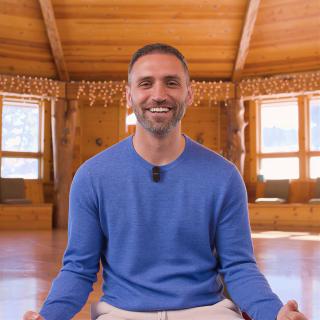
All right,
If you suffer from overthinking and a lot of different voices in your head,
You are not alone.
Step into my office.
Not physically,
Stay out of here.
Stay on your side of the screen.
So when we go to meditate and we've got all this noise in our heads,
What do we do?
So first of all,
I always like to say don't push,
Don't try to push the voices out or the noise out of your head or override it or bury it.
We're not forcing ourselves into inner peace.
That doesn't tend to last because when we get up from the cushion of the chair,
It all comes flooding back.
So there's two approaches here that I like to work with.
The first one is a very traditional one,
Where as we sit and we close our eyes and meditate,
We allow the noise to pass almost like clouds in the sky.
They pass as we sit still and we don't react,
We don't respond.
We don't argue.
We don't fight.
We just sit still.
Until the noise passes and slowly subsides.
And that does work to an extent.
It tends to be harder for beginners.
That's how a lot of Buddhist monks will meditate,
Vipassana meditators,
Zen,
Many different styles where we allow the noise to pass and we sit still.
And the other is we can actually say hello to the voices in our heads.
We can say hello to the commentator,
The critic,
The complainer,
The planner,
Whoever it is is taking the mantle at that moment.
I have something to say.
We have a lot to do this week,
And I'm going to map every possible terrible outcome out.
And you're going to watch and get more anxious.
So that does happen.
So what do we do in that moment?
I like to actually face the noise.
So we're going to do a short meditation here,
But let me just describe it briefly first.
You can sit and just allow that voice to kind of step forward.
Let's,
For example,
Say it's the critic.
And the critic comes forward and the critic either goes external or internal.
So somebody's bad or doing it wrong,
Or I am bad or doing it wrong.
So let's say the critic comes at you.
You did that wrong.
You messed up.
You said the wrong thing.
In the conversation.
How do we approach that in meditation?
Well,
We're not going to solve it or fight it,
Right?
So what I like to do is just allow that voice to come forward and just ask it a question.
So what is the energy behind you?
What is it that you're wanting to accomplish?
And you might get some real answers start to just bubble up and rise up in your system as you sit still.
So for example,
The critic might go,
Well,
I don't want you to mess up.
I want you to be seen in a positive light in the world so you're safe.
And successful.
Or there's a lot of pain here and I am just regurgitating pain.
So we start to get these answers from these voices.
Instead of being aggressive towards them or try to push them away.
The more you try to push the voices away,
The more they kind of come back with vengeance.
Nothing likes to be shamed into a corner.
And that might be where the voice came from in the first place.
So a lot of our inner voices are trying to guide us,
Protect us,
And they might just be doing a poor job and might be getting out of control.
And so without meditating,
It's kind of hard to reset the system.
To calm those voices down and to really start to process emotion and energy and get answers.
So let's do this together.
Let's just do this briefly together for a moment.
I want you to close your eyes.
If you can,
If you need them open,
That's fine too.
Take a slow,
Deep breath.
Fill your whole body in with some oxygen.
As you release,
Just start to let yourself relax.
Even if the voices don't want to relax.
Your body can start to.
Take like a shift downward.
And from here,
Just allow one of the voices that tends to be loud.
To come up.
Almost to take center stage.
I want you to get a sense of what this voice is.
Is it complaining,
Narrating?
Problem solving.
Regretting?
Criticizing.
What is its main shtick?
And see if instead of.
And see if instead of worrying about the content itself.
If you could just notice the energy behind the voice.
You know when you go to a movie and you know this is a drama,
Comedy,
An action.
A suspense film.
You get a sense this is the energy.
Behind the movie.
It has a direction.
Just notice the theme behind this voice.
And as you breathe slower and deeper,
Bring your calm awareness to it.
You don't have to judge it or fight it.
Of just being aware of it.
And then I want you to just ask it.
What is it trying to do for you?
Or to help you with.
Or solve.
Why are you here?
If we had to distill the question down,
It might just be,
What's your purpose here?
Go ahead and just ask and see what arises.
It might tell you in words.
You might get a sense.
You may slowly recognize that this voice is not your enemy and may be trying to protect you or guide you.
And just doing it.
In a poor way?
And see if you can show it some appreciation.
This voice may actually be a part of you.
And it doesn't even realize it's a part of you.
And you don't realize it.
And that gap is creating some tension.
It might be creating some tension.
So show us some compassion and appreciation.
And just like you,
It might be doing the best that it can.
I'm going to start to notice your energy shift Maybe relax your shoulders a bit.
And as you're present with this voice,
It might subside a bit.
It might relax,
And as it relaxes,
Maybe you relax.
And as you relax,
It relaxes.
You can say thank you to this voice.
And just recognize it has space.
You don't have to fight it.
And it doesn't have to yell for attention.
And you can even ask it to focus on more high-quality feedback when it does talk.
Say thank you to this voice for showing up.
And then see if you can give us some space to rest.
Take a nice,
Big,
Deep breath.
Bring yourself back to center.
Notice if you feel a bit calmer.
More present.
Really great work.
And then slowly,
When you're ready,
You can open your eyes.
It can stretch a little bit.
Oh,
There you are.
See if it's a bit quieter in your head.
And if you're a bit more centered.
And you can do this again and again,
Whenever a voice starts to rage or be loud.
Want your attention.
Thanks for sitting with me.
As always.
.
.
I will see you next time.
Be well.