Hey guys.
Welcome to this week's update.
This week I want to talk to you about something that affects every single one of us.
How your breathing shapes your focus,
Your stress levels,
And your performance at work.
And then at the end,
We'll do a couple of minutes of simple breathwork together,
So you leave this session feeling refreshed.
So let's start with a piece of research that stopped me in my tracks this week.
Researchers at Harvard found that we spend almost half our waking hours nearly 50% mentally somewhere else.
Not in the task in front of us,
Not in the conversation we're having somewhere else.
And here's the kicker.
They also found that a wandering mind is an unhappy mind.
When we're not present,
We're not content.
Now think about what that means at work.
Brain fog,
Trouble concentrating,
Feeling overwhelmed by lunchtime.
Reaching for that third coffee,
The chocolate bar,
Scrolling on the phone.
We blame the workload.
But very often the real culprit is sitting right under our nose.
Quite literally.
It's how we're breathing.
Here's what's happening physiologically.
Your brain is only about 2% of your body weight,
But it uses roughly 20% of your oxygen.
It is hungry for it.
And here's the part most people have never heard.
Carbon dioxide isn't just a waste gas.
It's what opens up your blood vessels and allows your red blood cells to actually release oxygen into the brain.
So when we're stressed and we breathe fast,
Shallow,
Up in the chest,
Through the mouth.
What I call over-breathing,
We blow off too much carbon dioxide.
And when that happens,
The brain gets less oxygen,
Not more.
And the neurons become overexcitable.
That's the overthinking,
The racing mind at two in the morning.
That's the rumination loop you can't switch off.
And it becomes a cycle.
Stress changes your breathing and then your breathing feeds the stress right back.
Round and round.
But here's the beautiful thing,
That cycle works in both directions.
Change the breath and you change the state.
The research backs this up.
Slow,
Light nasal breathing settles the nervous system and improves blood flow to the brain.
One technique,
Breathing slightly less air in than usual,
Creating a gentle air hunger,
Is estimated to improve blood flow by 5-10%.
And a study on attention training found that just two weeks of practicing resting the attention on the breath improved working memory and reading comprehension.
And I love this point,
Anxiety and flow,
That state where you're completely absorbed doing your best work,
Cannot coexist.
You can't be in both at once.
So every time you calm the breath,
You're opening the door to flow.
The breath is a skill.
Nobody taught us this at school,
But it's one you carry with you for your life,
Before a big meeting,
A difficult conversation,
Or just getting off to sleep.
So let's put it into practice right now.
Wherever you are,
At your desk,
On the train,
At home,
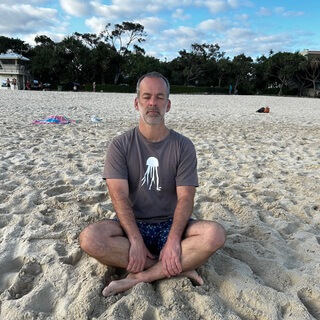
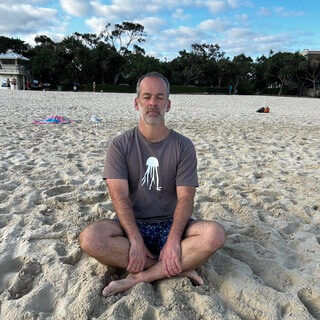
Sit comfortably.
Soften your shoulders.
And if it feels right,
Then it's appropriate.
Let the eyes close.
We'll start simply.
Breathe in through your nose and out through your nose.
The mouth must be closed and the tongue must be on the roof of the mouth.
Let the breath drop down low so the belly gently rises as you breathe in and softens as you breathe out.
Nothing forced,
Just quiet,
Gentle breathing through the nose.
Now let's lengthen that exhale.
Breathe in through the nose,
Nice and soft.
And let the breath out slowly.
Longer than the inhale.
That longer exhale is your signal to the nervous system that you're safe.
Because the exhale complements the increased oxygen delivery.
By activating our vagus nerve which puts the brake on the heart and lowers the heart rate.
Again,
In through the nose.
And slowly out the nose.
Keep going.
As you breathe.
Whenever the mine wanders off.
And it will.
That's what mines do.
Just notice it.
And gently bring it back to the breath.
That's not filing.
Every single time you come back,
That's one repetition for your attention.
Your training focus,
Right here,
Right now.
Keep going,
A few more slow breaths in the nose and even slower out.
Notice how you feel.
A little quieter,
A little clearer.
Maybe a buildup of saliva in your mouth.
That is you going into rest and digest,
Which is perfect.
That took less than two minutes,
That breathing exercise,
And it's available to you any moment of the day.
Mouth closed,
Tongue on the roof of the mouth,
Slow breath in through the nose,
Slower breath out through the nose.
That's it from me this week.
If you enjoyed this,
You'll find more of my guided practices here on Insight Timer.
And I'd love you to join me again next week.
Until then.
Look after yourself.
Breathe right,
Because you are important.
Take care.