The world’s largest free audio library for everyday wellbeing
Coaching & Behavior Change
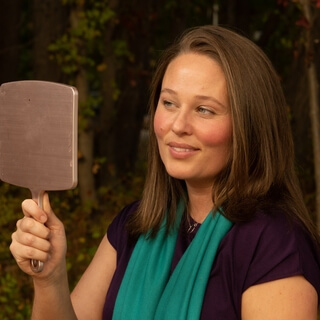
Mirror Work is a practice of looking into your own eyes in a mirror while speaking kind, affirming statements to yourself (Hay, 2016).
Last Updated
3 Jul 2026
We are still reviewing this page. Our research team checks every technique page for accuracy and evidence quality before final release. Details may change as that review completes. The evidence badge shows our current reading of the published research.
RECOMMENDED DOSE
No direct dose evidence; editorial synthesis. A short, low-pressure introduction — a few minutes of gentle self-directed statements in front of a mirror — helps build comfort and consistency without feeling exposed or overwhelming.
No direct dose evidence; editorial synthesis. Once the practice feels familiar, a slightly longer, near-daily rhythm supports habit formation, in line with general conventions for self-compassion and affirmation practices.
No direct dose evidence; editorial synthesis. A daily maintenance practice of around 10–15 minutes reflects a committed routine; extend only if it remains comfortable and beneficial for you.
Session length
Session length: 2–5 minutes
2
MIN
How long each individual practice session should last from start to finish.
Frequency
Frequency: 3–4 days
3
DAYS
The number of days per week to fit a session into your routine.
Session length
Session length: 5–10 minutes
5
MIN
How long each individual practice session should last from start to finish.
Frequency
Frequency: 5–6 days
5
DAYS
The number of days per week to fit a session into your routine.
Session length
Session length: 10–15 minutes
10
MIN
How long each individual practice session should last from start to finish.
Frequency
Frequency: 7 days
7
DAYS
The number of days per week to fit a session into your routine.
About this card. No direct dose-response literature exists for this technique. These recommendations are based on general practice conventions for self-compassion and affirmation practices and should be treated as starting points only. These recommendations are not a substitute for personalised guidance from a qualified practitioner.
Quick answers to what people most often ask. Each card links to the deeper section below.
evidence
No randomized trials have tested Mirror Work directly; it comes from Louise Hay's 2016 self-help book, which lays out a 21-day affirmation program rather than a clinical treatment. Broader research on mirror-based self-observation and self-affirmation points toward stress and self-compassion benefits, but that work is indirect, keeping the evidence at an emerging level.
Read moregood for
People quick to criticize themselves who want a simple daily way to speak more kindly may find Mirror Work supportive; Louise Hay's program frames it around self-talk, fear, anger, and repairing relationships. Because it has not been trialled, treat it as supportive self-practice for everyday stress rather than treatment for any diagnosed condition.
Read moresafety
Most healthy adults can begin Mirror Work safely at home. Because meeting your own gaze heightens self-focused attention, it can briefly stir self-criticism, sadness, or a detached, watching-yourself feeling before settling. People living with body-image distress, an eating disorder, trauma, dissociation, or acute low mood should approach gently and keep professional support in place.
Read morehow it works
Mirror Work is thought to work through cognitive reappraisal—deliberately offering a fairer reading of your own worth in place of an automatic critical one, spoken aloud while you hold your own gaze. The mirror is also proposed to create observer's distance. These mechanisms are inferred from the practice's design rather than measured in any trial.
Read moreMirror Work is a self-help practice of looking softly into your own eyes in a mirror while speaking kind, affirming statements to yourself, developed by author Louise Hay.
You stand or sit before a mirror, soften your gaze into your own eyes, and speak affirmations, self-compassionate statements, or your own name paired with encouraging words. Hay's 2016 book organizes this into a 21-day program with daily themes such as monitoring self-talk, overcoming fear, releasing anger, healing relationships, and receiving prosperity. What sets it apart is that you both deliver and receive the encouragement in the same moment, pairing visual self-witnessing with spoken self-address.
Mirror Work here means Louise Hay's affirmation-and-mirror practice specifically, not the mirror exposure therapy used in body-image or eating-disorder treatment, and not the mirror box therapy used in pain rehabilitation. It is a self-help routine rather than a clinical intervention, and it differs from silent meditation because it centers on active, spoken self-address while you hold your own gaze.
Not to be confused with
Mirror therapy (physical rehabilitation)
Mirror therapy uses a mirror box to treat phantom limb pain and support motor recovery after stroke or injury. It is a physical rehabilitation technique with no connection to self-talk, affirmation, or self-relationship.
Mirror gazing or scrying
Mirror gazing and scrying involve staring into a mirror to induce altered perception or for divinatory purposes. Mirror Work is about speaking kindly to yourself while meeting your own gaze, not about perceptual or occult experience.
Manifestation or law-of-attraction thinking
Although Hay's program includes prosperity themes, Mirror Work as described here is the concrete practice of kind self-address to your reflection, not a claim that positive thoughts directly control external events or outcomes.
Mirror Work is thought to work through cognitive reappraisal, the act of deliberately offering a fairer reading of your own worth in place of an automatic critical one, spoken aloud while you hold your own gaze (Hay, 2016). Over repeated sessions a familiar "I am not enough" can start to feel less like plain fact and more like one thought among many. The mirror may also create a kind of observer's distance, letting you watch yourself from the outside as you speak. These mechanisms are inferred from how the practice is built, not measured in any trial of it.
When your inner voice insists "I'm not enough," Mirror Work answers it out loud with something fairer. This is cognitive reappraisal, deliberately offering a more balanced reading of your worth in place of an automatic critical one, and over repeated sessions it can loosen a harsh judgment's grip until "I'm not enough" feels less like plain fact and more like one thought among others (Hay, 2016).
No physiological changes have been measured for Mirror Work specifically, so the honest picture is a felt one rather than a lab one. Meeting your own eyes can feel exposing at first, with a flicker of tension or self-consciousness, and for many people that gives way to slower breathing and a steadier, warmer sense in the body as the kinder words land. Any claim about hormones, heart rate, or brain activity would go beyond what has actually been studied for this practice.
Emerging is the honest evidence level here: the practice is documented mainly in Louise Hay's 2016 program rather than in clinical trials, so its intended benefits, easing harsh self-criticism, building self-compassion, and settling everyday stress, are described by the practice itself rather than confirmed by controlled research (Hay, 2016). Not yet supported are randomized trials of this specific protocol, measured effect sizes, and any evidence that it treats or replaces care for a diagnosed condition.
Mirror Work as a named method comes from Louise Hay's 2016 book, which lays out a 21-day program of affirmations and self-dialogue spoken while looking softly into your own eyes; it is a structured self-help practice rather than a clinically trialled treatment (Hay, 2016). No randomized trial of this specific protocol is available, so efficacy for any particular condition cannot be claimed here. Broader research on mirror-based self-observation and on self-affirmation points in a hopeful direction for stress and self-compassion, but that work is indirect and does not isolate Hay's method, which is why the current evidence level sits at emerging.
0
Meta-analyses
0
RCTs
0
Systematic reviews
0
Observational
1
Pilot
The available material sets expectations but comes from a self-help program, not controlled research. Treat it as general guidance rather than a promise about any single session, and not a replacement for clinical care.
Mirror Work as a structured practice was developed by Louise Hay, the self-help author and founder of Hay House publishing, and set out in her 2016 book Mirror Work: 21 Days to Heal Your Life (Hay, 2016). Her program organizes daily themes such as monitoring self-talk, overcoming fear, releasing anger, and healing relationships. These roots explain the practice's form, its mirror ritual and daily affirmations; they are not proof that its tradition produces any clinical effect.
For most healthy adults, Mirror Work is a low-risk practice you can safely start on your own at home. A few situations call for a gentler approach. Because meeting your own gaze sharpens self-focused attention, the pull to watch and evaluate yourself, the practice can briefly stir more self-criticism, sadness, or a detached, watching-yourself feeling before anything settles. Affirmations that clash sharply with what you currently believe about yourself can also feel hollow or invalidating at first. These are practice-informed and mechanism-inferred cautions rather than documented risks, since no safety-specific studies of Mirror Work exist. If a session raises distress instead of easing it, ease off and keep the practice short.
Take extra care if you live with body-image distress, an eating disorder, a history of trauma, dissociative experiences where you feel disconnected from yourself, or acute low mood. For these groups, sustained self-observation can amplify difficult feelings rather than soothe them. Mirror Work is a self-help practice, not a treatment for any mental health condition, so keep any professional support you already rely on in place, and involve a qualified clinician when you are managing a diagnosed condition. These cautions come from how the practice works and from general clinical understanding of self-confrontation and affirmation methods, not from trials of this specific technique.
Meeting your own reflection can sharpen self-scrutiny rather than soothe it if you live with body-image distress or an eating disorder. Keep any professional support already in place, start with very short sessions, let your eyes rest gently rather than inspecting your face, and stop if a session raises distress instead of easing it. This is a practice-informed caution, since no safety studies of Mirror Work exist for these groups.
Sustained self-observation in a mirror can amplify difficult feelings or a detached, disconnected-from-yourself sensation for people with a trauma history or dissociative experiences. Approach the practice gently, keep sessions brief, ground yourself afterwards, and keep any existing clinical support in place. This caution comes from how the practice works and from general clinical understanding of self-confrontation, not from trials of Mirror Work.
When mood is very low, self-focused attention in the mirror can briefly heighten self-criticism or sadness before anything settles. Treat Mirror Work as optional supportive self-practice rather than treatment, involve a qualified clinician where care is already needed, and stop the session if distress climbs rather than eases.
Statements that flatly contradict what you currently believe about yourself can feel hollow or invalidating and briefly sharpen self-criticism. Choose wording that feels like a small, reachable stretch from where you are now, so the phrase lands as genuine reframing. This is a mechanism-inferred caution rather than a documented risk.
Mirror Work is most gentle when you approach it as a brief, private practice at home, keeping early sessions short while you learn how meeting your own gaze feels. A sensible starting format pairs a minute or two in front of the mirror with a soft rather than searching look and wording that feels like a reachable stretch from where you are now. Treat it as a supportive addition to any care you already rely on, and give yourself full permission to ease off if a session stirs distress instead of settling it.
Begin with one to two minutes in front of the mirror rather than a long session, so you can learn how the eye contact feels before you extend it. The first meetings with your own gaze often feel intense or awkward, and a shorter session gives that intensity room to settle.
Pick affirmations that feel like a small, reachable stretch from where you are now rather than statements that flatly contradict your current self-view. A phrase that feels plausible tends to land as genuine reframing, while one that clashes too hard can trigger resistance and briefly sharpen self-criticism.
Let your eyes rest gently on your reflection instead of scrutinising your face, which keeps the practice from tipping into harsh self-inspection. If you catch yourself scanning for flaws, drop your gaze, take a slow breath, and return softly.
Pause partway through and notice whether you feel steadier or more agitated, tearful, or detached. If distress is climbing rather than easing, that is your signal to shorten or stop, not to push through.
Give yourself explicit permission to stop at any point, and do something grounding afterwards, such as a short walk or a familiar task, especially in the early days.
Treat Mirror Work as a supportive daily practice alongside, not instead of, any professional support you already use, and bring persistent or worsening distress to a qualified clinician.
This information is educational and is not medical advice. This practice is not a substitute for professional care and should not replace prescribed medication or treatment for any medical or mental-health condition. If you are managing a health condition or taking medication, talk with a qualified health professional before changing your practice. If you are in distress or crisis, seek professional support.
| Technique | Best for | Use with care | Evidence strength | Distinction |
|---|---|---|---|---|
| Positive affirmations (spoken or written, no mirror) | Building a simple daily habit of kinder self-talk without the intensity of facing your own reflection. | Affirmations that clash sharply with a current self-belief can feel hollow; gentler, believable wording tends to land better. | emerging EVIDENCE | Affirmations use the same supportive self-statements but drop the mirror and the eye contact. Mirror Work adds visual self-witnessing, so you both deliver and receive the encouraging message while watching your own face, which many people find more intense and more affecting than affirmations alone. |
| Mirror-based meditation (silent self-observation) | People who want to steady attention and soften self-focused reactivity through silent watching rather than speech. | emerging EVIDENCE | Mirror-based meditation involves quietly observing your own face without speaking, cultivating steady, non-reactive attention. Mirror Work keeps the reflection but adds spoken affirmations and self-address, making it an active dialogue with yourself rather than a purely observational practice. | |
| Self-compassion practice (compassionate self-talk, loving-kindness) | Softening harsh self-judgment in moments of difficulty, with or without a mirror. | moderate EVIDENCE | Self-compassion practices cultivate a kind inner stance toward your own suffering, often through phrases or gentle self-touch but no mirror. Mirror Work channels that same warmth specifically through eye contact with your reflection, tying the kind words to the sight of your own face. | |
| Compassion-Focused Therapy (CFT) | People with entrenched shame or self-criticism who benefit from structured, professionally guided support. | Choose therapist-led CFT over solo Mirror Work when self-criticism is severe or tied to a diagnosed condition. | moderate EVIDENCE | CFT is a structured, clinician-led therapy that trains the affiliative soothing system in people carrying high shame and self-criticism. Mirror Work is a self-guided routine that draws on a similar soothing response but without assessment, tailoring, or professional oversight. |
Mirror Work is a self-help practice, developed by Louise Hay, of looking softly into your own eyes in a mirror while speaking kind, affirming statements to yourself. To do it, stand or sit at a mirror, meet your own gaze gently, and say encouraging phrases aloud, often using your own name (Hay, 2016).
+
Mirror Work pairs seeing yourself with speaking to yourself, so you both give and receive the encouragement in the same moment. In practice you face a mirror, let your eyes rest gently on your reflection rather than scanning for flaws, and speak affirming or self-compassionate words out loud. Louise Hay set this out as a 21-day program with daily themes such as monitoring self-talk, overcoming fear, releasing anger, and healing relationships (Hay, 2016). This describes the practice as its source book presents it; it is supportive self-practice, not a treatment for any condition.
It is more structured than plain positive thinking, but not yet proven. Mirror Work pairs kind self-talk with eye contact in a mirror, and its named form comes from Louise Hay's 2016 self-help book rather than clinical trials (Hay, 2016). Treat it as an emerging practice, not established therapy.
+
It is more structured than positive thinking, but the direct evidence is thin. Mirror Work is a self-dialogue practice set out in Louise Hay's 2016 book, and no randomized trials of this specific protocol exist, so proven effects cannot be claimed (Hay, 2016). Broader research on mirror-based self-observation and self-affirmation points in a hopeful direction for stress and self-compassion, but that work is indirect and does not isolate Hay's method, which is why the honest evidence level sits at emerging.
Only a little, and it is indirect. Mirror Work as a named method comes from Louise Hay's 2016 self-help book, not a controlled trial, so its evidence level is emerging and its benefits are described by the practice rather than proven (Hay, 2016).
+
Only a little, and it is indirect. The single direct source for Mirror Work is Louise Hay's 2016 book, which lays out a 21-day affirmation and self-dialogue program; no randomized trial of this specific protocol exists, so effectiveness for any condition cannot be claimed (Hay, 2016). Studies of mirror-based self-observation and of self-affirmation more generally show encouraging signs for stress and self-compassion, but that work is suggestive rather than confirmed and does not isolate Hay's method. Treat it as an emerging self-help practice, not an established therapy.
Because it sharply raises self-focused attention: you meet your own gaze while both speaking and receiving the words, which can feel exposing at first. This intensity usually eases with repetition as the mirror adds a sense of watching yourself from the outside.
+
The likely reason is heightened self-focused attention, the pull to watch and evaluate yourself, combined with self-confrontation: you are the same person delivering and receiving the encouragement while holding your own gaze, which many people find exposing early on. The mirror is also thought to create a kind of observer's distance, letting you see yourself from outside as you speak, and that often softens the intensity as the practice becomes familiar. These explanations are inferred from how the practice is built rather than measured in any trial of Mirror Work, and no physiological changes have been studied for it specifically.
Possibly, as a daily practice rather than a proven fix. Mirror Work is built precisely for moments when self-talk turns harsh, giving you a repeatable way to meet your own gaze and answer self-criticism with kinder words (Hay, 2016).
+
Possibly. Mirror Work directly targets a harsh inner voice by pairing gentle eye contact with kind, affirming self-address, and it is thought to work through cognitive reappraisal, deliberately offering a fairer reading of your own worth in place of an automatic critical one (Hay, 2016). That mechanism is inferred from how the practice is built rather than measured in any trial, so treat this as a supportive, still-unproven self-practice for softening self-criticism, not a certain outcome or a treatment for any diagnosed condition.
Use extra care. If you live with body-image distress or an eating disorder, meeting your own reflection can amplify difficult feelings, so treat Mirror Work as optional supportive self-practice, not treatment. Keep any professional support in place, start brief and gentle, and stop if distress climbs.
+
Use extra care. No safety studies of Mirror Work exist for eating disorders or body-image distress, so this is a practice-informed caution rather than a documented finding: sustained self-observation in front of a mirror can heighten self-scrutiny and amplify difficult feelings for these groups rather than soothe them. Mirror Work is a self-help practice, not a treatment for any condition, so keep a qualified clinician involved where care is already needed, keep sessions short, soften your gaze rather than inspecting your face, and stop if it raises distress instead of easing it.
Ease off. If Mirror Work stirs sadness or self-criticism, shorten or stop the session, soften or drop your gaze, take a slow breath, and do something grounding afterwards. This reaction is common early on rather than a sign you are doing it wrong, and persistent or worsening distress is worth bringing to a qualified clinician.
+
Ease off and treat rising distress as a signal to slow down, not push through. Because meeting your own gaze heightens self-focused attention, it can briefly sharpen self-criticism, sadness, or a detached, watching-yourself feeling before anything settles; this is a practice-informed, mechanism-inferred caution rather than a documented risk, since no safety studies of Mirror Work exist. Shorten the session, let your eyes rest gently or look away, breathe slowly, and move to a grounding activity like a short walk. Mirror Work is a supportive self-help practice, not a treatment, so keep any existing professional support in place and involve a clinician if distress persists or worsens.
Start short: about one to two minutes is a sensible beginning, extending only once meeting your own gaze feels manageable. This is practice-informed guidance, not a trial-tested dose, so shorten or stop if distress climbs rather than eases.
+
Start short. Beginning with roughly one to two minutes in front of the mirror lets you learn how the eye contact feels before you extend it, since first meetings with your own gaze can feel intense or awkward. Lengthen sessions gradually only once that intensity settles, and treat a rising sense of agitation, tearfulness, or feeling detached as a cue to shorten or stop rather than push through. No controlled study sets an optimal session length, so this is practical starting guidance drawn from how the practice is structured, not a trial-validated dose.
Choose wording that feels like a small, reachable stretch rather than a bold statement that flatly contradicts your current self-view. A phrase you can half-believe tends to land as genuine reframing, while one that clashes sharply can feel hollow and briefly sharpen self-criticism. This is practical guidance, not a wording proven in trials.
+
Pick affirmations that sit just ahead of where you are now, not far beyond it. If "I love myself" feels false, a plausible bridge like "I'm learning to treat myself more kindly" or "I'm willing to be gentler with myself" often lands better, because believable phrasing reads as real reframing rather than a claim your mind rejects. Let your eyes rest softly on your reflection instead of scrutinising it, and if a phrase raises resistance, ease off and try gentler wording. No trial has validated specific affirmations for Mirror Work, so treat this as practical guidance for making the practice feel genuine rather than evidence that particular wording works.
The mirror. Both use the same kind, affirming self-statements, but Mirror Work adds eye contact with your own reflection, so you deliver and receive the message while watching your own face (Hay, 2016). Many people find that visual self-witnessing more intense and affecting than affirmations alone.
+
The mirror is the difference. Plain affirmations use supportive self-statements spoken or written without a reflection, while Mirror Work pairs those same words with a softened gaze into your own eyes, so you both give and receive the encouragement in the same moment (Hay, 2016). That added visual self-witnessing tends to feel more intense, which some people find more affecting and others find harder to start with. This distinction comes from how the practice is described rather than any head-to-head trial. It marks how the two differ; it is not proof that one works better or treats any condition, and both sit at an emerging evidence level.
A short, supportive statement you say to yourself on purpose, such as an encouraging or accepting phrase about your worth. In Mirror Work these are spoken aloud while looking into your own eyes.
Deliberately reframing the meaning of a thought or situation so it carries a different, less painful emotional charge. In practice a once-automatic self-criticism starts to feel like one possible interpretation rather than plain fact.
An emotion-regulation strategy in which a person generates alternative interpretations of a stimulus or self-appraisal to change its affective impact.
The shift from being caught up inside your thoughts and feelings to watching them as passing mental events. Facing your own reflection can add a literal sense of seeing yourself from the outside, which loosens automatic reactivity.
A metacognitive stance in which internal experiences are observed as transient events rather than as literal truths, reducing identification and reactivity.
The body's care-and-comfort response, the settled, safe feeling that usually arises from warmth and kindness from others. Gentle self-address and soft eye contact are proposed to turn that same response toward yourself.
The affiliative affect system associated with attachment and caregiving, linked to oxytocin and parasympathetic social-engagement activity, producing states of safety and warmth.
Gradually reworking the story you tell about yourself, changing how past events and future hopes are connected and understood. Kind, repeated self-address can begin to replace a critical inner storyline with a more supportive one.
Revision of autobiographical narrative identity through reinterpretation of self-relevant events, altering the coherence and valence of the self-story.
Turning investigative attention inward by asking yourself honest questions, such as what you are afraid of or what you really want, and letting the answers surface. It is active questioning rather than simply observing your thoughts.
Introspective self-referential processing in which the practitioner examines beliefs, values, and identity constructs through sustained questioning.
The idea from psychology that reminding yourself of your values and worth can steady you against threats to self-esteem. It is the theoretical backdrop often cited for why affirmation practices may help.
Louise L. Hay (2016). Mirror Work: 21 Days to Heal Your Life.
Cited in: Benefits, How it works, Research, Roots and tradition, What it is
Editorially curated. Tracks are not themselves clinically studied; evidence on the page applies to Mirror Work as a technique.
Beginner content for Mirror Work

★ 4.7
·
Guided
·
3 min
Jennifer Ransaw Smith
How hard is Mirror Work?
Mirror Work stays below the heavier coaching rows, but it breaks above simple affirmations because direct self-address in the mirror adds real vulnerability.
2
Mental Effort
2 / 4
▾Emotional Depth
2 / 4
▾Physical Intensity
1 / 4
▾Prior Knowledge
2 / 4
▾Explore guided sessions to deepen your Mirror Work technique.