The world’s largest free audio library for everyday wellbeing
Breathwork
Paced breathing is a breathwork technique in which you breathe at a slow, prescribed rate, most often about six breaths a minute set by a metronome, app, or count, to steady the nervous system (Shao et al., 2024).
Last Updated
3 Jul 2026
We are still reviewing this page. Our research team checks every technique page for accuracy and evidence quality before final release. Details may change as that review completes. The evidence badge shows our current reading of the published research.
Beginner video for Paced Breathing

★ 5.0
·
Talks
·
7 min
Naomi - Soul Tranquility Healing
How hard is Paced Breathing?
This stays light because the user is maintaining a therapeutic pace, not pushing retention or activation.
2
Mental Effort
2 / 4
▾Emotional Depth
1 / 4
▾Physical Intensity
2 / 4
▾Prior Knowledge
2 / 4
▾RECOMMENDED DOSE
A large randomised controlled trial had participants practise coherent breathing (~5.5 breaths/min) for about 10 minutes per day, and a cross-over study used 10 minutes of paced breathing at 6 breaths/min. A conservative 5-minute floor is offered for those new to slow breathing; the 5-minute end is editorial synthesis.
Four-week RCTs of daily paced breathing at 6 breaths/min and HRV-biofeedback, alongside the 10 min/day coherent-breathing trial, support a daily habit at this level. The 10-minute session length is trial-tested; extending toward 20 minutes is editorial synthesis.
Longer-term studies sustained daily slow-paced breathing over six weeks and seven weeks, supporting continued daily practice as a maintenance dose. These studies did not specify a longer session length, so the ~20-minute target is editorial synthesis.
Session length
Session length: 5–10 minutes
5
MIN
How long each individual practice session should last from start to finish.
Frequency
Frequency: 7 days
7
DAYS
The number of days per week to fit a session into your routine.
Session length
Session length: 10–20 minutes
10
MIN
How long each individual practice session should last from start to finish.
Frequency
Frequency: 7 days
7
DAYS
The number of days per week to fit a session into your routine.
Session length
Session length: About 20 minutes
15
MIN
How long each individual practice session should last from start to finish.
Frequency
Frequency: 7 days
7
DAYS
The number of days per week to fit a session into your routine.
About this card. Frequency guidance and shorter session lengths reflect protocols directly tested in trials; longer session targets are conservative editorial extrapolations. These recommendations are not a substitute for personalised guidance from a qualified practitioner.
Quick answers to what people most often ask. Each card links to the deeper section below.
evidence
A meta-analysis of 31 studies found slow-paced breathing reliably lowers blood pressure and heart rate and raises heart-rate variability in the short term. Controlled trials show narrower benefits for panic and for sleep and anxiety in cancer survivors, while effects on everyday mood are modest, and one placebo-controlled trial matched a sham pattern.
Read moregood for
Adults wanting to steady themselves under everyday stress, a racing pulse, or looping worry are the main fit for paced breathing. It has also been studied in people with panic disorder, breast cancer survivors with disturbed sleep and anxiety, and adolescents managing stress. It works best alongside other care, not as a replacement treatment.
Read moresafety
Most healthy adults can practise paced breathing safely, and none of the cited studies reported measured harms. A few people feel briefly light-headed in the first minutes of slowing the breath so far; letting it return to a natural rhythm settles this. Take extra care with low blood pressure, and treat it as add-on care for panic or anxiety.
Read morehow it works
Slowing the breath to about six breaths a minute shifts the body toward its rest-and-recovery branch, letting a wound-up system settle. At this resonance pace breath and heartbeat fall into step, maximising heart-rate variability, while the steady count gives attention a single place to rest so worry loops less. These pathways are proposed rather than fully proven.
Read moreExplore guided sessions to deepen your Paced Breathing technique.
Paced breathing is a breathwork technique in which you breathe at a slow, guided rate, often about six breaths a minute, set by a metronome, app, or count.
A typical session starts by settling into a comfortable position and breathing to a set pace, classically a five-second inhale and five-second exhale for roughly six breaths a minute, held for several minutes. A metronome, app, count, or visual pacer keeps the rhythm, and some practitioners watch a live heart-rate or HRV signal to tune the breath toward a personal resonance rate near 0.1 Hz. No belief or special setting is needed; the repeating count and the felt movement of the breath carry the practice.
Paced breathing is defined by its slow, fixed rhythm, not by forceful or rapid technique. It differs from breathwork styles built on fast or heavy breathing, and from open-ended mindfulness of the breath, because the defining feature is holding a prescribed slow rate. When it is paired with a live heart-rate display, people often call it HRV biofeedback or coherent breathing; the breathing itself is the same, with the screen added only as a guide.
Not to be confused with
Coherent (Resonance) Breathing
Coherent or resonance breathing is essentially paced breathing at a fixed slow rate near five to six breaths a minute, so the terms overlap heavily. Paced breathing is the broader label for breathing to any prescribed pace, while resonance breathing specifically targets each person's cardiovascular resonance rate.
Box Breathing
Box breathing uses equal counts for inhale, hold, exhale, and hold, often four seconds each, and includes deliberate breath holds. Paced breathing usually has no holds and centers on a slower overall rate, around six breaths a minute, tuned to steady the heart rhythm rather than to structure four equal phases.
Diaphragmatic (Belly) Breathing
Diaphragmatic breathing is about how you breathe, engaging the diaphragm for deeper, lower breaths, rather than how fast. Paced breathing is defined by rate and rhythm: you can breathe diaphragmatically at any speed, whereas paced breathing specifies a slow, timed pace.
Paced breathing works mainly by slowing the breath to a rate near six breaths a minute, which shifts the body toward parasympathetic dominance, the rest-and-recovery branch of the nervous system that lets a wound-up body begin to settle (Sévoz‐Couche & Laborde, 2022). At this pace the breath and heartbeat fall into step, a coupling that tends to maximise heart-rate variability, the beat-to-beat variation that signals a system able to move flexibly between alert and calm (Song & Lehrer, 2003). The steady count also gives attention a single place to rest, so worry and rumination have less room to loop. These pathways are drawn largely from mechanism and theoretical work rather than confirmed proof, and one trial found calmer, sharper thinking without any measurable change in vagal tone (Bahameish et al., 2024).
When the body feels wound-up and won't switch off, slow breathing at roughly six breaths a minute engages the parasympathetic nervous system, the body's rest-and-recovery branch, which lets an on-edge body begin to feel settled, less tense, and steadier under pressure (Sévoz‐Couche & Laborde, 2022).
When you feel wired and can't downshift, breathing at a slow, resonant pace of about six breaths a minute may strengthen vagal tone, the activity of the vagus nerve that carries rest-and-recovery signals between heart and brain. Many people feel this as a steadier calm that arrives with less effort and holds a little longer when a stressful moment lands (Sévoz‐Couche & Laborde, 2022).
Following a slow, counted breath turns attention toward what the body is actually doing: the rise and fall of each breath, small shifts in tension and pace. Researchers propose that this steady inward focus may sharpen interoception, the sense of signals coming from inside the body, so rising stress can be noticed and settled before it builds (Sévoz‐Couche & Laborde, 2022).
Racing thoughts settle as attention rests on a simple, repeating target. Following the count and felt movement of a slow, paced breath takes up the same mental space that worry and rumination would otherwise fill, which practitioners often experience as a quieter mind and less pull toward spiraling thoughts (Sévoz‐Couche & Laborde, 2022).
When tension eases and breathing slows into a calmer, more even rhythm, that settling reflects autonomic balancing, the swing between your fight-or-flight and rest-and-recovery systems tipping toward calm. Breathing at about five to six breaths a minute lets breath and heart rhythm fall into step, which early evidence links to stronger calming vagal signals and larger beat-to-beat heart-rate swings (Sévoz‐Couche & Laborde, 2022), (Song & Lehrer, 2003).
The keyed-up, on-edge feeling can start to loosen as slow breathing at a resonant pace, around five to six breaths a minute, strengthens the calming vagal signals that travel between heart and brain (Sévoz‐Couche & Laborde, 2022), (Song & Lehrer, 2003). Arousal downregulation is the body stepping down out of high alert, often felt as the chest softening and the urge to brace beginning to ease.
Slow-paced breathing produces short-term, measurable shifts in the cardiovascular system: heart-rate variability rises while heart rate and blood pressure fall (Shao et al., 2024). In a meta-analysis of 31 studies in nonclinical adults, systolic blood pressure dropped by a standardized mean difference of −0.45 (95% CI [−0.86, −0.04]), a moderate change meaning the average practitioner's reading sat roughly half a standard deviation below comparison conditions, alongside gains in the heart-rate-variability markers RMSSD (SMD = 0.37, 95% CI [0.16, 0.58]) and SDNN (SMD = 0.77, 95% CI [0.26, 1.28]) (Shao et al., 2024). Breathing at a personal resonance rate has also been measured to sharpen baroreflex sensitivity, the reflex that adjusts heart rate to keep blood pressure steady, in one small study of 28 healthy adults (Masahito et al., 2020). In the body these register as a slower, steadier pulse, tension loosening, and breathing that feels less driven.
When stress leaves the body braced and tense, slow-paced breathing can help it settle, and many people feel tension loosening and the breath slowing. In measured studies this shows up as a short-term drop in blood pressure, the force of blood pushing against artery walls (Shao et al., 2024).
A racing, pounding pulse tends to ease with slow-paced breathing: heart rate, the number of times the heart beats each minute, drops modestly, a small but consistent shift when results are pooled across many studies (Shao et al., 2024). Most people feel this as a slower, steadier pulse and a sense of the body settling out of high alert.
As the breath slows, the body can settle into a steadier, less reactive rhythm. Part of that steadiness is baroreflex sensitivity, the reflex that nudges heart rate up or down to keep blood pressure stable, which one small study measured strengthening during slow breathing at a personal resonance pace (Masahito et al., 2020).
Many people feel the body settle, the chest and shoulders loosen, and a steadier calm return as they slow the breath to about six breaths a minute. That shift reflects rising vagal tone, the rest-and-recovery signaling carried by the vagus nerve, measured as higher heart-rate variability during and just after practice (Shao et al., 2024).
After a stressful stretch, slow, guided breathing can leave the body settling, the breath lengthening, and a steadier calm returning. That shift reflects rising parasympathetic tone, the activity of the body's rest-and-recovery branch, which shows up as higher heart-rate variability during and just after practice (Shao et al., 2024).
As slow, paced breathing settles you, the body tends to downshift: the breath lengthens and steadies while physical urgency eases. Underneath, sympathovagal balance, the tug-of-war between the body's stress branch and its rest-and-recovery branch, tips toward recovery, so heart rate and blood pressure drop while heart-rate variability rises (Shao et al., 2024).

The keyed-up, on-alert feeling that lingers after stress tends to settle during slow-paced breathing. Breathing at around six breaths a minute has been measured to lower heart rate and blood pressure and raise heart-rate variability (Shao et al., 2024), changes that point to lower sympathetic arousal, the body's fight-or-flight gear, and that many people feel as the body downshifting, muscles loosening, and breath coming more easily.
During slow-paced breathing, the body can feel like it is evening out, with breath and pulse settling into one smooth, steady rhythm. Researchers call this cardiac coherence, a state in which heart-rate variability rises into a more regular, higher-amplitude beat-to-beat pattern (Shao et al., 2024).
During paced breathing the breath lengthens and slows to roughly six breaths a minute, well below the usual resting pace (Shao et al., 2024). Many people feel that drop in respiratory rate first as a sign of settling: longer, smoother exhales, less sense of air hunger, and more space between one breath and the next.
Moderate evidence from controlled trials supports paced breathing for specific symptoms: slow 0.1-Hz breathing with biofeedback reduced panic symptoms in 52 adults with panic disorder (Benedict et al., n.d.), and daily practice improved sleep and anxiety for 60 breast cancer survivors (Dolgilevica et al., 2025). The strongest and most consistent effects are the short-term bodily ones, higher heart-rate variability and lower blood pressure and heart rate, from a meta-analysis of 31 studies (Shao et al., 2024). Early findings link even brief one-minute slow-breathing prompts to lower everyday stress and rumination (Schwerdtfeger et al., 2025), though the pooled effect on negative emotion in that same review was modest and fell short of significance (SMD = −0.51, 95% CI [−1.06, 0.03], p=0.06) (Shao et al., 2024). What is not yet supported: large long-term trials, and any claim that paced breathing replaces treatment for a diagnosed condition.


Steadier calm under pressure is what higher heart-rate variability tends to feel like, and slow-paced breathing at around six breaths a minute reliably raises this marker of a flexible, resilient nervous system (Shao et al., 2024). In everyday life, even brief slow-breathing prompts have been linked to lower stress and less rumination (Schwerdtfeger et al., 2025).

After a few minutes of slow, paced breathing, many people feel a steadier calm and a sense of the body settling and recovering. Breathing near six breaths a minute may strengthen the calming signals the vagus nerve carries between heart and brain, the body's main rest-and-recovery line, though this is still an early mechanism idea rather than proven (Sévoz‐Couche & Laborde, 2022).
When the breath slows to a steady, guided pace, a wound-up mind and body get a simpler rhythm to settle into, and stress and low-grade negative feelings may ease a little. A large review of slow-paced breathing found a modest, not-yet-definitive reduction in negative emotion (Shao et al., 2024).

Stress and looping thoughts can lose some of their grip after a single slow-breathing break. In everyday life, even a one-minute paced-breathing prompt was linked to lower perceived stress and less rumination, the repetitive turning-over of the same worry (Schwerdtfeger et al., 2025).
Paced breathing is among the most studied breathwork methods, and its clearest results are physical: a meta-analysis of 31 studies found reliable short-term drops in blood pressure and heart rate and gains in heart-rate variability, the beat-to-beat variation that signals a flexible nervous system (Shao et al., 2024). Controlled trials show narrower symptom benefits, for panic (Benedict et al., n.d.) and for sleep and anxiety in cancer survivors (Dolgilevica et al., 2025). Two limits matter for expectations: a large placebo-controlled trial found slow coherent breathing no better than a matched sham breathing pattern for everyday stress and mood (Fincham et al., 2023), and faster pacing at 0.25 Hz did not change autonomic markers at all (Pinna et al., 2005).

1
Meta-analyses
4
RCTs
0
Systematic reviews
0
Observational
11
Pilot
Studied populations
Outcomes measured
| Outcome | Effect size | 95% CI | N | Comparator | Source |
|---|---|---|---|---|---|
| systolic blood pressure | SMD = -0.45 | 95% CI [-0.86, -0.04] | 1,133 | — | Shao et al., 2024 |
| RMSSD (time-domain HRV) | SMD = 0.37 | 95% CI [0.16, 0.58] | — | — | Shao et al., 2024 |
| SDNN | SMD = 0.77 | 95% CI [0.26, 1.28] | — | — | Shao et al., 2024 |
| heart rate | SMD = -0.10 | 95% CI [-0.19, -0.01] | — | — | Shao et al., 2024 |
| perceived stress / negative emotion | SMD = -0.51 | 95% CI [-1.06, 0.03] | — | — | Shao et al., 2024 |
| Baroreflex sensitivity (BRS) and LF amplitude under paced breathing | reported significant; p<.05 (BRS); p<.001 (LF) | — | 28 | — | Masahito et al., 2020 |
| perceived stress (study 1) | reported significant; P<.001 | — | — | — | Schwerdtfeger et al., 2025 |
| subjective stress (group x time interaction) | reported narratively | — | 400 | attention-placebo at 12 breaths/min | Fincham et al., 2023 |
The research is useful for setting expectations, but study methods and participant groups vary. Treat the findings as general guidance rather than a promise about any single session, and not a replacement for clinical care.
Effectiveness of 2 Just-in-Time Adaptive Interventions for Reducing Stress and Stabilizing Cardiac Autonomic Function: Microrandomized Trials
2025
Finding: Across two small everyday-life trials (60 and 50 adults using wearable trackers), a one-minute slow-breathing prompt at about six breaths a minute was followed by clear drops in perceived stress and repetitive worrying thoughts. The slow breathing itself lifted heart-rate variability, a marker of how flexibly your nervous system adapts, and did so most when that variability had dipped low, which is often when you feel most tense. One honest caveat: the mood and stress improvements showed up whether or not people got the breathing prompt, so the calmer feeling can't be pinned on the breathing alone. Still, the pattern hints that a brief pause to slow your breath may help steady your system in the moments it needs it most.
reported significant; P<.001
Short-Term Effects of Heart Rate Variability Biofeedback on Working Memory.
2024
Finding: In a small randomised trial with 38 adults, a single session of paced breathing with heart-rate feedback improved working-memory performance and left people feeling calmer and more focused right afterward. Interestingly, when researchers traced why, the gains did not come from measurable shifts in vagal tone (the branch of the nervous system usually credited for a slower, steadier heartbeat), so something else about the practice seems to be doing the work. For someone trying it, this hints that even one short session may sharpen attention and settle the mind, though the benefits here were measured immediately after a single sitting in a small group, not over weeks of practice.
See full citation in referencesHeart rate variability and slow-paced breathing:when coherence meets resonance
2022
Finding: This review explains why breathing at a slow, steady pace of about six breaths a minute feels so settling: at that rate your breath lines up with the natural rhythm of your heart and blood pressure, which produces the largest, smoothest swings in heart rate. The authors propose that this rhythmic coupling strengthens the calming vagal signals passing between heart and brain, which is one reason slow breathing can leave you feeling more composed. Because this is a review piecing together how the effect likely works rather than a single controlled test, the exact biological pathways are described as multiple and complex, not settled science. In practice it points to a simple takeaway: aiming for roughly six slow breaths a minute is a reasonable target if you want to lean into the technique's calming effect.
See full citation in referencesThe effect of a single-session heart rate variability biofeedback on attentional control: does stress matter?
2023
Finding: In a controlled trial with 56 adults, a single session of slow paced breathing did not sharpen attention across the group as a whole, when measured against breathing at a more ordinary pace. The one place it seemed to help was among people who were feeling more stressed at the time, who showed a modest edge on the attention task. So if you are reaching for paced breathing to boost focus, this study suggests the payoff is most likely when you are already keyed up, rather than a reliable across-the-board effect. Keep in mind this looked at short single sessions in a small group, not the cumulative results of weeks of practice.
See full citation in referencesEffect of coherent breathing on mental health and wellbeing: a randomised placebo-controlled trial
n = 400
Finding: In the largest breathing trial of its kind, 400 adults practised about 10 minutes a day for four weeks, half doing slow coherent breathing at roughly 5.5 breaths a minute and half a matched comparison pace of 12 breaths a minute. Both groups improved equally on stress, anxiety, depression, and overall wellbeing, and the slow-breathing pace showed no measurable edge over the comparison. For someone considering paced breathing, this suggests the practice may be worth doing for its general calming benefit, but there is no strong evidence here that one specific slow pace outperforms simply breathing on a steady rhythm. Keep in mind the study ran online over just four weeks, so it does not tell us what longer or in-person practice might bring.
reported narratively
Heart Rate Variability Biofeedback Training Can Improve Menopausal Symptoms and Psychological Well-Being in Women with a Diagnosis of Primary Breast Cancer: A Longitudinal Randomized Controlled Trial
n = 60
Finding: In this four-week trial, 60 women recovering from breast cancer practised slow paced breathing at six breaths a minute each day using a smartphone app that showed their heart rhythm in real time. Compared with women who breathed at a faster pace or did nothing, this group slept better, felt less anxious, had fewer night sweats, and showed changes in heart-rhythm patterns that point to a more balanced nervous system. If you are managing similar symptoms, this suggests a few minutes of slow, steady breathing each day may bring noticeable relief within a month, though the study was small and focused specifically on breast cancer survivors, so the same clinical benefits should not be assumed for everyone.
reported narratively
Heart Rate Variability Biofeedback
2006
Finding: This peer-reviewed study looked at paced breathing, the practice of deliberately slowing and evening out your breath. The specific outcomes it measured aren't detailed in the record available here, so we can't yet describe how large an effect it found or in whom. If you're considering paced breathing, treat this entry as a placeholder: the technique is being actively researched, but this particular study's results should be confirmed against its full published findings before drawing conclusions.
See full citation in referencesEffect of a Biofeedback Intervention on Heart Rate Variability in Individuals With Panic Disorder: A Randomized Controlled Trial.
n = 52
Finding: In a 4-week controlled trial with 52 adults living with panic disorder, slow breathing at about six breaths a minute (0.1 Hz), paired with biofeedback that let people watch their heart rhythm in real time, increased heart-rate variability, a sign of a more flexible, resilient nervous system, and lowered scores on a standard panic and agoraphobia scale. A comparison group that practised a sham version saw no such change, which suggests the slow, paced rhythm itself was doing the work. For someone prone to panic, this points to paced breathing as a promising tool for steadying the body's stress response, though the study was short and small, and it was tested as a guided practice rather than a standalone treatment, so it's best used alongside professional care.
reported narratively
Physical activity, mindfulness meditation, or heart rate variability biofeedback for stress reduction: a randomized controlled trial.
2015
Finding: This randomized controlled trial recruited people looking for self-guided ways to manage everyday stress and compared three approaches head to head: regular physical activity, mindfulness meditation, and heart-rate variability biofeedback, the paced-breathing method that trains you to slow your breath in sync with your heart rhythm. Of 126 people invited, 76 took part, so this is a modest-sized study of adults who chose a self-help route rather than clinical treatment. It offers a useful direct comparison of paced breathing against other common stress tools, though the specific size of any benefit is not captured here, so treat it as one piece of a wider picture rather than proof that one method beats the others for you.
See full citation in referencesThe Effect of Slow-Paced Breathing on Cardiovascular and Emotion Functions: A Meta-Analysis and Systematic Review
n = 1,133
Finding: Across 31 studies of healthy adults (about 1,133 people in total), breathing slowly at roughly six breaths per minute produced immediate drops in blood pressure and heart rate along with a rise in heart-rate variability, a marker of a flexible, well-regulated nervous system. In practical terms, a few minutes of slow, paced breathing can shift your body toward a calmer state right away, and people reported a modest easing of stress and negative emotion, though that emotional benefit was small and fell just short of statistical certainty. Keep in mind these are short-term effects measured soon after practice; whether paced breathing delivers lasting blood-pressure or cardiovascular benefits over months and years has not yet been established.
SMD = -0.45
Psychophysiological effects of slow-paced breathing at six cycles per minute with or without heart rate variability biofeedback.
2021
Finding: This study of about 112 people set out to separate two things that often get bundled together: the simple act of breathing slowly, and doing that same slow breathing while watching a live display of your heart rhythm. In other words, it asked whether the on-screen feedback adds anything beyond what the paced breathing itself provides. If you are considering paced breathing, the practical takeaway is that the slow-breathing pattern is the core ingredient worth building a routine around, with or without a device to track it. Because the specific results were not available here, treat this as a look at how the technique works rather than proof of a particular benefit for any condition.
See full citation in referencesThe effect of slow‐paced breathing on stress management in adolescents with intellectual disability
2016
Finding: In this experiment, adolescents with intellectual disabilities who used slow-paced breathing during a stressful mental task showed higher vagal tone, a heart-rate-based sign that the body's calming system is more engaged, than peers who simply listened to an audiobook. In practical terms, deliberately slowing the breath appeared to help these young people stay physically calmer under pressure, and it is simple enough to learn without special training. This was a small controlled experiment rather than a large clinical trial, so it points to promise for stress management in this group rather than proof of lasting benefit.
See full citation in referencesThe Effects of Specific Respiratory Rates on Heart Rate and Heart Rate Variability
2003
Finding: In this experiment, volunteers breathed at a range of paces from 3 to 14 breaths a minute, and the swings in their heart rate grew larger as they slowed down, peaking at around 4 to 6 breaths a minute before shrinking again at the very slowest pace of 3 breaths a minute. That pattern points to a sweet spot rather than a "slower is always better" rule, so aiming for roughly five or six breaths a minute is likely to give your heart rhythm the biggest, steadiest oscillations. Keep in mind this was a very small study of just five women, so the exact ideal pace may differ from person to person, and it measures a physiological response rather than long-term wellbeing.
See full citation in referencesEfficacy of Paced Breathing at the Low-frequency Peak on Heart Rate Variability and Baroreflex Sensitivity.
n = 28
Finding: When 28 healthy young adults breathed at a slow pace tuned to their own natural rhythm, their bodies showed stronger baroreflex activity, the automatic reflex that steadies blood pressure and heart rate, along with larger heart-rate swings that signal a more responsive nervous system. In practical terms, matching your breath to a personal resonance rate seems to sharpen the built-in system that keeps your cardiovascular rhythm balanced, at least while you are actually breathing that way. These were single-session changes measured in a small group of healthy young people, so the results point to what happens in the moment rather than to lasting effects or benefits for other populations.
reported significant; p<.05 (BRS); p<.001 (LF)
Effect of paced breathing on ventilatory and cardiovascular variability parameters during short-term investigations of autonomic function
2005
Finding: When 40 healthy middle-aged adults breathed at a set fast pace of 0.25 Hz (about 15 breaths a minute) for 8 minutes while lying down, their bodies showed only slight over-breathing and no real change in how the nervous system steered heart rate and blood pressure, compared with breathing naturally. In practical terms, breathing faster on a fixed schedule does not appear to shift the calming autonomic balance that people often hope to reach through breathwork. This points to a useful distinction: the speed of the pace matters, and this study suggests the payoff comes from slow, resonance-frequency breathing rather than simply following any set rhythm. Keep in mind it was a small, short, single-session test in healthy volunteers, so it speaks to immediate effects at one fast pace, not to longer daily practice.
See full citation in referencesPsychophysiological Effects of Slow-Paced Breathing on Adolescent Swimmers’ Subjective Performance, Recovery States, and Control Perception
2024
Finding: In a small 7-week trial with 13 national-level adolescent swimmers, those who practised slow-paced breathing at about six breaths per minute reported feeling more in control, more recovered, and better about their own performance than the group who didn't. The same breathing did not measurably lower their perceived stress or shift their heart-rate and heart-rhythm readings, so the gains here were about how the athletes felt rather than changes you could see on a monitor. Because the group was tiny and drawn from one specific population of young competitive swimmers, treat this as an encouraging early signal for the mental side of training rather than proof the practice calms the body's stress markers.
See full citation in referencesPaced breathing grew out of two streams: long-standing breath-control practices that slow and regulate the breath, and modern heart-rate-variability biofeedback research that pinpointed a resonance rate near six breaths a minute where breath and heartbeat fall into step (Sévoz‐Couche & Laborde, 2022). These roots help explain the practice's form, its steady count and resonance target, rather than proving any particular clinical effect. Today it is most often delivered through metronomes, apps, or biofeedback displays that make the slow pace easy to follow (Lehrer et al., 2006).
Paced breathing is a low-intensity practice that most healthy adults can do safely, and none of the cited studies reported measured harms. A few people feel briefly light-headed or slightly dizzy in the first minutes of slowing the breath so far below its usual pace; this is a practice-informed caution rather than a finding from a safety trial, and letting the breath return to its own rhythm settles it quickly. It works best as a steadying support for everyday stress, and for concerns like panic or clinical anxiety it works best as an add-on alongside care rather than a stand-alone treatment, since its clearest measured effects are short-term (Shao et al., 2024).

Take extra care if you have low blood pressure or tend to feel faint. Slow-paced breathing can produce short-term drops in blood pressure and heart rate, the settling that many people notice as tension loosening but that can tip into light-headedness for some (Shao et al., 2024); because this caution is inferred from physiology rather than measured as harm, keep early sessions short and return to sitting or standing slowly afterward. People managing panic disorder or a diagnosed anxiety condition can still benefit, but paced breathing was tested as a complement to professional care rather than a replacement, so use it that way and keep working with your clinician (Benedict et al., n.d.), (Dolgilevica et al., 2025). And if close attention to the breath tends to heighten anxiety or a sense of air-hunger, that tight, not-enough-air feeling, ease in gently and stop if distress builds.
A few people feel briefly light-headed, dizzy, or spacey in the first minutes of slowing the breath far below its usual pace, most likely because slow-paced breathing produces a short-term dip in blood pressure and heart rate. This is a practice-informed caution rather than a finding from a safety trial, and none of the cited studies reported measured harms. Letting the breath return to its own rhythm usually settles the feeling within a few breaths.
Slow-paced breathing can produce short-term drops in blood pressure and heart rate, the settling many people notice as tension loosening but that can tip into light-headedness for someone whose blood pressure already runs low. This caution is inferred from physiology rather than measured as harm, so keep early sessions short, stop if you feel dizzy, and return to sitting or standing slowly afterward.
People managing panic disorder or a diagnosed anxiety condition can still benefit, but paced breathing was tested as a complement to professional care rather than a replacement. Use it as a supportive add-on and keep working with your clinician on the underlying concern.
For some people, close attention to the breath can heighten anxiety or a sense of air-hunger, the tight, not-enough-air feeling. If that happens, ease in gently, let the breath return to a more natural rate, and stop if distress builds.
Paced breathing is best approached as a gentle, low-intensity way to steady yourself, and it works well sitting or lying somewhere supported where your breath can slow without feeling forced. A good starting format is just a few quiet minutes at a comfortable pace with a simple count or app to guide you, easing in gradually and letting the breath return to its own rhythm if you ever feel light-headed. If you are managing panic or anxiety, it sits best alongside the care you already have rather than in place of it.
Sit or lie somewhere supported where your shoulders and belly can move freely, so slowing the breath feels easy rather than forced.
Use a metronome, app, or simple count to breathe at roughly six breaths a minute, about a five-second inhale and a five-second exhale. This resonance-range pace is where the calming effects are strongest.
Begin at a slightly faster, more natural rate and slow down over the first minute or two rather than dropping straight to six breaths a minute, which can feel like air-hunger if rushed.
If you feel light-headed, dizzy, or short of breath, let the breath return to its own natural pace. That brief spacey or floaty feeling usually clears within a few breaths.
Start with a few minutes and build up over several sessions. If you have low blood pressure, come back to sitting or standing slowly at the end.
If you are managing panic, anxiety, or another health condition, treat paced breathing as a supportive add-on and keep working with your clinician on the underlying concern.
This information is educational and is not medical advice. This practice is not a substitute for professional care and should not replace prescribed medication or treatment for any medical or mental-health condition. If you are managing a health condition or taking medication, talk with a qualified health professional before changing your practice. If you are in distress or crisis, seek professional support.
| Technique | Best for | Use with care | Evidence strength | Distinction |
|---|---|---|---|---|
| HRV Biofeedback | People who want a device and a real-time signal to train toward their personal resonance rate, including in therapy or clinical settings. | Needs a sensor and setup; more than you need if you just want a simple, portable way to slow the breath anywhere. | strong EVIDENCE | HRV biofeedback is paced breathing with a live display: you slow the breath toward a personal resonance rate while watching a real-time heart-rate or heart-rate-variability signal that shows the rhythm settling. Paced breathing is the breathing step on its own, guided only by a count, metronome, or app. The biofeedback version adds a sensor and a visible training target, but the slow breathing itself is the active ingredient in both. |
| Mindfulness Meditation | Building broad, ongoing awareness and acceptance of thoughts and emotions, not just a calmer breathing rhythm. | Less targeted if you specifically want the quick autonomic downshift that holding a set slow breath rate can produce. | moderate EVIDENCE | Mindfulness meditation trains open, present-moment awareness of whatever arises, whether thoughts, sensations, or emotions, rather than steering the breath to a set pace. Paced breathing has a narrower, more physiological aim: holding a slow, specific rhythm to shift heart rate and heart-rate variability. They can overlap, but paced breathing gives the nervous system a concrete rhythmic target while mindfulness cultivates a broader attentional stance. |
About six breaths a minute, roughly a five-second inhale and five-second exhale, is the standard target (Shao et al., 2024). This slow pace sits near the cardiovascular resonance frequency of about 0.1 Hz, where breath and heartbeat couple most strongly and heart-rate variability tends to peak (Song & Lehrer, 2003).

+
About six breaths a minute is the standard target, set by a metronome, app, or count at roughly five seconds in and five seconds out (Shao et al., 2024). This pace sits near 0.1 Hz, the resonance range where breathing and heart rhythm reinforce each other and heart-rate variability, the beat-to-beat variation in your pulse, tends to be largest (Song & Lehrer, 2003). Some people fine-tune to a personal resonance rate using a live HRV display. Treat six breaths a minute as a practical starting pace rather than a treatment for any condition.
Yes, for specific outcomes it is genuinely supported, not hype. A meta-analysis of 31 studies found reliable short-term drops in blood pressure and heart rate and higher heart-rate variability, the beat-to-beat variation signalling a flexible nervous system (Shao et al., 2024). Effects on mood are more modest and mixed.

+
Yes, for specific outcomes. Paced breathing is one of the most studied breathwork methods, and its clearest, most reliable effects are short-term bodily ones: a 31-study meta-analysis found lower blood pressure and heart rate and higher heart-rate variability (Shao et al., 2024). Controlled trials show narrower symptom benefits, for panic (Benedict et al., n.d.) and for sleep and anxiety in breast cancer survivors (Dolgilevica et al., 2025). The support is real but bounded: one large placebo-controlled trial found slow breathing no better than a matched sham for everyday mood (Fincham et al., 2023), and long-term benefit is not yet confirmed (Shao et al., 2024).


Yes, in the short term. A meta-analysis of 31 studies in nonclinical adults found slow-paced breathing produced a moderate short-term drop in systolic blood pressure (SMD = -0.45), alongside a slower heart rate and higher heart-rate variability (Shao et al., 2024). These are measured in-the-moment shifts, not a treatment for diagnosed high blood pressure.

+
Yes, in the short term. Pooled results from 31 studies of nonclinical adults showed slow-paced breathing lowered systolic blood pressure by a standardized mean difference of about -0.45, a moderate change, while also slowing heart rate and raising heart-rate variability (Shao et al., 2024). This short-term physiological shift is well supported; lasting, between-session blood-pressure reduction is not yet established, and the clearest results are for immediate effects rather than long-term change (Shao et al., 2024). Because slowing the breath can briefly drop blood pressure, anyone prone to low blood pressure or faintness should keep early sessions short and treat this as a support alongside care, not a replacement for treatment.


Mainly by shifting the body toward its rest-and-recovery, or parasympathetic, mode. Breathing near six breaths a minute lets breath and heartbeat fall into step, which tends to raise heart-rate variability and gives attention a single place to rest (Song & Lehrer, 2003), (Shao et al., 2024). These are proposed pathways, not fully proven.
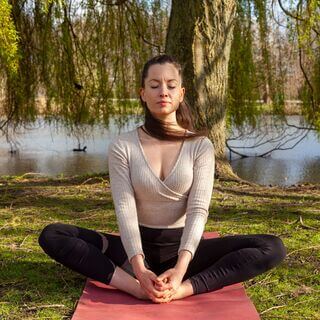
+
Mainly by shifting the nervous system toward parasympathetic dominance, the rest-and-recovery branch that lets a wound-up body settle (Sévoz‐Couche & Laborde, 2022). At roughly six breaths a minute the breath and heartbeat couple, which tends to maximise heart-rate variability, the beat-to-beat variation signalling a flexible system, alongside short-term drops in heart rate and blood pressure (Song & Lehrer, 2003), (Shao et al., 2024). The steady count also anchors attention away from looping worry. These pathways come largely from mechanism and theoretical work rather than confirmed proof, and one trial found calmer, sharper thinking without any measurable change in vagal tone (Bahameish et al., 2024).

Yes, a brief floaty or light-headed feeling can occur when you first slow the breath this far, and it usually eases as the pace becomes familiar. This is most likely a normal transient sensation tied to the short-term drop in blood pressure and heart rate that slow-paced breathing produces, not a sign of harm (Shao et al., 2024).
+
Yes. Some people feel briefly dizzy or spacey in the first minutes of slowing the breath toward six breaths a minute, likely because this kind of breathing produces a short-term dip in blood pressure and heart rate (Shao et al., 2024). This is a physiology-inferred caution rather than a safety-trial finding; no cited study reported measured harms, so treat it as an expected transient sensation that usually clears within a few breaths once you let the breath return to its own rhythm. Take extra care if you have low blood pressure or tend to feel faint: keep early sessions short and stand up slowly afterward.
Use care. Paced breathing is low-intensity and most people tolerate it well, but because it can cause short-term drops in blood pressure and heart rate, those with low blood pressure or a tendency to faint should keep early sessions short and rise slowly afterward (Shao et al., 2024).
+
Use care. This is a caution inferred from physiology rather than a measured safety finding: slow-paced breathing reliably produces short-term reductions in blood pressure and heart rate, which most people feel as settling but which could tip into light-headedness for someone whose blood pressure already runs low (Shao et al., 2024). No cited study measured fainting or adverse events directly, so treat this as a sensible precaution, keep first sessions brief, stop if you feel dizzy, and return to sitting or standing slowly. If light-headedness persists or you have a diagnosed condition, check with your clinician.
Possibly, as an add-on. In a controlled trial of 52 adults with panic disorder, slow breathing at about six breaths a minute with biofeedback reduced panic symptoms (Benedict et al., n.d.). Use it alongside professional care, not as a stand-alone treatment, and ease in gently.
+
Possibly, and best as a complement to care. A randomized controlled trial in 52 adults with panic disorder found that slow 0.1-Hz breathing (about six breaths a minute) paired with heart-rate-variability biofeedback reduced panic symptoms, a moderate effect from a small trial rather than settled proof (Benedict et al., n.d.). It was tested as an add-on used alongside professional treatment, not a replacement for clinical care of panic disorder. Because closely following the breath can heighten air-hunger, the tight not-enough-air feeling, for some people, ease in gently and stop if distress builds.
Hold the roughly six-breaths-a-minute pace for a few minutes, begin with short early sessions, and build up gradually as it feels comfortable. This is practice-informed guidance rather than a proven ideal dose, since studies confirm short-term effects rather than an optimal schedule (Shao et al., 2024).
+
Breathe at about six breaths a minute (roughly five seconds in and five seconds out) for a few minutes, easing in over the first minute or two rather than dropping straight to that slow pace. Start with short sessions and build up over several sittings, since the steadying tends to grow with repetition. This is practical guidance, not a validated prescription: the research shows reliable short-term physiological changes, while the ideal duration or weekly frequency has not been established (Shao et al., 2024).
The main difference is the display. Paced breathing means breathing at a slow, guided rate, often about six breaths a minute, using only a count, metronome, or app (Shao et al., 2024). HRV biofeedback is that same slow breathing done while watching a live heart-rate signal to steer toward your personal resonance rate. The slow breathing is the active ingredient in both.
+
The difference is a sensor and a target, not the core practice. Both rely on slowing the breath toward roughly five to six breaths a minute, the pace that tends to maximise heart-rate variability, the beat-to-beat variation that signals a flexible nervous system (Song & Lehrer, 2003). HRV biofeedback adds a real-time heart-rate or HRV display so you can fine-tune toward your personal resonance rate; paced breathing skips the device and uses only a count, metronome, or app (Shao et al., 2024). If you just want a portable way to slow the breath, the count is enough; the display mainly helps people who want a visible signal to train with, and it is not established that the feedback itself adds benefit beyond the slow breathing.
The small beat-to-beat variation in the timing of your heartbeats. More variability generally signals a nervous system that can shift flexibly between alert and calm.
Beat-to-beat variation in cardiac inter-beat intervals; common time-domain indices include RMSSD and SDNN.
The natural rise and fall of heart rate across each breath, speeding slightly on the inhale and slowing on the exhale. Slow breathing makes these swings larger.
How readily the reflex that keeps blood pressure steady adjusts heart rate. Higher sensitivity means the body corrects pressure changes more smoothly.
The slow breathing rate, roughly five to six breaths a minute, at which breath and heart rhythm reinforce each other most strongly, producing the largest heart-rate swings.
Activity in the vagus nerve and the body's rest-and-recovery branch, which slows the heart and quiets the stress response. Higher tone tends to feel like settling more easily.
Parasympathetic (vagal) influence on the heart, often inferred from vagally-mediated HRV rather than measured directly.
A steady, regular heart rhythm in which heartbeat and breath rise and fall together, often felt as the body evening out.
Two common numerical measures of heart-rate variability used in research. Higher values reflect more beat-to-beat variation in the heartbeat.
The sense of signals coming from inside the body, such as breath movement, heartbeat, tension, or temperature.
A practice that pairs slow paced breathing with a real-time display of your heart-rate or HRV signal, so you can steer the breath toward a calming rhythm.
Andreas Schwerdtfeger, Martin Josef Tatschl, Christian Rominger (2025). Effectiveness of 2 Just-in-Time Adaptive Interventions for Reducing Stress and Stabilizing Cardiac Autonomic Function: Microrandomized Trials. https://doi.org/10.2196/69582
Mariam Bahameish, Tony Stockman, Bahameish Mariam, Stockman Tony (2024). Short-Term Effects of Heart Rate Variability Biofeedback on Working Memory.. https://doi.org/10.1007/s10484-024-09624-7
Cited in: Faq, How it works, Research
Caroline Sévoz‐Couche, Sylvain Laborde (2022). Heart rate variability and slow-paced breathing:when coherence meets resonance. https://doi.org/10.1016/j.neubiorev.2022.104576
Cited in: Benefits, Faq, How it works, Research, Roots and tradition, What it is
Berenike Lisa Blaser, Mathias Weymar, Julia Wendt, Blaser Berenike L, Weymar Mathias, Wendt Julia (2023). The effect of a single-session heart rate variability biofeedback on attentional control: does stress matter?. https://doi.org/10.3389/fpsyg.2023.1292983
Cited in: Research
Guy W. Fincham, Clara Strauss, Kate Cavanagh (2023). Effect of coherent breathing on mental health and wellbeing: a randomised placebo-controlled trial. https://doi.org/10.1038/s41598-023-49279-8
Karina Dolgilevica, Elizabeth A. Grunfeld, Nazanin Derakhshan (2025). Heart Rate Variability Biofeedback Training Can Improve Menopausal Symptoms and Psychological Well-Being in Women with a Diagnosis of Primary Breast Cancer: A Longitudinal Randomized Controlled Trial. https://doi.org/10.3390/curroncol32030150
Cited in: Benefits, Faq, Research, Use with care, Who should use care
Paul M. Lehrer, Evgeny Vaschillo, Shou‐En Lu, Dwain L. Eckberg, Bronya Vaschillo, Anthony Scardella (2006). Heart Rate Variability Biofeedback. https://doi.org/10.1378/chest.129.2.278
Cited in: Roots and tradition
Herhaus Benedict, Siepmann Martin, Kahaly George J, Conrad Rupert, Petrowski Katja (n.d.). Effect of a Biofeedback Intervention on Heart Rate Variability in Individuals With Panic Disorder: A Randomized Controlled Trial.. https://doi.org/10.1097/psy.0000000000001031
Cited in: Benefits, Faq, Research, Use with care, Who should use care
van der Zwan Judith Esi, de Vente Wieke, Huizink Anja C, Bögels Susan M, de Bruin Esther I (2015). Physical activity, mindfulness meditation, or heart rate variability biofeedback for stress reduction: a randomized controlled trial.. https://doi.org/10.1007/s10484-015-9293-x
Cited in: Comparison
Robin Shao, Idy S.C. Man, Tatia M.C. Lee (2024). The Effect of Slow-Paced Breathing on Cardiovascular and Emotion Functions: A Meta-Analysis and Systematic Review. https://doi.org/10.1007/s12671-023-02294-2
Sylvain Laborde, Mark S. Allen, Uirassu Borges, Maša Iskra, Nina Zammit, Min You (2021). Psychophysiological effects of slow-paced breathing at six cycles per minute with or without heart rate variability biofeedback.. https://doi.org/10.1111/psyp.13952
Cited in: Comparison
Sylvain Laborde, Mark S. Allen, N. Göhring, Fabrice Dosseville (2016). The effect of slow‐paced breathing on stress management in adolescents with intellectual disability. https://doi.org/10.1111/jir.12350
Cited in: Benefits
Hye-Sue Song, Paul M. Lehrer (2003). The Effects of Specific Respiratory Rates on Heart Rate and Heart Rate Variability. https://doi.org/10.1023/a:1022312815649
Cited in: Faq, How it works, Research, What it is
Sakakibara Masahito, Kaneda Munehisa, Oikawa Leo O (2020). Efficacy of Paced Breathing at the Low-frequency Peak on Heart Rate Variability and Baroreflex Sensitivity.. https://doi.org/10.1007/s10484-019-09453-z
Cited in: Research, What happens in the body
Gian Domenico Pinna, Roberto Maestri, Maria Teresa La Rovere, Elena Gobbi, Francesco Fanfulla (2005). Effect of paced breathing on ventilatory and cardiovascular variability parameters during short-term investigations of autonomic function. https://doi.org/10.1152/ajpheart.00438.2005
Cited in: Research
Quentin Merlin, Philippe Vacher, Laurent Mourot, Guillaume Levillain, Guillaume Martinent, Michel Nicolas (2024). Psychophysiological Effects of Slow-Paced Breathing on Adolescent Swimmers’ Subjective Performance, Recovery States, and Control Perception. https://doi.org/10.3390/jfmk9010023
Cited in: Research
Editorially curated. Tracks are not themselves clinically studied; evidence on the page applies to Paced Breathing as a technique.