Hi,
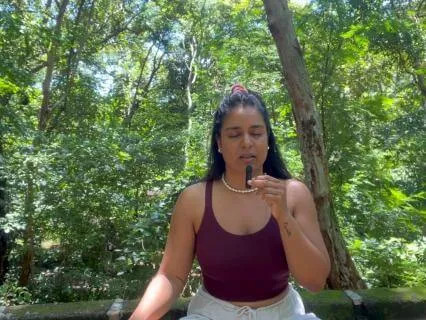
I'm Rakshita.
I'm a pranayama and breathwork instructor,
Amongst other things.
And when I tell people this,
The first question I get is,
What is the best way to breathe,
Rakshita?
And so my answer to you is breathe like a tortoise,
Okay?
We breathe slow.
We breathe even and we breathe deep.
Slow as in we're going to breathe slow,
Making sure when we inhale,
It's at a slower rate.
And when we exhale,
It's at a slower rate.
Deep meaning we're going to breathe deep into our belly,
Making sure when we inhale,
The air goes all the way into your lower lungs and then your belly expands.
Not having shallow breasts in our chest.
That's not good for our nervous system.
And even meaning the length of our inhale and the length of our exhale is even.
And this is how the tortoises breathe.
And that's why their average lifespan is between 150 to 200 years.
And this is what yogic wisdom tells us as well.
To look at nature,
Look at nature for our examples.
Look at who is the healthiest and who has the longest lifespan and be inspired by that.
That's why we have so many yoga poses which are inspired by animals in nature and to try and mimic that,
To help the flow of energy in our body mimic that so we can get the benefits from really learning and being inspired by nature.
Is inspired by the tortoise.
I'm calling this the tortoise breathwork floor.
Okay,
Well we're going to spend a few minutes.
Trying to breathe like the tortoise so we can regulate our nervous system,
So we can remove stress from our body,
So we can increase our lifespan.
And there's absolutely no restrictions for this practice.
You can do it how many ever times a day.
You can do it how many ever times a week.
It only is going to give you benefits.
Okay so.
.
.
Join me on this practice.
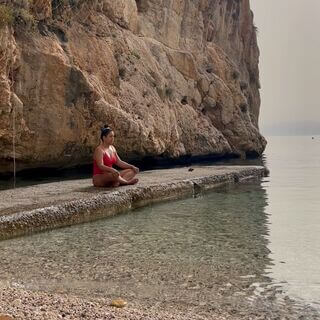
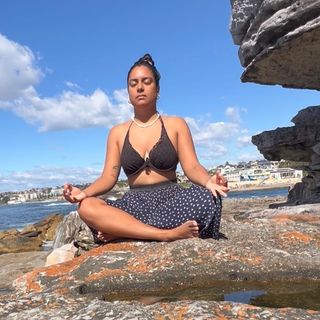
Find a comfortable seat.
Or maybe you want to lie down if you find that better for you.
And make sure you won't be disturbed for the next 5 to 7 to 10 minutes.
And so you can really drop into this breath practice.
Breathing like a tortoise.
So as you come to find a comfortable seat or lying down.
Taking the view around you.
Looking at all the elements wherever you are.
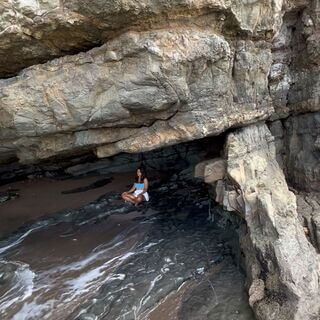
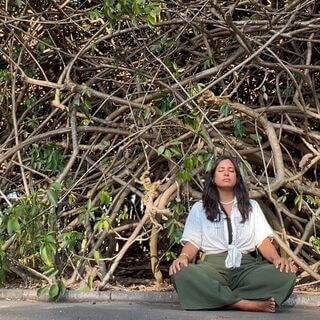
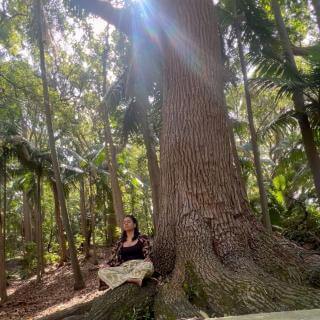
Maybe you're out somewhere in a park and doing this.
Maybe you're at home in your bedroom.
Maybe you're out in your backyard or your front porch.
Wherever you are,
Just noticing the view around you,
Taking in all the elements.
And once your eyes feel complete in noticing the things around you,
Starting to gently flutter your eyes closed.
And as you flutter your eyes closed,
Starting to drop into your inner world.
Drop into the rhythm of your breath.
Starting to relax your forehead.
The point in between your eyebrows where we hold so much tension.
So you can move your eyebrows up and down,
Up and down,
And then maybe find.
.
.
An easeful,
Restful,
Neutral position,
Relaxing the forehead.
Relaxing your jaw.
Letting your tongue rest gently over the roof of your mouth.
Relaxing your shoulders.
Relaxing your hips.
Relaxing your knees.
All the way down to your ankles.
And to the tips of your toes.
Your whole body.
Is one step deeper.
And as you come to this deeper expression of relaxation.
Starting to bring your focus and awareness and your presence to your breath.
Noticing how when you inhale your belly expands And when you exhale.
Your belly contracts.
There's nothing else you need to be doing right now for these few minutes.
So telling the mind,
Hey,
I'll come back to you.
Whatever thoughts may arise,
We're going to come back to you in a bit.
Right now.
We're focused on our breath.
Inhaling and exhaling into the belly.
Connecting with the rhythm of your breath.
Just having to slow it down.
And now,
Before we go into this breath practice,
Let's start to sync our breaths first.
Inhale for three.
To One,
Exhale for three Two.
Inhale for three.
Two,
One.
Exhale for three.
Inhale for three,
Two,
One.
Exhale for three.
Two.
Inhale for 3,
2,
1.
Exhale for 3,
2,
1.
Keep flowing like this.
Continue your inhales.
And counting your exhales.
Inhaling for 4 counts.
And exhaling for four counts.
We're practicing the tortoise breath.
Breathing even.
Breathing deep into the belly.
And breathing slow.
And if you're ready.
We're going to move to 5g.
So increasing your counts.
Inhaling for five.
And exhaling for five.
If five feels challenging for you today,
You can say it four.
Or if even four feels challenging.
We can go to three.
Just noticing where you are,
Noticing where your body is at,
Noticing where your breath is at today and honoring that.
Not adding more stress.
Not being judgmental towards yourself.
And just honoring.
Where you're at,
Observing where you're at,
And giving your body that ease.
That's exactly what the tortoises do.
They try to find more ease.
And that's how they stay stress-free.
Breathing slow.
And even.
And deep.
And if you're feeling like five is starting to feel easy,
Invitation.
To go to six.
Inhaling for six.
And exhaling for six counts.
We're slowing down our heart rate.
Moving to our parasympathetic nervous system.
Finding rest and relaxation in our parasympathetic nervous system.
Showing our body.
What it feels like.
To be in a parasympathetic nervous system.
So it knows the way here.
It starts to build safety around the state of.
Being.
If you're feeling good and you want to keep going.
Keep going,
Connecting with your breath.
Breathing slow.
Even.
And deep.
But if you're ready.
To move back into your normal nasal breath.
You can start to move back into.
Breathing normally,
Letting go of the count.
Letting go of the control of your breath.
And just letting the breath do whatever it wants to do.
Breathing in and out through the nose.
Just adding to wriggle your finger.
Starting to wriggle your toes.
Bringing your palms,
One on your belly,
One on your chest.
Just observing,
Observing how your body feels,
Observing how your breath feels.
Observing how your nervous system feels.
In just a few minutes.
This practice of breathing like a tortoise.
Making these observations,
Making mental notes of these observations.
And as you feel complete in your observations.
Starting to move your head left to right.
Bring your knees up,
Get your feet on the mat.
If you were lying down.
If you were sitting,
Starting to spread your legs out.
And then you can go grab a journal.
Go grab a paper.
And write down your observations of how you felt in this practice.
And continue this introspection on your own.
This is where I love you and leave you.
I hope you enjoyed this practice.
You can come back to it as many times as you want in a day.
There's absolutely no rules on this practice.
Whatever health issues you may or may not have,
There's absolutely no contradictions to this practice.
It just really helps increase.
Actually your lifespan.
Through your breath.
Helps you regulate your nervous system.
Helps you find more calm and ease.
I hope you enjoyed this practice.
Thank you.