Hey there everybody,
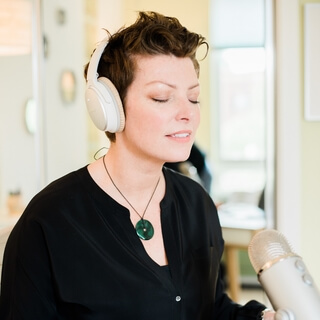
This is Kristen from Teaching Balance and I am here with this week's Mindfulness Meditation practice.
And we are currently in the month of June and our theme for the month of June is rest.
We are long overdue for some rest and some calm and of course I do record these several weeks ahead of time so I'm working with the understanding that hopefully the continued gradual bettering of the COVID-19 pandemic will very gradually,
Circumstances will continue to improve.
And so in the second week of June,
With this hope that that's what's going on and of course the assumption that most of you,
If not all of you at this point are done with your school year,
Congratulations again,
It is now time to rest.
Not that of course you shouldn't be giving yourself the opportunity to rest all the time and all school year long,
But this is the time for some deeper rest.
And so for this week,
Because I just feel like it always is useful to touch on this,
I wanted to have our theme for this week's invitation to be around the idea of sleep.
Now I know that there is so much out there about sleep and I know that you know the value of sleep.
And I also know that in spite of the fact that we know these things,
We don't always necessarily listen to our bodies,
We don't always necessarily make choices that are conducive with what's optimal when it comes to giving ourselves enough sleep.
And so I just want to put out there this invitation for you to reflect how is your sleep going and of course barring other external circumstances that may be occurring because at any time anything could be happening,
But with the hope that with the school year having concluded and with things hopefully steadily improving in terms of the pandemic,
Maybe it is time to allow ourselves to get out of that elevated state of high cortisol and the stress hormone and you know all of the escalation associated with that.
And as such,
I think there is almost inevitably going to be some sort of a resulting need for more sleep than perhaps you even typically would need.
So someone like me,
I definitely do need a good amount of sleep and when I don't get it,
It does not serve me well.
I definitely find myself feeling the effects both physically and mentally.
So you probably have a handle on how much sleep you typically find to be optimal.
And if right now you're not necessarily getting that amount of sleep,
Again barring extending circumstances like you just had a baby or something,
What can you do to structure things so that you can actually give yourself that opportunity?
And I know sometimes people get excited and they stay up watching TV or if you have kids,
When the kids go to sleep,
That's your time to have the quiet adult time where you don't have to worry about them and you might not want to miss that time.
I've talked to people who are like,
I try to stay up as late as I can because I don't want to miss out on having a lovely evening and the fun associated with that and all that.
And I get that.
And I also know that giving yourself the opportunity to get enough sleep will help you to actually enjoy your waking hours that much more.
So just thinking about that sort of thing and I mentioned a moment ago this idea of you might find that you actually need more than usual and that could just be as a result of all the intensity and the stress that you've been dealing with for so many weeks.
And so just be thoughtful about that and monitor it and give yourself permission to listen to your body and decide what it is that you need.
And if there are other people in your life who you need to work something out as far as timing and how that all works,
I would invite you to do that too,
As much as you have control over these things.
So in the interest of rest and sleep,
Let's go ahead and do a hopefully pretty restful meditation.
I'm going to get my timer going.
And we'll sit for 10 minutes.
You'll hear a chime and three at the end.
So allow yourself to find that mindful posture.
And beginning with those deeper,
Slower breaths.
And when you're ready,
Allowing your breathing to resume its natural rhythm.
And of course,
Remembering you can always return to those deeper breaths.
They're there for you at any moment.
If you'd like to invite in that quality of activating your body's relaxation response and more deeply dropping into your body.
Now,
If there's a particular anchor for your awareness that you prefer to rest your awareness on,
Go ahead and do that.
But last week,
We took a little bit of a deeper dive into breath.
So I thought we would work our way through those three anchors.
And this week,
Take a slightly deeper dive on resting our attention on the body.
So as you allow yourself to further settle in,
Typically when I am at the beginning of a meditation,
I always like to just help myself to ground in my body and tell my body feel more grounded to the earth.
Even if you're not outside on the grass,
Which I would assume most of us are not.
The earth is ultimately beneath you.
And so I'd love for you to just check in with whatever surface you are sitting on.
For me,
I'm sitting on a cushion on a bed.
You might be on a cushion on the floor or on a chair on the floor.
But ultimately,
Under the support of whatever you are sitting on or resting most of your weight on,
As I said earlier,
The earth is beneath you.
So I always like to start there.
If you're in a chair,
Allowing the contact that the bottoms of your feet are making with the ground also,
Allowing yourself to relax into that quality of support and stability.
So even as we talked about sleep earlier,
If you find yourself having a hard time falling asleep or falling back to sleep,
You might want to explore this idea of contact and support and groundedness.
And with curiosity,
Just explore what parts of your body in the bed are making contact with the bed itself.
What are the boundaries of that contact?
Where does it cease to be touching?
Just another one of those things for us to rest our awareness on,
To keep us grounded in the present moment.
And of course,
Inevitably,
Your mind is going to wander to other things that are more important than the support of your chair or cushion or bed.
And when your mind does wander,
Of course,
Knowing that there's nothing wrong with that,
It's expected.
And as you notice the thoughts,
And perhaps even if you care to,
You can identify what type of thought it is,
Say,
Mood or a memory,
A worry or a list of to-dos.
You notice it,
You look at the mental images associated with it,
Either those that you're remembering or those that you're creating.
And then once you've really seen it for what it is,
You're just going to choose not to follow it.
For this amount of time when we rest in meditation,
You're going to let those thoughts drift away.
Perhaps they'll be waiting for you when you're done.
But for right now,
The invitation is just to rest your awareness on the physical body.
Now if you'd like,
You can maintain your attention just on this quality of feeling the contact of the chair or the cushion or the bed,
Or you can expand your awareness to rest on your body in its entirety,
Feeling the perimeter of the body,
How much space it takes up,
Noticing how much of its density can you sense,
Noticing gravity.
And then you can explore internally noticing perhaps sensations in your muscles or joints or the internal organs of your torso or the muscles in your face and head,
Whatever feels easy for you to rest your attention on,
That you can notice and observe sensations.
And if you notice that some of that sensation has a quality of discomfort,
Realizing that really there's very few minutes left,
So instead of resisting that discomfort,
Perhaps allowing that to be the object of your awareness for the remainder of our meditation,
The last two minutes or so.
You don't want to feed this discomfort,
Try to make it worse or tell yourself the story about it,
But instead,
Just like with any other sensation,
What are the boundaries?
It's not your whole body that hurts,
So what are the boundaries of the discomfort if there is any,
Its qualities like sharpness or dullness?
Does the discomfort move or shift in any way?
Just allowing yourself to make these moment-to-moment observations,
Whether they are potentially displeasing or pleasing or neutral,
And just allowing yourself to notice whatever you can notice in the body.
So let's just sit for the last few moments before the bell in silence,
Observing those body sensations.
When you're ready,
We're going to just close the processor works correctly by incorporatingmable Shine.
So that is our 10 minutes.
And hopefully you're finding that this revisiting of the sensations,
Like the various anchors for your awareness,
Is a useful reminder.
And of course,
As always,
Like I said at the beginning,
You do whatever it is that you want to do.
This is just always suggestions and invitations,
And you will know,
I'm sure,
What's best for you.
So as always,
Thank you so much for taking this time for yourself,
And thank you for allowing me to accompany you on this journey.
And I will see you next week.
Take care.
Bye bye.