Hi,
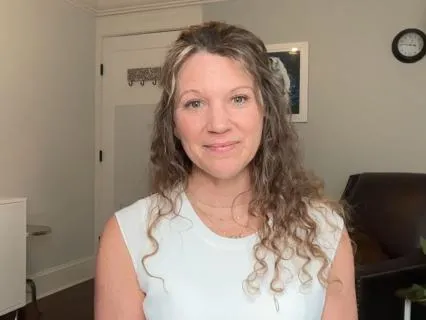
I'm Susan Guttridge.
I'm a master's degree counselor and EMDR clinician,
And I'm glad you're here.
In our previous videos,
We talked about how EMDR helps your brain organize difficult memories and how your emotional safety is prioritized through all phases of the therapy.
Today,
I want to address a very common hurdle that many people face when they begin somatic or body-focused therapies.
And that's the fear of tuning into the body.
Many of us are familiar with the way our bodies can automatically brace against strong emotions,
Whether that looks like an instantly clenched jaw or a tight stomach meant to stop the physical response in its tracks.
This is especially true if you experienced trauma or chronic stress early in life.
Your nervous system may have learned that The safest defense was to emotionally check out.
Mentally zoning out and disconnecting from your physical cues entirely because your body no longer felt like a safe place to be.
If this feels true for you,
I want to validate that that numbness you feel,
The zoning out or ability to tune out your body wasn't a mistake.
It was a brilliant survival strategy.
Your system learned to turn down the volume to protect you when the internal world felt too overwhelming.
But because of this,
Being asked in a therapy session to notice what sensation is in your body when a memory arises can feel like a lot.
You might automatically dismiss or ignore the physical cues because they feel uncomfortable or because you are used to overriding them.
The job of your EMDR therapist is to assist you in easing into noticing these sensations in a way that keeps the emotional overwhelm manageable,
Allowing your nervous system to slowly dial down that intensity.
EMDR trainer and consultant Thomas Zimmerman highlights that you are never expected to dive head first into being present with intense physical sensations.
Instead,
We use a protective,
Dip-your-toe-in metaphor approach,
Looking at a difficult sensation or memory just a drop at a time.
Think of it like testing the temperature of water in a swimming pool.
You wouldn't dive into the deep end.
You would just touch the surface with your toe and then immediately pull back to the safety of the warm,
Dry deck.
So during sessions,
We might bring awareness to a physical sensation for just a few seconds.
Curious about where it is,
Its shape.
Like a subtle constriction maybe in the throat or a tingling in the hands,
And then we immediately return our focus to a grounding tool,
A peaceful place image,
Or that safe container metaphor.
And if you glance inward and notice nothing there,
That's also information,
And it certainly doesn't mean that you aren't doing it right in our work.
That nothing or numbness.
It's not a failure to feel.
It's your body's protective shield.
And it's also a completely good starting point.
We can be curious about the numbness without needing to force it to change.
By tracking the sensations in your body in these tiny micro doses,
We teach your nervous system a new truth.
That you can notice the physical sensations without being consumed by it.
You learn that sensations are simply waves of energy passing through.
In fact,
The very word emotion includes the word motion.
They're meant to move.
They have a beginning,
A middle,
And an end.
When deeper processing begins in later phases of EMDR,
It's important to remember that if strong waves of emotion do crest,
EMDR is not causing this pain,
It's actually safely releasing it from your system.
Because these sensations have been shut down for so long,
Letting them move can bring immense relief.
And your therapist is right there to provide emotional stability and a steady anchor of safety throughout it.
If it feels as though you've spent a lifetime disconnected from your body,
Please know that healing doesn't require you to be flooded by all those sensations or by pain or to move at a pace that isn't right for you.
It simply asks us to gently and with immense compassion,
Help you relearn how to feel safe within your own skin,
One tiny moment at a time.