Alrighty,
So I'd like you to make your way to your mat if you're not already there.
And we're going to start with a centering pose.
So we're going to lie down on the abdomen and come into Makarasana.
So for this pose,
The abdomen is grounded down,
And then you can choose.
You either stack your forearms or your hands,
And then you'll just rest your forehead down.
Your legs can stay as they are with the tops of the feet on the floor,
Or you might feel more comfortable to bring your knees out a little bit and then point your toes outward.
Just start to settle in.
I'm just going to lift my head so I can talk,
But you'll continue to rest your forehead down on your forearms.
So at any point,
If this posture is uncomfortable,
You're welcome to also turn around and rest on your back in Shavasana.
But let yourself settle in.
Really allow your body to relax.
Really allow the weight of your body to be held.
Relax your shoulders and down your arms.
Relax down your torso.
Start to relax your abdomen.
And then down through your hips and all the way down through your legs.
And then without making any changes,
Just start to notice your breath.
So really start to gather your awareness.
Your mind might be more calm right now.
It might be a little bit more scattered.
But start to gather your awareness of your mind and rest it at the abdomen on your breath.
I'm just looking to spend a few minutes at the start of our practice to start to connect more fully to the breath.
You're still in crocodile.
You'll notice as you inhale,
The abdomen naturally expands,
Pressing into the support of the floor.
You might notice movement through the lower back and the sides of the ribs.
And then as you exhale,
Everything relaxes.
Start to observe the movement of the breath in the body.
As you inhale,
The abdomen rises.
You might sense that low back movement.
And as you exhale,
You relax.
And then next time you exhale,
Start to lengthen the breath.
So gradually making the breath a little bit more deep and a little bit more smooth.
And it's really a relaxed effort.
So there's a softening in the abdomen.
And you're just gently inviting the breath.
A little bit more smooth a little bit more deep And since possibly some subtle changes in the mind as you slow down your breathing.
So the breath is our primary tool for our Hatha Yoga practice.
When we begin to calm the breath it has a subtle effect on calming the mind And when we begin to link our movement to our breath,
We can gain greater access to the more subtle dimension of the breath,
Which is prana.
Is the pulsation of life force.
Animating our breath.
And supporting every cell in our body.
Begin to gently rock your head side to side,
Massaging your forehead,
Releasing the neck.
Good,
And then go ahead and,
With your knees wide,
Send your hips back.
Towards child's pose.
You can take any variation.
If the hips are really tight,
You can take more of a puppy pose,
Which is sort of a half That way the hips are sort of halfway down.
So just do what feels good,
But if it's available,
You can press the hips all the way back.
Arms are extended out in front of you.
Lengthening through the low back as you extend out through the fingers Breathe into the abdomen.
Notice there's a little bit more space here in the belly as you breathe.
Inhale,
Let's rise up to table pose.
Spread the fingers,
Ground down through the palms.
Give yourself a nice,
Stable foundation.
Begin to work through some cat-cow movements.
And really linking it to the breath.
So as you exhale,
You start to press through the hands,
Draw the chin in toward the chest,
Round the spine.
And then inhale,
Lengthen through the front of the body,
Lift the chin.
Relax the abdomen.
Just like that move with your breath,
Exhale as you round.
Inhale as you lengthen.
The eyes can be closed here as you move.
Really linking this movement to the speed of your breath.
Next inhale,
We're going to lengthen through the front of the body.
Then we're going to tuck the toes and then lift the hips up and back,
Coming into downward dog.
Keep the knees bent here and take any movements that feel good.
So for me it feels nice to pedal out the feet.
Shifting the weight from side to side.
Ground nice and firmly through those palms.
Keep lifting your hips.
Just slowly waking up the body,
Just feeling things out.
We're going to inhale back to table,
Lengthen through the front of the body.
And then exhale,
Send the hips back to child's pose.
So we'll continue in that little sequence.
Inhale brings us to table.
Lifting the chin finding length through the spine.
And then exhale,
We alternate,
Tucking the toes to downward dog.
We're sending the hips back to child's pose.
So continue just like that.
Inhaling to table.
Exhale as you alternate Really feeling things out,
Warming up the body.
Noticing where there might be places of tension or tightness.
Just to be aware,
Not to.
.
.
Be judging ourselves in any way.
Then we'll come back to downward dog and pause there.
Lift the hips nice and high.
And then you'll bring your left foot toward more of the midline of the mat,
And then inhale the right leg up and back.
So coming into this three-legged dog.
At any point,
You can rest in child's pose,
Take a break,
Really listen to yourself as you.
.
.
Continue to practice.
Good.
We're going to look forward.
On the exhale,
We're going to draw the knee in toward the nose,
Chin toward the chest,
Round the spine.
So finding some activation at the navel.
Inhale up and back into that three-legged dog.
So move just like that.
Rounding the spine.
Engaging at the navel.
You can even do this with the back knee down if that's more comfortable.
Taking any variations throughout the whole class.
Whatever feels good for you.
Next time we're going to step that right foot in between the hands.
Coming into this runner's lunge,
This extended lunge,
Back knees lifted.
And really keep pressing through that back heel and keep drawing out through the crown of the head.
So you slightly lift the heart.
And breathe.
Breathe into the hips.
Lower the back knee,
Untuck the toes,
Hands come to the thigh.
And then just a couple times,
We're just going to kind of pulse in and out of this low lunge,
Just finding.
A nice stretch so you'll likely feel this along that left side so as the front side of that left hip.
So just a little bit of.
.
.
Pulsation here And then you'll bring your hips forward as much as feels good.
And then really ground down through that front foot.
Start to draw the inner thighs together,
Just a slight movement.
And then if it's available,
You'll bring your arms overhead.
So coming into your low lunge variation.
Thank you for those hearts.
And so in this lunge,
The hips are coming forward.
But at the same time,
See if you can sort of energetically lift through the core space of the body.
So you're lifting up and out through the root,
Out through the fingertips.
You might even engage the pelvic floor if that's available,
Mula bandha.
And breathe here.
Good.
Lower the hands down.
Right hand comes to the thigh.
Left hand onto the floor or block.
Lengthen out through the spine and then engage at the navel,
That low belly,
And then from that engagement start to twist toward your bent knee.
Nice low lunge twist here Let your breath be your guide.
If your breath becomes challenged and you're unable to keep that nice flow,
Then that's when you know you need to back out of the pose a little bit.
Good.
Untwist.
Come back to center.
Inhale as you look forward.
Exhale.
Send the hips back.
Rest here for a moment.
Stretch the back of the leg here.
I personally like to keep a slight bend in the knee.
For me,
It feels good to come up onto the heel of that foot.
You do what feels good for you.
Nice.
And then take your time,
Gradually make your way back to downward dog.
So each time you come to Down Dog,
Think about perhaps lifting the hips a little bit higher,
Finding a little bit more length through the spine.
And then we'll bring the.
.
.
I'm just gonna switch sides have a little bit more room We'll bring the right foot toward the midline of the mat and come into that three-legged dog left leg comes up and back Good.
And then now,
Just like we did as you exhale,
Knee to nose,
Chin to chest.
See if you can find a little bit of engagement in the core space of the body.
Smooth with your breath.
Building some shoulder strength.
Building some activation at the core.
Eating up the body a bit here.
And then next time you come forward,
Let's step that left foot in between the hands,
Finding the runner's lunge here on the second side.
So back knees lifted,
Heart is slightly lifted as well.
Breathe.
Notice how things might feel a little bit different than the first side.
Good,
Back knee comes down,
Untuck those back toes.
Hands come to the thigh.
And then just like we did,
Just a few.
.
.
Few rounds just kind of bringing your hips and pelvis forward.
Just being mindful of that front knee so the knee is over the ankle.
So we're just trying to find what's that place That feels good for us.
And then just kind of maybe move into that just a little bit more.
So expanding.
Through our comfort zone just a bit And then when you've found that place,
Ground down.
That front foot And then bring your arms up,
Finding your low lunge here on the second side.
And so same thing.
See if you can sort of create a little bit of lift while your hips come forward,
But then you create a little lift through the core space of the body.
You might do that through some pelvic floor activation.
A little bit of drawing in at the navel.
Then reaching up all the way out through those fingertips.
Good left hand comes to the thigh right hand comes down Inhale to find length.
Exhale,
Engage at the navel.
Let that engagement help to twist the torso toward the bent knee.
Nice twist here.
As you're ready,
You can release.
Actually,
Sorry.
Extend that front leg on this side as well.
So you'll send the hips back and.
.
.
Find a little bit of length along the left leg now.
This can be a really small movement if this leg doesn't need to be straight.
Just looking to get into the hamstring a bit.
Good.
And then now,
As you're ready,
You'll find your way back to down dog.
So finding that navel activation again as you exhale,
Engage.
Draw your belly in toward your spine.
And as you inhale,
Release.
Do that a couple times.
Engage as you exhale.
Release as you inhale On this next engagement,
We're going to engage.
And then from that place,
See if you can start to bring the weight of the body forward.
Shoulders will come over the wrists.
You may need to lower your knees.
Finding this plank position here.
Pressing through the heels.
Keep some activation at the core.
Then you're going to lower your left knee and then slide the lower leg behind you so you sort of kickstand that foot behind you.
I'll show you what that looks like on this side.
The knee,
You're on your knee and then the kickstand is sort of behind you.
Then you'll extend the opposite leg.
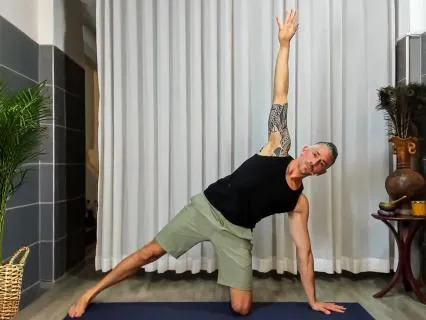
So we're coming into this supported side plank here.
Extend the top arm.
Breathe here.
Now if it's available and you want to,
You can make this more of an active side plank.
So you can stack the ankles.
In both variations,
Just make sure to continue to keep lifting through the hips.
And then we're going to bring that top arm forward,
So along the top ear,
And then reach.
Just keep extending through those fingertips.
Nice.
You'll slowly.
.
.
Come back.
Lift the hips,
Come to downward dog.
And we'll do the same thing on the second side.
So on the exhale,
We're going to engage,
Let that engagement help to bring us forward.
So coming into this plank pose.
Let's hold plank for a bit,
Just a few rounds of breath.
And then that side plank,
So lowering the right knee.
Extend the lower right leg behind you,
Extend the left leg Open up the top arm.
This is a really nice variation.
It's one of my favorites.
It's a really easy way to start to get into the side body,
Especially when you start to bring that top arm.
Forward you can really feel yourself creating length from the waist all the way up that side body And only if it's available and feeling good and you can maintain a steady breath,
You might take the active variation as well.
When you're ready you can release your way down.
Finding your way in downward dog.
Take your time.
Start to walk your hands toward your feet.
Nice and slow.
Eventually you'll make your way to a forward bend.
Relax your head.
Really release the weight of your shoulders.
Breathe into your belly.
Find that nice breath rhythm,
Nice and smooth and even.
Just like you had in your crocodile pose.
Feet are about hips distance apart.
We're going to bend the knees.
Keep the hips back.
Weight of the body is more in the heels.
Inhale,
Arms overhead.
Coming into chair pose.
Utkatasana.
Breathe here.
Think about without moving the heels,
You're sort of.
.
.
Drawing the heels toward one another feeling some activation through the inside of the legs.
Inhale,
Arms overhead.
Exhale lower the arms down A few more of those.
So inhale arms overhead.
Exhale,
Sit the hips back.
Keep the knees bent.
Coming into chair pose.
If you need to,
You can bring hands together at prayer or bring your hands down to your hips.
Just breathe here.
Notice.
How quickly the body changes.
You'll feel the body temperature increase.
But also the mind,
Right?
The mind just wants to run.
Just notice.
Good,
Exhale,
Fold forward release down Inhale,
Halfway lift,
Reach up through the crown.
An exhale fold.
Inhale,
Soften the knees,
Rise all the way back up,
Arms overhead.
Exhale,
Release the arms.
So we'll do one more of those.
Inhale,
Arms overhead.
And then exhale as you sit the hips back.
So finding your chair pose.
Seeing if you can really use this as an opportunity to expand your comfort zone just a bit so it's going to be uncomfortable physically,
Mentally.
You're probably.
.
.
Yeah,
Not wanting to be in this pose necessarily,
And I promise this is the last one.
See if you can use this as an opportunity to expand.
Really good.
Slowly take your time,
Release down.
Inhale,
Halfway lift out through the crown of the head.
Exhale,
Fold.
We're going to rise all the way up arms extend Exhale,
Hands release.
Really nice Just take a slightly wider stance.
Without making too much movement,
Too much disturbance in your body.
And then bring your awareness inward,
So soften your eyes,
Close your eyes.
Find your breath.
Notice.
If your heart rate has.
.
.
Increased.
Gradually lengthening your exhale deepening your inhale Sense the floor underneath you.
You're nice and supported under your feet.
This awareness on your breath for the length of your inhale your palms face up your arms sweep out and overhead And for the length of your exhale,
Your palms face down,
Your arms alongside the body.
Continue just like that.
Length of the inhale arms sweep overhead length of the exhale arms relax alongside the body And so the focus and the awareness is on the breath.
And perhaps even beyond the breath,
The more subtle aspect of the breath.
Sensing that flow of energy that is supporting every limb of your body.
Just like your breath is smooth and even without any pause,
Same thing.
Your movement is smooth and even.
Without any pulse.
Lower the arms keep the arms lowered And resist any temptation to move.
Or adjust your clothing in any way.
So find absolute stillness next time you lower your arms.
Just simply relax.
Pause for a moment.
And just notice your experience.
Notice.
Your inner world.
Notice how you feel.
Sensing once again that connection.
The floor underneath the feet.
And if it's comfortable,
You can bring your hands together at your heart.
Feel the connection between your hands.
Uniting the left side and right side of your body left side is the more feminine.
Lunar energy.
Right side is the more masculine solar energy.
Each of us is a combination of both.
Just taking a brief moment to honor all of yourself exactly as you are.
You can relax your arms down and open your eyes as you're ready Let's bring the fingertips onto the shoulders.
And start to make some circles.
Just big circles.
Feel free to move your head and neck if that feels good.
But use the breath.
These are simple movements.
But as you inhale,
Use the uplifting,
Expansive quality to open.
And then as you exhale,
Use that relaxing and releasing quality to release down.
It feels natural you can bend the knees a bit.
Even though it's a simple movement,
We're still aligned with the breath.
Opposite direction Nice,
Slowly release the arms.
Give yourself some room and begin to sweep your arms.
So for me my lower body just naturally sort of rocks.
A little bit coming up onto the heels.
So just see what feels good for you.
If you inhale your arms up,
Exhale,
Sweep your arms through.
So just find it.
Nice rhythm here.
Allow your joints to be nice and heavy,
Your shoulders,
Your elbows,
Your wrists.
Feels good.
You can start to cross the arm,
So coming back towards center.
Switching which arm is on top each time Really opening through the chest here.
Helping to improve circulation in the body.
Come back towards center.
And then standing up nice and tall,
Starting with the elbows,
Twisting from the base of the spine.
We're going to twist.
And as we twist,
We lift up the opposite heel.
This keeps protection for the low back and the knees.
Spy nice and long,
Find a nice twist.
Then you can start to extend that opposite arm if that feels good.
Really nice.
Come back towards center.
And then let's just shake out the body a bit Check out the wrists.
Shake out the legs.
Leave them look a little silly.
It's all good Go with any more attention.
If this is the morning,
Shaking away any of that inertia that might be there from your sleep.
Keep breathing deeply.
Come back to center once again.
Find your mountain pose,
Tadasana,
So hips,
Excuse me,
Feet about hips distance apart.
Really ground down through the feet.
And then extend all the way up through the legs,
Out through the spine and the crown of the head.
Nice and long.
Shoulders relax.
Any comfortable hand position?
Arms alongside the body.
You can tuck the chin in just ever so slightly,
Find some more length in the back of the neck.
Just notice the experience of being in this standing posture.
You can draw in at the navel just a little bit,
Lengthening the low back.
If you're familiar with the pelvic floor,
You can activate just ever so slightly,
Find a little bit more.
Energetic support So this standing pose really is the foundation for all other standing poses.
Just take a mental snapshot.
Remember how this feels and we'll try to Come back to the same place,
But in a slightly different variation.
Allow the eyes to open and make your way to the front of the mat.
So with the feet separated a bit,
We're going to just take a nice big step back with the right foot.
So your feet are almost.
.
.
Kind of toward either edge of the mat and then you'll bend into that front knee.
So hips are square to the short edge.
If it's more comfortable,
You can lift up that back heel coming into more of a high lunge.
But we're preparing for Warrior I,
Virabhadrasana I.
And that feels good.
You can inhale your arms up.
Keep bending through the knee.
Just like we did in Mountain Pose,
Find a little bit of engagement.
The navel.
Reach out through the crown of the head,
Relax the shoulders.
So it's that same energetic alignment.
Happening,
Just a different position of the arms and the legs.
As you exhale now straighten the front leg,
Lower the arms.
Inhale back into warrior.
So do that a couple times.
Exhale as you release.
Inhale as you come into the pose.
Next time we're going to stay in the pose.
Good.
Hands can stay where they are.
You can bring hands to the hips.
You're going to bend into that front knee.
Start to shift the weight into that front leg.
So we're going to prepare for a balancing pose.
So you can perhaps just kind of gracefully make your way up.
Maybe coming into a warrior three.
Maybe your hands come down onto blocks or onto the floor,
Finding a standing split variation.
So you decide.
Just come into a nice balancing posture on that left leg.
Good.
Take your time.
We're going to lower the back leg,
Finding our way into our warrior position.
Then release the arms and step the back foot forward Good.
We'll do the same thing on the second side.
So left leg.
Straight back,
Nice,
Big wide stance.
Hips are square to that short edge.
If that's a challenge,
You can bring that back leg out a little bit more.
That'll help to give you a little bit more space in your hips.
Bend into your front knee.
Good arms come overhead warrior one Exhale we're going to release the arms straight in the front leg Inhale.
Rise up into warrior Just like that,
Moving with your breath.
Nice and steady,
Nice and easy.
Find your warrior.
Stay there.
And then now you know where we're going,
So maybe this time a little bit more easeful.
You start to come up onto the toes of the back foot.
Shift that weight forward as much as you can.
And then.
.
.
Find any version.
Maybe it's a warrior three or a standing split.
You might have your arms extended.
I don't quite have the room where I am,
But hands at the heart center is a really good option as well.
If you're in this warrior three,
Keep lifting up through that back leg,
Extending through that back heel.
Relax the shoulders.
Going to take our time slowly lower down finding R.
Virabhadrasana 1 once again.
This time we're going to send the hands down,
Step the feet back,
Coming into downward dog.
Really nice.
We're going to make our way to table pose.
So if there's any issues with the knees,
If you have a thin blanket,
You can use a blanket there.
Bring the awareness inward,
So allow the eyes to close.
Neutral spine to start off.
Rather than the focus being on the spinal movement,
We're going to work with that squeeze and release at the navel.
The yogis call this the pranic center of the body.
So really working to.
.
.
Wake up prana,
Help to strengthen our digestive fire here at the navel.
So your awareness is there.
As you exhale,
You're going to engage.
You're going to draw the belly in toward the spine.
Slightly rounding the spine,
But not a full cat-cow movement.
And then as you inhale,
You release the abdomen.
Bring the spine in the opposite direction it's a little bit of spinal movement But for the most part,
Really the focus is on the activation as you exhale.
Draw the belly in.
And release as you inhale.
Just like that continue Engage on the exhale.
Release on the inhale The awareness stays right there at the navel.
We were able to also impact prana with our awareness so where the awareness goes the prana flows You're familiar with pelvic floor work,
Mula bandha.
You can perhaps start to explore a little bit with.
.
.
Adding.
As you exhale,
You might start to gently find a little bit of lift through the pelvic floor as you draw the belly in.
Inner thighs draw in.
There's a gathering all at that navel.
And then on the inhale,
Everything relaxes in the reverse order.
Continue to explore It's a new.
.
.
Exercise,
It might seem a little strange.
Trust in the power of your own.
Your own body.
More than just the physical body,
Also this energy body.
Tapping into our.
.
.
Own place of power and personal will right here at the Naval.
Increasing our capacity for transformation.
Slowly come back towards center.
Let's just take a moment to rest.
So send the hips back,
Knees wide,
Come to child pose.
You can take any arm variation.
Maybe you stack the forearms.
Just breathe into the space of the belly.
Slowly unwind and make your way to a seated posture.
Start with the legs extended out in front.
You're going to bend the right knee,
Place the right foot on the floor.
And then you decide.
You see what feels good.
Either stay with this.
This is a great option.
If it's more comfortable you can cross that foot over the extended leg.
Stay there if it's more comfortable you can bend that extended leg bringing the left heel toward the right hip Every one of those feels good in your body.
You're going to sit up nice and tall.
Left arm wraps around the right knee.
Inhale lengthen through the spine Exhale,
Engage at the navel.
Let that engagement help to guide your twist.
The right arm can come behind you for support.
Breath is nice and relaxed.
Each time you inhale,
You might think about creating a little bit more length.
Keep reaching up to the crown.
Take your time gradually unwind Uncross the legs.
We'll keep that left leg extended out,
So same side,
But now the right foot is going to go on the inside edge of the left leg.
Feel free to keep a bend in that extended leg or you can extend out through that leg.
Inhale Lengthen,
Exhale.
From the heart,
Start to walk forward.
So keep your spine nice and long.
Reaching forward.
Far as feels comfortable And when you've reached your capacity,
You release your head and your neck.
Moving to this head to knee pose,
Janu Sirsasana.
Notice where you're feeling any tension.
Invite the breath to help to release any of that tension.
As you're ready you can walk your way back up.
Then we'll switch sides both legs extend Bending the left knee,
Left foot comes onto the floor And then either variation.
For me,
I like to cross that leg and then fold that bottom leg as well.
It just sort of depends on your flexibility and the proportions of your body.
You're going to inhale and lengthen.
Right arm clasped to the left knee.
And then as you exhale twisting from the base.
Nice twist with that bend knee.
So same thing.
Anytime we're in a twist,
Really looking to keep.
.
.
Vertical spinal alignment so keep reaching up through the crown Breath is still smooth and even.
Take your time as you slowly unwind.
Extend both legs.
Now the left foot comes to the inside of the right leg.
We'll find our head to knee pose on the second side.
Nice inhalation,
Nice length out through the crown.
And then as you exhale,
Almost as if you're just being led from the heart.
Only make your way forward.
It might just be a really small forward bend for you.
But when you've gone as far as you can,
Then you'll relax your head and your shoulders.
And remember,
The right capacity of any pose is the one where your breath.
.
.
And remain effortless.
Once we've lost that effortlessness in the breath,
Then we know we need to back out a little bit.
Take our time as we gradually expand into the posture.
We're going to slowly unwind,
Come back up.
Bring the bottoms of the feet together now.
You can explore a little bit,
Bringing the feet either closer to your body or further away.
Then you choose either just relaxing here.
If you need to use blocks for a little bit of support,
Feel free to do that.
But you'll just gradually let the knees relax down toward the floor.
And you might stay here.
You might feel nice to kind of hinge forward a bit.
It feels good.
Release your head and your muscles.
And breathe.
Likely feeling this more on the.
.
.
Inner thighs,
The groin.
Just breathing with awareness there.
We'll come back up towards center.
And then let's make our way down.
So you'll come make your way onto your back.
I'm just going to adjust my microphone here sometimes on the back.
It starts to.
.
.
Mess up a little bit so if there is any issues you can kindly just let me know but we're going to bring the um The feet down onto the floor,
Knees are bent.
Arms are alongside the body.
And then coming into a bridge variation.
So we're going to start to press through the feet,
Lift the hips up toward the ceiling.
We'll just come in and out of that just a couple times so you'll release your hips down.
We'll do that a couple times.
So press through the feet,
Lift the hips up.
So legs are really active,
Hips are driving straight up.
For the ceiling Legs and knees stay hip distance apart.
And then if it's comfortable you'll press through the hips this time you'll keep the It's extended up.
So there's still an opening for the chest.
Legs really active,
Pressing up.
And maybe if it's available from here,
You start to.
.
.
Roll your shoulder blades together,
Possibly clasping the hands underneath you.
And breathe here.
Take your time.
Slowly unwind.
Come back down to the mat.
Bring the feet nice and wide now.
And then start to lower the knees from side to side.
So both knees in one direction.
Back to center.
Both knees in the opposite direction Come back to center.
Left leg extends out in front of you.
And then just go ahead and draw that right knee into the body.
Nice stretch.
Shoulders stay relaxed.
And breathe.
I like to kind of bring the knee a little bit out to the side,
Not too much,
Almost like I'm trying to.
.
.
Place that right knee under the right arm.
Activate the left toe so you're active through that left leg at the same time.
Inhale,
Extend the right leg up.
Clasp the back of the thigh,
If that's available.
And then perhaps start to draw the leg in toward the body.
Feel free to bend the knee as much as you need to.
Feels good.
And then just begin to circle.
Nice circles with the ankle and the foot.
Both directions bend the knee,
Release the leg.
Pause for a moment and just relax.
The moment you.
.
.
Check in with your left and right side.
Noticing some subtle differences there And then we'll switch.
We're going to bring left knee in toward the body.
Right leg extends,
Right foot is active,
Pressing out through that heel,
Shoulders relaxed.
Same thing on the side.
We'll extend that left foot toward the ceiling.
Plasming the back of the leg.
Nice opening for that hamstring.
And as it feels good,
You can circle at the ankle.
Throw these down.
Bring both knees in toward the chest.
Bring your chin in toward your chest,
Lifting your shoulders.
And then we'll release all the way down,
Extend the legs.
And come into shavasana so coming into your your final resting position here And take as much time as you need to get comfortable.
That might mean also adjusting your space,
Dimming the lighting.
Maybe putting on more layers of clothing.
You stay where you are.
I'm just going to sit up.
That way I can guide you a little bit more clearly.
Resting in your shavasana Really do your best to.
.
.
Allow the full weight of your body to completely relax into the floor.
And then also release any effort in your breath.
So your body and breath are completely relaxed.
And completely supported without any effort.
Eyes are closed.
Just take a moment here in stillness to notice how you feel.
Thinking back to perhaps.
.
.
The state of your mind,
The state of your body before.
You signed on here onto Insight Timer.
Is reflecting and then noticing Where you are right now,
Noticing how you feel.
As a way to integrate and deepen the nourishing effect of everything that we've done.
I'm gonna guide you now through a relaxation.
So you'll stay just as you are in stillness in your Shavasana.
I'm going to call out points on your body.
He's chronic.
Pools of pranic awareness.
And,
You know,
Simply as I.
.
.
Call out these points.
You'll simply bring your awareness to those spaces.
And just breathe.
Effortlessly into those spaces.
Starting first at the very top of the head,
The crown of the head.
Relax and breathe.
Then allow that relaxed awareness to travel down.
Softening all the muscles of the face And then resting awareness at the center of the mind.
Allow your eyes to get nice and heavy.
Relax your tongue.
Travel awareness down to the throat center.
And breathe into that space.
Relaxing.
Across the collar bones to your shoulders Down your arms to your elbows.
And your wrists.
Palms of your hands.
And the tips of your fingers.
Back up the arms,
Starting at the wrists.
Elbows shoulders Center of the throat.
Relaxed awareness traveling down.
Resting at the heart center Breathe into the space of the heart.
As you inhale the body is nourished.
As you exhale the body is cleansed It's those Beautiful qualities of the breath,
The nourishment on the inhale.
Cleansing on the exhale Allow that awareness to travel down into the abdomen,
Relaxing the belly.
Softening through the hips the knees,
The ankles.
Soles of your feet.
And the tips of your toes Back up the body to the ankles.
Knees.
Hips abdomen Art Center.
Throat center.
Eyebrow Center and the crown of your head.
Become aware of all of these points on your body.
And allow your breath to fill this entire space.
Each inhale energizing every cell of your body each exhale cleansing every cell of the body Start to sense that the whole body is breathing together as one.
Deeply nourished and cleansed with each breath.
And you just stay with the awareness of your breath.
Sensing that more subtle dimension of the breath.
That energetic dimension,
Which is prana.
Divine.
Intelligent force that supports our entire life.
Nourishes Protects.
And guides us on every level.
Take your time.
No rush.
As you're ready,
Slowly deepen your breath and begin to invite small movements.
In the hands and the feet.
It might also feel really nice to reach your arms overhead.
Stretching out the length of your body.
And maintaining that inward sense of focus and awareness.
You'll make your way onto your side.
Enjoy resting in the fetal position for a few rounds of breath.
Really sensing the nourishing quality of that posture.
And then keep that inward focus,
That inner awareness.
Use your arms,
Press yourself up.
Find a comfortable seat.
One that is suitable for meditation.
Might be sitting up on prop or a block Maybe even sitting in a chair.
Spend at least five minutes in a seated posture.
For me,
I'm going to sit up on a block here,
Give myself a little bit more.
Room for the hips So once you've found your seat Sit up nice and tall,
Really lengthen out through that spine.
Allow your eyes to close,
Allow your shoulders to relax.
Take the first few moments to keep settling in.
Adjust the body as you need.
Looking to align the The spine,
The head,
The neck Trunk.
And gradually we're moving towards stillness.
Excuse me.
It starts with the body.
Relaxed and non-rigid kind of a way.
When the body becomes still,
There's a.
.
.
Deeper sense of stillness that starts to arise from within.
Reverse stillness you're able to access.
Breathe effortlessly into that stillness.
Bring your awareness to your breath.
Notice.
How easy and smooth and effortless your breath is.
May even be into a sense that Your body breathes.
And that you are simply the observer.
You are the witness of that experience.
Continue deepening your awareness of your breath.
Sense of stillness And as you do that,
Also gradually Soften and relax the body.
The spine stays nice and tall.
Face the arms the legs Everything Nice and relaxed.
And allow those qualities So you continue to.
.
.
Deepen and expand with each breath.
Sense of stillness that sense of relaxed effortlessness.
All fully supported by the flow of the breath.
Which is fully supported.
By the power of prana.
Krana Shakti.
Allow awareness to travel up to the opening of the nose.
Begin to sense the breath here With each breath,
Sensing that Gentle touch of breath.
Flowing in and out of the nostrils.
Gradually finding that that place where the two worlds merge,
That inner and outer world.
Right there at the opening of the nose.
Keep resting your awareness there.
As you breathe there If you can begin to sense the more subtle dimension of the breath.
Tapping into that pulsation of prana which is the subtle essence of the breath.
Anytime the mind wanders off in thought.
Just really playfully,
Effortlessly.
Bring it back.
So that space at the opening of the nose.
Let that be the anchor Relax that effort.
Just sit for another few moments in stillness.
And once again,
Notice your experience.
Notice the effects of your practice recognizing that anything that you've created here together has come from within you.
Always accessible.
Through the breast.
Breath align movement relaxation and meditation Bring hands together at the heart.
Gently bow the head toward the heart a moment to Honor that divine life force that keeps us alive.
Honoring yourself or taking care of yourself in this way.
Through your practice.
Honoring.
All the other folks in this class Rub your palms together.
Warm up the hands.
Comfortable.
You can cover your eyes with your palms.
Slowly open the eyes into the palms.
Release your hands down as you're ready You all have a wonderful day.
Namaste.