Hi and welcome to your practice.
So this class is specifically designed for anyone who has experience.
Anything challenging to do with their health.
So things like fibromyalgia,
Chronic fatigue syndrome,
Whether you're in burnout or if you're just physically and mentally exhausted,
Then this practice is going to help you find a bit of space just to soften and to feel supported more than anything.
We're not going to be doing much movement at all really,
The only movement we will be doing will be to set our body position up into one posture and then when we arrive in that posture We're just going to work a little bit with some eye movements.
We're going to work with the breath.
And just where we're placing our attention.
Now I understand that sometimes bringing our attention into the body,
As yoga often wants us to do,
Can be a very uncomfortable process when we have been living with things like chronic illness.
So I just want to remind you before we begin that if you've been going through a flare up or having a particularly challenging time with your body,
Then you don't need to place your attention in there if it's going to be too difficult for you.
You can place your attention elsewhere.
You can place it on the sounds.
You can place it even into disassociating.
You know,
Sometimes we're told that we need to be fully present all the time,
But it's a lot more complex than that when you're working with chronic health conditions.
So I'm going to give you permission to just be in the space in however you present.
I'm going to give you permission to disassociate if you need to.
Because sometimes that is what we need in order to feel safety and support within our body.
So that will be our practice today.
Now I have a lot of props around me that I'm going to be using.
These are specific yoga props of course.
I've got a bolster here,
I've got a blanket,
I've got a couple of cushions from my sofa and I've got a different,
Several different sets of blocks.
Now if you don't have all of this equipment available that's okay,
You can modify your position to basically any space where you feel comfortable.
That might be sat in a chair for this,
It might be sat on a sofa,
You might be lying on the floor,
You can even do this in bed.
Ideally,
If we can,
We want to be lying on the back in a supported way.
But as I said,
It's more important that you feel comfortable in your body so that you can just find a bit of safety and a bit of support.
So if you have similar props available,
Or even if you don't,
If you don't have a bolster,
A couple of cushions or rolled up towels or blankets made into this sort of shape can work just as well.
So if you need to pause the video,
Go ahead and grab whatever it is that you need.
Bring as much as possible so that we have prepared ourselves and then we'll come back to it.
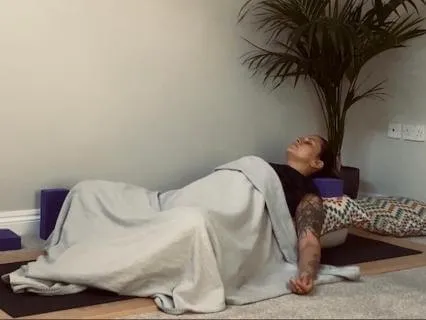
So I'm going to set myself up with a bolster down the center of my mat and then I know that I like to have a bit of extra height onto my bolster here.
From there,
I'm gonna place.
A block here.
Now,
What we're going to do is we're going to come to bring our lower back as close to the bolster or cushions as we can.
And then we're going to lie back.
So of course we want to feel supported here.
We want to make sure that the height between our buttocks and the floor,
And then our back leaning onto the bolster isn't too low or too deep of a back bend.
So having this block here for me is better because I'm not so low to the floor.
Now here my neck doesn't feel great so i'm going to place something else underneath my neck for support.
Now my spine feels like it can really soften into the posture.
And then there's the legs to think about.
So there's a couple of options here.
We can just have the knees touching into the centre and the feet slightly wider.
You can straighten your legs out.
You can have your feet a little bit bent.
Or if you'd like to try something else where we open up the hips.
Again,
I need some blocks.
And then I'm gonna bring the soles of my feet together.
And just drop the knees out to the side.
Now I'm placing these blocks underneath my thighs so that they have something to rest against and feel supported.
Now,
It's really important that you take as much time as you need.
Get comfy in the position because this is where we will be for the remainder of the session.
So I'm going to give you some time now to get settled.
And really don't be afraid to kind of pack out your support here.
If you have that available and if you don't have blocks.
For your legs,
You can have cushions underneath.
And again,
A rolled up blanket might work well underneath the head if you don't have any of these bricks available.
And there is also the other option here to cover yourself with a blanket.
Coming into autumn time now.
You might not be watching this in autumn time,
But that's where we currently are as I'm filming.
So it might be nice just to cozy up under a blanket.
Now what might be even really,
Really nice if you have one at home is a weighted blanket.
These can be very calming for the nervous system.
Okay.
So again,
Just taking your time.
Moving with care and attention as you come into your position.
And then with your arms,
Just let them come out to the sides and fall naturally so that gravity takes the weight of the shoulders down.
And we might feel a gentle opening of the chest here.
Okay,
So hopefully you have found your position.
That you feel comfortable to be in.
And there is the invitation to bring some stillness to the body,
But understandable if that doesn't feel accessible today.
Don't pressure yourself to have to stay still.
Allow yourself just to move and wiggle around so that you can find comfort and ease.
And that's the invitation to close the eyes.
Or you can just keep them open.
Often if we have been feeling discomfort in our body or if it's been a challenging time,
Then closing the eyes can feel overwhelming.
So keeping them open allows us to see what's around us.
And it can just minimize the sensations in the body,
Especially if they are uncomfortable.
Again,
It's kind of the opposite of what we would normally do in a yoga class.
But we need to adapt to where we're at.
We need to make the practice for us.
So choose the best option for you.
Just give yourself some permission to settle into this space.
Hopefully you're feeling somewhat supported by.
.
.
The props and your body position.
And then we'll take a moment to soften the forehead.
Let's see if you can release all of the muscles up in the forehead and in the temples.
And then letting the eyes just sink back into their sockets.
Softening the eyelids.
And then releasing the cheek.
And then from here,
Just open your mouth slightly and wiggle your jaw side to side.
Loosen it off.
And then let it return back to its natural position.
And then notice if there's any holding in the neck area and the shoulders.
See if there's any more space to soften there.
And then let your back sink down into the support below.
So I'm going to give you two options now depending on how your body's been feeling and whether or not you have the capacity to do so today and it's absolutely fine if you don't.
We'll either bring the attention into the body and just notice any sensations that are there.
But if that's not okay today,
Then I'd like you to focus on sound.
So we're just extending the attention outwards instead and noticing the sounds in the environment.
And all we're doing here is just placing our attention on something so that we can focus the mind.
And now we'll bring attention to the breath.
Just noticing where you feel it.
Again,
If that doesn't work for you,
If it feels too much of a challenge,
Just keep focusing on the sound.
It doesn't matter whether you focus on the sound or whether you focus on the breath,
What matters is that you're just here.
In this space.
And giving yourself this time.
Maybe it feels okay to start to make the breath a little longer in length.
We'll keep breathing through the nose as we do this.
And if that doesn't feel okay,
Just allow the breath to move in any way that it wants.
We'll take a few more slow breaths.
Now if that felt good in your body,
Then you can continue breathing in that way.
If you need a rest then just let it move naturally.
And now we're going to keep our head still,
We're keeping the rest of the body still or just fidgeting gently.
And then the only thing we're gonna move now are the eyes.
So just take your gaze over to the right side.
Head stays still,
But gaze goes over to the right.
We keep it soft,
We keep it steady.
And we'll just stay with the eyes here for a little while longer.
Okay,
Now just changing the eyes,
Looking over to the left side now.
Head stays still.
And if you notice any shifts or changes in your body,
And just stay with that.
If you feel the urge to yawn,
Let it out.
Couple more seconds on this side.
We change the gaze again,
Going over to the right,
Nice and slow.
And then one more time over to the left side.
Good and now bringing your eyes back to the centre.
Maybe just looking up at the ceiling or closing the eyes and just giving them a little rest.
A reminder that if you need to move your position at any time,
Please do.
You're not obliged to stay.
This is your practice.
Okay so you can keep the eyes closed if they are or open them again you choose.
Bring attention back to the breath and just start making it slower and longer once again.
What can be useful here is to really focus on slowing the exhale down.
That will help calm the nervous system.
And take us into that parasympathetic side where the body often feels more rested.
And I say more rested,
But this is on a physiological level.
So whilst mentally we may still feel exhausted.
And the body of course may still feel exhausted coming into that state of the nervous system.
Will have other benefits,
So the breathing will slow down further,
The digestion will work a little bit better.
And some of those feel-good hormones will be released such as our oxytocin and dopamine and endorphins.
Now just to help with that process we are going to Take some hums now.
If you have an eye pillow and if you'd like to shut off the light from your eyes you can place it over your eyes now.
Again,
There's the option to keep the eyes open or closed as well.
So,
Breathing slow,
We're going to take 10 hums on the exhale.
You want to try and make the hum as long as you possibly can.
I tend to have quite a long hum,
So I'm going to shorten mine a little bit for the purposes of this class and video.
You can go at your own speed or you can hum along with me.
And when you're done,
Just allow yourself to rest in the space once again.
So when we inhale,
We'll take that nice and slow into the abdomen and the ribcage.
And then begin your hums on the exhale.
You Aum.
Mmmmmmm.
Mmmmmmm.
Mmmmmmm.
Aum.
Mmmmmmm.
Aum.
Mmmmm.
Aum.
When you've completed your hums again,
Just be in the space.
And now we'll just take a few minutes of quiet.
If you can,
Just stay still in your position.
Maybe it's feeling okay to focus on the natural flow of breath,
Or again,
Just bring attentions to the sounds in the environment.
Stop bringing your attention back into the room.
And we're going to slowly release our position.
So start by just moving your fingers.
Maybe your wrist.
And we can take a deeper breath and just.
.
.
Stretch as we slowly bring ourselves out.
Nice and slow,
Bringing the knees back up to the centre.
If you've had your knees wide then touch them together and take your feet slightly wider and just pause there for a moment.
And then we'll use our hands to support ourselves.
Slowly coming up.
And out of our position.
So just a moment to close the practice.
So just take a moment to acknowledge.
That you had the strength and the courage to show up today and come to practice.
That is something to be proud of.
Thank you very much for joining me.
And I'll see you next time.