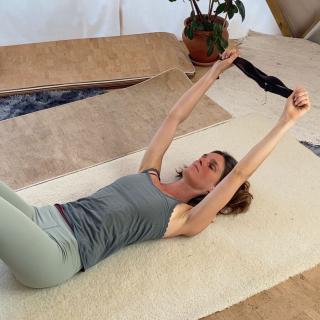
So come lying on your back,
Placing your feet on the ground.
Having the knees bend.
And your hands can rest on your pelvis,
On your belly.
Or you can have your arms alongside your body.
Whichever is most comfortable for you.
You can place your feet a little bit wider than hip width apart.
And allow the knees to drop in.
Or you can keep your feet and knees at hip width apart.
And allow your legs to rest like that.
And this position is called constructive rest.
And we'll use it often to come back to as our check-in position throughout practices that we do.
If this feels uncomfortable for your lower back,
You can place a blanket below your whole back and head to be more comfortable.
And if you notice that your head is tilting back,
Then you can place a folded blanket or a firm pillow or a block below your head for support.
Because you want to make sure that your chin is around the same height as your forehead so that your head is not tilting backwards.
And then take a moment to just allow your body to be supported by the ground.
See if there are any tensions that you can let go of or not.
Feel how your feet are touching the ground.
The toes.
The ball of your foot.
Heels,
Sensing the legs.
The pelvis,
The buttocks.
And just noticing where there's contact with the ground and where there isn't.
Feeling the pressure or the lack thereof.
Sensing your lower back.
Noticing if there's a small arch.
Or if it's resting on the ground.
And there's nothing that you need to change.
Just observe what you notice now.
Feeling where your back is in contact with the ground below.
And where it isn't.
Traveling up along the spine in the back sensing the shoulder blades.
Shoulders.
The arms,
The elbows and hands.
And just noticing how they are resting.
Sensing the curve of the neck.
The head and the weight of the head.
Sensing your face and your jaw.
Your tongue.
Bring your awareness to your breath.
Sensing the breath.
Noticing the sensations of air through your nose.
If you can feel that.
And sensing if there's movement around the chest.
Around the ribs.
Around your back.
Your belly.
Your waist and your lower back.
And just notice where you can sense the movement of the breath.
There's no need to change the breath or to deepen it.
Just feel what you can feel in this moment.
Is there discomfort or pain anywhere in your body?
And where do you feel that?
And can it change as you sense it?
As you bring your awareness to it.
And notice if there are any differences in pressure in your body,
One side compared to the other.
There's maybe more weight in your left shoulder compared to the right.
We're in the left border compared to the right.
And how the soles of your feet are touching the ground.
Or if there's any difference between the left and the right foot in contact with the ground.
And the back of the head.
Does it feel like it's the back of the head that's touching the ground.
Or does it feel like there's a bit of a tilt or a rotation?
And that's all good.
Just notice what you notice.
And then this is kind of the baseline check-in of your body in this moment.
And I invite you to come back to this constructive rest posture throughout the practice.
Just to be able to check in with shifts and changes that have happened after doing a particular movement.
So that you can become aware and learn how these movements are affecting your body.
Feeling the tensions that you're holding.
And just the general effect of the movement.
And it's also good to take some time to integrate what has happened after you've done a movement.
To allow your brain and your nervous system and your muscles to integrate this communication that they've had with the movements that you were doing.
And your own awareness of that.
So doing this will help you better understand what is happening and what is useful and what isn't useful in and for your practice.
The things that aggravate your symptoms and the things that alleviate them.
So make use of this simple but very effective.
Constructive rest posture to come back to.
Often.
During and after your practices.