Come to a comfortable seat first.
Invite a nice tall spine.
You might need to sit up on a higher cushion or even a block.
That can work.
Soften your shoulders and imagine there's a string.
Attached to your whole spine from the crown of the head,
Gently pulling up.
So you're creating some space in between those vertebrae.
Just a gentle lengthening.
You might close your eyes or find a soft gaze down in front of you.
And just begin to tune in.
Notice how your body feels.
Notice if there's any areas of tightness or tension or even discomfort.
Notice your whole body.
Notice if there's any areas where you're not really feeling much.
Maybe it's feeling just blah.
That's okay,
Just notice.
Soften your lower belly.
Allow your inhale to fill your lower abdominal area.
And as you exhale,
Lengthen your exhale.
Maybe about two counts longer than your inhale,
Breathing in and out through your nose.
Take one more nice full inhale through your nose.
And then exhale,
Sigh it out in your mouth.
Let it go.
And then gently open your eyes.
So we're going to do a little bit of warm up first.
So come off your blanket.
And just come into table pose.
Knees about hip distance apart.
Wrists about shoulder distance,
Maybe a little wider.
And just gently press into the mat as you lengthen through your spine.
So think of your tailbone going towards the back of your mat and crown of the head going towards the front of the mat.
Just a gentle elongation,
No strain.
And then soften your belly on your next inhale.
Draw your heart forward.
Tip your tailbone up.
Come into cow.
Exhale,
Navel to spine.
Look to your knees for cat.
A few more rounds here.
Move with your breath.
Inhale,
Cow.
Exhale,
Cat.
Notice your bath.
Notice the shoulder area.
And then come back to neutral.
So before we get started into any pose,
You might come off your hands and just rotate your wrists a little bit.
We're going to come into another assessment pose that we'll come back to.
Downward facing dog in whatever way works for you,
Finding your variation.
Back into table moving your hands forward slightly tuck your toes and lift your hips up and back Bend your knees a lot to start.
Push into your hands to lift your hips up and back.
So like you're lifting your tail up to the sky.
Maybe you pedal your feet a little bit.
Notice how your legs feel.
Think of lengthening through your spine like someone's taking your hips up and back.
And then slowly and thoughtfully come out.
And just notice how that felt.
We'll get into the neck first.
Open up your blanket.
Just about maybe a little narrower than your mat.
At the end.
And start from the short folded end.
Roll your blanket nice and tightly.
So rolling it just about halfway,
Smoothing out the wrinkles as you go,
It'll feel better.
If you have a shorter neck,
You might want to unroll it a little bit.
If your neck is longer,
Maybe you need to roll it more.
If your plank gets thinner,
Maybe you have to roll it the whole way.
So as we come into this position first,
Keep your knees bent.
Feet about hip distance apart.
Thoughtfully lay down so your neck is on that rolled blanket.
So you want your shoulders sort of in front of the blanket,
Not on the blanket.
So that your shoulders can sort of drip towards the mat.
You might feel pressure in your nap.
If it's too much,
You can unroll the blanket.
The back of your head may or may not be touching the unrolled part of the blanket.
That's okay.
Let your head be heavy.
Then you're going to slowly straighten one leg and then the other,
And you might feel a little decompression in the neck.
Inhale,
Allow your lower belly to expand.
Inhaling through your nose.
Exhale.
Through the mouth and as you exhale through the mouth,
Relax your lower jaw.
As if it's being pulled.
By gravity.
Closing the lips,
Inhale through the nose.
Exhale,
Soft side.
Continue that breast pattern.
And with each exhale,
Invite your body.
To be heavy and soft.
Focus on your bra.
Stay present.
Relongating into the neck area by the use of the blanket.
So if it's too much,
You can adjust easily.
Let your head be heavy.
So this is compression and gentle elongation.
When we straightened our legs,
You might have felt that.
Little bit of a stretch through your neck.
Pointing your variation as you need to.
Each exhale is an invitation to soften.
And release.
You Keep your breath smooth and even.
And then we're going to have a little variation in a moment,
Which again is just an option.
Stay present with your breath.
If you like,
You can just breathe in and out through your nose,
Letting your exhale be longer.
If you have any jaw issues,
I highly encourage the first option of letting your jaw be heavy.
And softened.
Sigh out your exhale.
Imagining your jaw releasing with each exhale.
Inhale through your nose.
Exhale,
Soften.
Like you're melting over this prop.
Shoulders dripping closer to the mat.
Legs and feet soft and heavy.
So now getting into the little variation.
Take an inhale,
And then as you exhale,
Slowly and slightly begin to turn your head.
Towards the right,
So your nose is going from 12 o'clock towards one o'clock.
Breathe here.
Slowly on your next inhale,
Come back to neutral.
And on your next exhale,
Slowly and ever so slightly turn your head to the left.
Notice the pressure to the left side of your cervical spine.
Raise here.
As you inhale,
Slowly bring yourself back to neutral.
Another breath here.
Side it out.
Keeping your head on the blanket initially,
Bend one knee and then the other.
And decide which way you're going to roll over.
Shift your hip.
Rolling over with your head still on the blanket and then maybe using one hand.
To support your head and then use your hands and arms to slowly press your weight back up to a seat and pause.
Notice if there's any expansion or energy.
That maybe you didn't notice before.
And even though we.
.
.
Focused on the neck area.
Notice if there's any other.
Maybe sense of openness in other parts of your body.
So we're going to get into the upper back a little bit with the rolled blanket.
Couple options.
You can have it just about like we did before,
Rolled halfway.
Or if you want a deeper release,
You can roll the blanket all the way.
And maybe have your other blanket Maybe about.
.
.
That distance me about eight inches or so away.
For your head.
Just an option.
Just in case you need that blanket.
You can have it handy near the end of your mat.
If you want to start with it rolled halfway.
Your head will be on the unrolled part of the blanket.
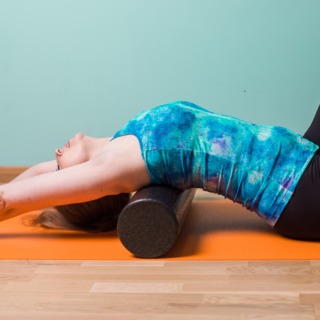
And our upper back is going to be on the rolled part of the blanket.
Arms and shoulders are going to be above the blanket.
It's sort of going to be just about at your mid upper bow.
So you decide how much blanket to be on here.
And again,
If you're not sure,
Just do the half fold blanket.
Start with your knees bent,
Maybe bring your elbows onto that rolled blanket.
Lower your upper back down onto the blanket and use a hand behind your head to help support your head and neck.
Straighten one arm out and notice.
Make sure your shoulder and arm is above the blanket.
Slowly lower your head down.
Arms extended or goal post arms.
And notice how you're going to feel some pressure there on your upper back.
That's okay as long as there's no sharp sensation.
Once you've found that position and you feel like,
Yeah,
That's enough of a.
.
.
Thickness of a blanket or if you need that other blanket under your head,
Just lift your head and pull the blanket under your head.
Then straighten one leg and then the other.
Same breath in through your nose.
Exhale longer than your inhale.
Either through your mouth like a soft sigh.
Or just breathing in and out through your nose if you prefer.
Imagine you're melting over the blanket.
So there's not much elongation happening here.
It's more compression.
If you want to add elongation,
You might reach your arms up overhead.
Gently reaching through your arms and fingers and then softening.
You might have that blanket above to rest the backs of your hands on.
Again this is just an option.
Softening with each of your exhales.
And telling yourself,
Telling your body.
It's okay to let go.
It's safe to release.
Unheld tension.
Tightness,
Stress,
Even trauma.
It's all held in our fascia.
Touches every single cell in our body.
Our fascia really is like our subconscious.
It has more neuroreceptors than our muscles.
And sends information instantly through our body.
Our fascia has consciousness.
It's fluid.
It's light,
It's like liquid light.
Like plasma.
It's our own.
Internet in our bodies.
Sending information,
Receiving information,
Holding memories.
Softening if you need to move your arms into a different position as we're holding here that's totally fine shoulders and upper back softening a little bit more with each exhale.
If you feel you want to move slightly,
Maybe your head.
Slowly moving to one side or the other where your arms want to move in any different position that's totally fine allow your body to move And if you think of like how our bodies.
Do a yawn.
Like a yawn is sort of automatic.
We don't try to yawn,
At least not usually.
We can try and make ourselves yawn.
Or if we see someone else yawning,
Sometimes we'll yawn.
Or just thinking about yawning.
Maybe you start to yawn right now.
So it's sort of an unconscious movement of the body.
And there's this movement associated with the myofascial release.
Called Unwinding.
And it's sort of like your body.
Doing a yawn.
Like a stretch that your arm just wants to do or your head wants to slowly turn in one way or another.
Maybe your wrists want to do different movements.
It's a way your body is releasing.
Apparently,
It's sort of coming into positions of past trauma.
So that these trauma and memories and tensions and adhesions can be relieved.
So allow your body to move.
The wisdom of our body is so amazing.
Maybe just slowly want to have your head or allow your head to move in a certain direction.
Slowly bring your arms.
Closer to your sides.
Bend one knee and then the other.
Pause.
Bring one hand behind your neck and head.
Gently lift your head.
Roll over,
Use your hands and arms,
And slowly once more push yourself back up.
To a comfortable seat.
Notice what you're feeling.
Notice your upper back.
This is a great time to drink some water.
It's really important to stay hydrated.
And after you have a release.
Might feel spacey or energy flowing.
It's really important to drink the water,
Allowing the fascia to absorb that fluid.
Set your rolled blankets aside if you are on a hard surface.
And you have sensitive knees.
You might want to open up a blanket.
Across your mat.
Something like this.
So that your knees have a little more cushion.
So you might want a block.
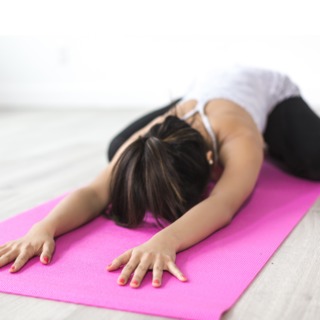
Your head and we're going to come into a variation of child's pose where we're elongating through the spine.
And choose your variation,
Of course.
From about like.
.
.
Your waist area.
Lumbar spine.
Through your sacrum is going to be extending back towards your heels.
And the cervical and thoracic.
Through the crown of your head is going to Think of it elongating forward.
You can just visualize this or a little bit more active elongation on your part.
It's totally up to you.
Visualizing creating space between your vertebrae.
But again,
Don't force it.
To start,
Make sure you have some space to reach your arms forward on your mat so your feet are closer to the back of your mat.
Your knees might be closer,
Like hip distance or wider and start to sit your hips back,
But not all the way.
So if you can take your hips back further,
Come up just a little bit to start.
Reach your hands forward.
Keeping your hands on the mat.
Bring your block closer if you need it.
It'll be easier to get.
And then taking your hips almost all the way back.
And then forehead either to the mat or the block.
Option to keep your arms straight and use your fingertips to sort of reach your fingertips forward so you hope to get that elongation through the upper body.
And then think of taking your hips towards your heels.
Head is supported on the block or your mat.
You can also have your forearms on the mat.
Still actively elongating and reaching through your arms.
Reaching your fingertips forward and then lowering the forearm.
So make sure your neck is comfortable if the block is too high.
Maybe just forehead to the mat or blanket.
If your hips are up higher,
You may need a block under your head.
So find what works for you.
There's no right or wrong.
Listen to your body.
Where can you relax a little bit more?
If your knees are wide,
You're going to get into the hips a little bit here too.
So if it's too much,
Bring your knees a little closer together.
You can have your toes touching or apart.
Find what works for you.
Forehead to the mat or a prop.
And soften into this shape.
Breathing just nice and easy here.
So if your hips tend to get overstretched,
You'll probably definitely want to have your knees closer together and use a block under your head.
Stay present with your breath.
Stay present with this moment.
Staying aware.
Be here for just about another minute.
Stay present.
You Slowly start to come out of the pose.
Lift your hips slowly.
Bring your knees underneath you if they were wide.
And slowly make your way down onto your belly.
If you have a blanket on your mat,
You can leave it there or remove it to the side,
Whatever you prefer.
Elbows out.
Stack your hands and just rest your head on the back of your hands in Makrasana.
Notice sensation.
If this is uncomfortable for you,
You can come onto your back like a Shavasana.
And just pause there.
And then when you're ready.
Thoughtfully make your way.
Back up,
Coming to a seat with your legs out in front of you.
So our knees were bent.
They're probably going to want to straighten a little bit now.
So moving into another part of the body with the ball.
Getting into.
.
.
This area I just really like.
Is using the ball under the upper traps.
It can really release areas into the shoulder.
Roll around it a little bit until you find the area that feels like,
Mm,
That's a spot,
And then we're gonna hold.
I'll give the option when it's been about half the time if you need to move the ball into another area.
Have a blanket under.
Your head.
Get your hair out of the way.
Move the blanket up if you feel your neck is on the blanket.
Knees are bent.
Feet flat on your mat.
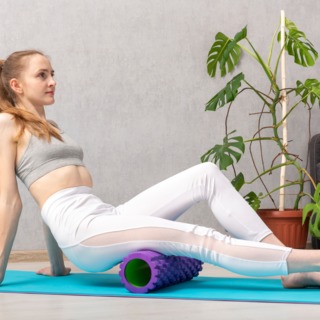
And lift your right shoulder up and place that ball right under your upper traps.
So it's to the right of your spine.
Above your shoulder blade on soft tissue.
Use your left elbow to support you as you lift your left shoulder up.
And you might wanna move the right arm around.
Just explore,
Find where that ball feels like.
Adjust it as you need to,
Up or down,
Left or right.
Find where it feels like,
Oh,
That's a spot.
And then we're gonna hold and relax.
So you can keep your knees bent.
A little easier to keep the ball in place.
You can just relax.
Your arms.
Or keep yourself on your elbows.
And use the pressure that feels good to you.
So you might want to actively push your upper body onto the ball.
You can slowly move your head one direction or the other.
Breathe here.
So again,
If you want to extend that.
Right arm and turn your head a certain way,
That's totally fine.
You choose the amount of pressure on the ball.
So we're going to stay on the ball for about five minutes,
But I'm going to give an option.
That if you want to do your other side too.
Can switch sides.
But if you found like the spot that is really a knot that you've been struggling with,
You might want to just stay where you are.
Totally up to you.
Little bit more on this side.
So you can always hold it for like two minutes.
And get some benefits.
So if you want to get into certain areas and you're like,
Oh,
I don't have five minutes,
Just do what you have.
You're still going to feel better.
Still get a benefit.
Okay,
Option to switch sides.
Or stay where you are.
Find another spot.
Just slightly until you go,
Oh,
That's a good spot.
There's so many to choose from,
It's hard to say,
Oh,
I guess I'll choose here.
Any variation with your arms.
You might even use a block.
I have a block next to me to rest my left arm on that feels pretty good.
Or just reach your arms out.
Maybe you want to stretch through that left arm.
Reaching those left fingertips.
Away from your head.
Notice how that feels.
You might relax the arm there or actively stretch.
And you might slowly turn your head or neck.
Stay present.
Again,
We're encouraging and allowing our bodies to release.
We're not forcing it.
So we're using the pressure,
The compression.
And the elongation.
To get deeper into the fascia as we hold longer.
A little bit more.
And then thoughtfully coming off that ball.
Pause,
Set the ball aside.
Notice sensation.
And then slowly transition.
One side use your hands and arms and press yourself back up to a seat and Paul.
Notice how you feel.
You might have a sense of spaciousness,
Maybe even feel spacey.
Great time to drink some water.
We've gotten into most of the back and shoulders and neck.
But we haven't really done much on the lower body.
So we're going to do that two for one with the hamstrings and calves.
And use the blanket,
Again rolling it halfway.
And we'll add a little variation.
So rolling your blankets.
We may not hold it for the full five minutes.
We will do what we can.
So having the blanket rolled about halfway.
Have your blocks handy.
And come to a kneeling position.
So bring the blanket behind your knee crease.
You can have one hand in front of you and the other hand sort of pushing the blanket behind your knee crease.
And sit your hips back towards your heels.
If your knees bother you at all,
Come out.
You might place a blanket on your mat to kneel on.
Or if it's just really bothering your knees with the rolled blanket,
Try a folded blanket instead of rolling it.
Hands on your thighs or hands on the mat.
Or forearms on blocks.
So any movement here,
With your head and neck if you would like.
Or you can support the head.
With your head on your hands or fingers.
So option here.
To be a little more upright to get more compression into your calves and hamstrings.
Listen to what your body wants here.
Do your best to relax your calves.
And then slowly make your way up out of whatever position you were in.
Set your props aside.
Setting the blankers aside.
And come into one more downward facing dog.
Notice how this down dog feels.
Notice your upper back,
Your mid back,
Low back.
Notice your calves and hamstrings.
Notice your shoulders and neck.
How is this down dog different from your earlier one?
Notice your breath.
Come out of your down dog.
Time for Shavasana.
If you need any other movement or pose before settling into your final resting pose,
Please find that.
And then make sure you're warm enough,
Comfortable enough.
You might use one of your blankets under your head or over your hips.
And as you settle in for your final resting pose.
Invite your whole body to soft to be heavy.
Feet and legs soften,
Relax.
Invite your hips to relax and release.
And visualize space between all your vertebrae.
Soften your shoulders and arms.
Soften your lower belly.
Soften the area around your beautiful heart.
And allow your head to be heavenly.
Jaw relax.
Soften all the muscles in your face,
Especially around your arms.
And visualize the fascia in your whole body.
It's beautiful.
White light of a web structure holding and supporting you.
Into every single cell in your body.
Glowing with this beautiful white light.
See yourself shine from within.
Beautiful white diamond light appreciating your fascia and your whole body.
And let go.
You you Gently bring your awareness back to being on your mat.
Notice your body.
Notice your breath.
And observe your mind.
When you're ready,
Begin to make small movements,
Wiggle your fingers or toes,
Whatever would feel good.
And then thoughtfully bend one knee and then the other.
And make your way over onto one side.
Support your head with your bottom arm or a prop.
Pause there.
And then use your hands and arms and press your way back up to a comfortable seat.
And with appreciation for your awareness and your focus.
Bring your hands together at your heart in Anjali Mudra.
The light in me sees and honors the light in each of you.
Namaste.
Thank you,
Everyone.