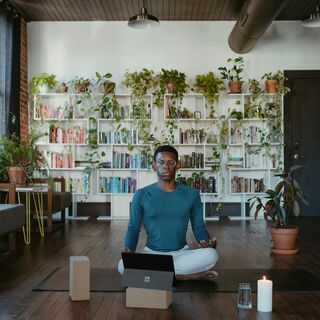
Hello and welcome to this guided meditation for anxiety and for nervous system regulation.
The focus of today's meditation is for you to understand that you are not overreacting.
So let's start by letting yourself arrive here.
Not forcing anything to slow down,
But just by noticing that you've stopped moving for a moment.
You don't need to already feel calm to begin this.
In fact,
If you're feeling a kind of low hum of tension right now or a tightness that you can't quite name,
That's not a problem.
That's exactly where we are starting.
And I want to say something first before we do anything else.
The anxiety you experience,
The looping thoughts,
The physical tension,
The sense that something is slightly wrong even when you can't say what,
Isn't necessarily a flaw in your thinking.
It's your nervous system doing something that it was designed to do,
Is trying to protect you.
The problem isn't that it's doing that.
The problem is that it's doing that when there is no actual threat and it doesn't know how to turn itself off.
So what we're going to do today isn't to fight that.
We're going to meet it and in meeting it clearly,
Give it somewhere to land.
So bring your attention to your body.
Start to notice it.
Is there anywhere you're holding tension?
A jaw that's slightly clenched?
Shoulders that have crept upward?
A chest that feels a little compressed?
Like it's bracing for something?
If you found something,
Just stay with it for a moment.
Don't try to release it yet.
Just notice that it's there.
And that it's been there probably for a while.
Maybe long enough that you stopped registering it as unusual.
This is what chronic low-level anxiety does.
It moves into the body and sets up a kind of baseline tension that you stop noticing until something tips it over and then suddenly it's very loud and it seems to have come out of nowhere.
But it didn't come out of nowhere.
You've been carrying it.
Your nervous system has two dominant modes.
One is activated,
Alert,
Scanning,
Ready to act,
While the other one is settled.
It's present,
It's connected,
At ease.
When anxiety is high,
The activated state can get stuck on.
This happens because the nervous system has learned through experience that it needs to stay vigilant.
And here is what's important to understand.
You can't think your way out of an activated nervous system because logic doesn't reach it.
So telling yourself that there's nothing to worry about doesn't reach it.
Because it's not processing language right now.
It's processing sensation,
Pattern,
Threat.
But what does reach it is signal.
So slow,
Deliberate signals from the body that says we are okay right now,
We can settle.
So I invite you to place one hand on your chest just the weight of it,
Nothing more.
And now breathe in just a slightly fuller breath than you've been taking.
No need to force deep breaths.
And then let the exhale go slowly longer than the inhale if you can.
Now do this for three full breath cycles.
The extended exhale is the signal.
It activates the part of your nervous system that governs rest.
And not that this happens because you decided to relax but what you just did was that you sent the body a physiological message and the body listens to that in a way that it doesn't always listen to your thoughts.
Stay here for a moment.
Give your system a chance to receive this.
Now notice,
Is there anything?
Even something very small that feels slightly different from when you arrived?
Anything that feels marginally quieter?
Maybe just one degree less tense?
Quickly scan your body from the top of the head to the tips of your toes.
Noticing any small shifts.
Knowing that this is your nervous system responding.
What I want you to take from this isn't necessarily a breathing technique but more of an understanding that anxiety does make sense.
It is developed in a context and therefore has a logic.
And while that doesn't mean that you have to live inside it it means that you don't have to fight it or be ashamed of it.
It means that you can begin to understand it and when you begin to understand it you begin to work with it instead of against it.
I invite you to come back to this guided meditation whenever the noise gets loud so that you can meet yourself with compassion and understanding.
Thank you so much for trusting me today.
Namaste.