Hello,
Welcome.
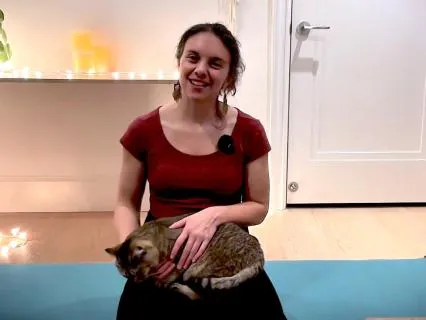
My name is Natalie and this is my sweet little kitty.
Her name is Maple.
And we will be guiding you through a 30 minute yin yoga practice.
So a gentle practice that you can do before bed or in the morning or really any time where you have the time and space to give yourself some rest.
Yin yoga is a really great way to not only stretch the body and get into the deeper connective tissues,
The fascia of the body,
Especially when we hold tightness from feeling quite stiff or sitting or not a lot of movement throughout the day,
But it's a really wonderful opportunity to bring in some more meditation and breath into our yoga practice.
And so we're gonna set up for the first shape.
You can set yourself up on a yoga mat or a carpet,
Somewhere that feels somewhat supportive.
You can use a yoga bolster and blocks if you have them.
If you don't,
You can also use a pillow.
You can use stacked books or any other props that you have handy.
And we're going to set up in butterfly shape.
So you have the option to lie back on a bolster or pillow for a gentle heart opener.
You can also just lie on the ground.
And then you'll place the soles of your feet together,
Knees apart.
You could rest your knees on blocks or not.
And hopefully your cat will crawl right onto your belly like mine is.
And you can settle in.
Make any adjustments.
And ensure that your body feels supported.
So in yoga may not always feel incredibly comfortable.
But we do want to find a place where we can kind of sink into the support beneath us.
So whether that is the ground or props.
We want to find a place where we can breathe with ease.
Maybe we can even start to let go of any controlled breathing.
Allowing a natural rhythm to take over.
Cultivating a sense of trust that our body will start to breathe for us and we can just relax.
And sometimes the natural breath isn't always slow and quiet.
It could be a big sigh.
Or a few deeper breaths as you start to settle from your day.
From whatever you had going on before this practice.
And can you notice and connect to these next few breaths,
Their quality and how they land and move through your body?
Breath by breath,
Can you continue to connect to this present moment?
Connecting to your body,
Connecting to yourself just as it is.
And inviting in a feeling of acceptance.
For how things have landed.
For where you're at.
And at the same time holding a sense of openness.
To see how things shift as we move through this practice.
Continue to connect to the support beneath you.
And can you allow your body to soften into that support a little bit more?
Relaxing places that may tend to naturally hold on or grip.
Invite softness into the jaw.
Tongue.
Eyes.
Forehead.
And even inviting some softness into the back of your neck.
And your shoulders.
Allowing this area to soften as you allow space.
And breath into the chest,
Belly.
And we'll take a few more slow breaths.
And you can take as much time as you need.
Bring your knees up to center.
And you can roll over to either side.
And then beginning to really slowly Press yourself up.
If you had props under your body,
You can slide them out to the side.
So we'll set up for a forward fold.
And so you can bring your legs long in front of you.
You can have a seat.
Find a tall spine.
And then very slowly,
Let your arms soften beside you.
You can tuck your chin as you let your head very slowly come down.
You may even find that a little bit of a swaying motion side to side.
Feel supportive as you make your way down.
And there's no rush.
We want to create a bit of opening and stretch in the back,
In the neck.
And you might let your head hang heavy here.
You can let your feet relax as well.
And at some point,
You might also let your head relax on a couple of blocks stacked.
And we'll take a couple of minutes here.
Breathing into the back body.
Very gently allowing space.
Breathing through tension or any places that may feel stuck or tight.
You may notice again if those places that you tend to naturally hold or grip Notice those spaces.
Invite in a little bit of softening.
Invite them to relax.
Patiently.
And so in yin yoga,
We generally want to invite the natural breath to kind of take over,
But there can be moments when we also do a little pranayama breath.
And so the intention here is to help soften the muscles of the back,
Create some space.
And so I'll invite you to breathe with me.
We'll start to take a slow breath in for five,
Four,
Three,
Two,
One.
One gentle hold at the top.
And then a sigh out.
Letting your head relax.
Letting everything go.
We'll do that a few more times and I'll breathe with you.
And a few more natural breaths.
And you can start to roll back up very slowly.
Removing any props.
And then we're gonna lie back down onto the ground.
And once you arrive on your back,
You're welcome to bend your knees.
Let them wash side to side.
And you could even hug them into your chest.
And then from here,
We're going to come into a thread the needle shape or a figure four shape.
And so you can cross your right ankle on top of your left thigh.
Maybe you stay here.
You could also bring your legs in,
Hold them with your hands,
Or even interlace your fingers to hold onto your left hamstrings or your shins.
This shape can be done in stillness.
Or you could even find a gentle rocking side to side.
And we're going to take this shape into a twist.
And so I'll get you to step your hips over to the right side.
And then you can lower your legs over to your left.
And so you'll be keeping this figure for a shape.
And of course,
Listening to your body,
It's always optional.
So if this doesn't feel right,
You could also stack your knees for a twist.
You could have a pillow or bolster in between your knees as well.
And extending your right arm long.
And here,
Just notice how things feel in your right hip,
Your thigh,
Your right side.
And can you allow your breath to breathe with what you feel?
To breathe through it.
So notice if you tend to try to wish away the tension or discomfort or even pain,
If you have pain in your body.
And taking note that we don't wanna feel pain in this practice,
So readjust if you do feel any pain.
But if you tend to wish away any discomfort with your breath,
Can you simply try to Be with the sensations.
And this could be physical or emotional.
In the practice of staying with,
Being with.
We'll take about another minute or so here.
And you may count the last five or six breaths.
Or simply notice the quality of each breath as you breathe with yourself here.
Breathing with your experience.
Very slowly,
You can start to bring your knees back to center.
And you may widen your feet.
Slowly rock your knees side to side.
And then we'll come into the other side of the figure four shape or thread the needle.
You can cross your left ankle on top of your right thigh.
You could stay here or bring your legs in a bit closer,
Holding or cradling the legs.
Or interlacing fingers around your right hamstrings or shin.
And you could choose stillness here or you could choose a really gentle,
Subtle rocking.
Side to side.
And sometimes this really gentle movement can help to create a bit more ease.
Can help to release some tension.
And can also be a reminder of the rhythm of breath.
So rhythm is naturally calming and soothing for the nervous system.
And then from here,
Taking your time,
You can step your hips over to the left.
And slowly lower your legs over to the right.
You can extend your left arm.
And find a shape that feels supportive for this side,
Knowing that can always make adjustments if needed.
If you feel any pain,
Make adjustments.
And perhaps if there is discomfort,
Tightness,
Tension.
Again on this side.
The practice of breathing with and being with.
Notice and acknowledge what you feel.
And then tune into that natural rhythm of breath.
About five or six more slow breaths.
Take your time.
Bring yourself back up to center.
And allow a few moments for a bit of gentle movement or stillness,
Allowing any sensations from the last shape to fade away.
And we'll come into our final shape.
This will be a restful,
Supportive bridge.
So you can have any prop underneath.
Could be a block,
Pillow.
Anything you have,
You can slide underneath your tailbone.
So the hips are just slightly elevated.
And you can have your feet on the ground.
You could also lengthen your legs above you,
Let them float in waterfall.
Breath by breath Let your whole body be supported.
Allow your thoughts to drift in and out of your mind,
Just like they were clouds on a clear day.
Blue sky.
Floating in.
And then floating out.
You may even imagine this bright blue sky in your mind's eye.
The fluffy white clouds as thoughts,
Dreams,
Ideas.
Floating by.
Different shapes.
Slowly changing.
And sometimes the clouds may be thick.
Sometimes they may be dark.
Sometimes they may be light.
And they float by time and time again.
Continuously changing.
Always in transformation.
And your being.
Is the blue sky.
You hold all of these experiences.
And in your practice.
Learning to let them enter.
Let them float by.
And let them go.
From here.
Let yourself find.
Any resting shape.
Could be Shavasana on your back.
Could be on your front or even in seated.
And I'll guide you through.
Body scan for the next minute or so.
Start to bring your attention to the top of your head.
And then very slowly guide your attention.
Down the back of your head.
The back of your neck.
Down the back of your shoulders,
Your shoulder blades.
Slowly down your arms into your fingers.
Letting your attention glide.
Moving down the middle of your back.
To your low back.
Through your hips and your seat.
Down your legs.
To the soles of your feet.
And to the tips of your toes.
And then again,
From the top of your head,
This time down the front body.
Forehead.
Eyes.
Nose cheeks.
Mouth.
Chest.
Down your belly and the sides of your waist.
And at the same time,
Sensing your arms.
And fingers.
Sensing the palms of each hand.
And slowly sending your attention down your hips.
Thighs.
Your knees.
Lower legs.
Ankles on the tops of each foot.
And again,
Into the tips of your toes.
Now connect to your whole body.
Connect to the support beneath you.
And your natural breath.
Let your thoughts soften and dissipate like the clouds.
Let them float by.
And imagine they float.
Up.
.
.
Up.
.
.
And out of your awareness.
And your thoughts and your whole being.
Or the sky.
Invite in a slow breath.
And you may wiggle your fingers and your toes.
And you're welcome to stay just as you are or continue to rest.
Maybe this practice will even take you into a sleep.
And you can close your practice in any way that feels best for you.
You may place a hand onto your chest,
Hand onto your belly or palms together.
And a moment of gratitude for your body.
For your own practice.
And gratitude to all teachers and students,
Past,
Present,
And future.
Thank you so much for taking the time to practice with me and with Maple today.
We hope you have a peaceful sleep and a peaceful rest of your day.
We'll see you soon.