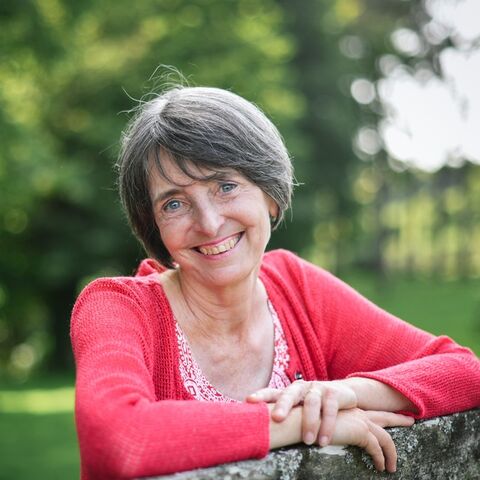
Hello and welcome to Five Minutes in Nature with me Liz Scott.
Out and about on a walk around the area of Kendal and Sedgwick which is in the north of England.
I love exploring walks when I go out and about.
What's wonderful about England is there are lots of little footpaths that cut across fields and countryside and it means you can go to an area,
Take out a map,
See where the paths are and just follow these footpaths on routes that just take you into the most beautiful rural heartland of England.
And there are surprises along the way.
And today's talk is about what I just discovered.
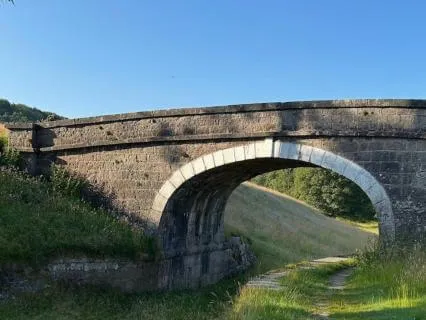
It's like a big grey bridge in the middle of what looks like in the middle of a field.
Now this is a Victorian built bridge.
It looks very,
When I first saw it,
I thought,
Oh,
That looks like a railway bridge.
And I came and I thought,
Where's the railway?
And then I looked underneath this bridge.
So imagine it's,
It's like,
It's just on its own in a field.
And I looked under this bridge and I saw that there was quite a deep channel.
And,
And then I thought,
No,
This looks more like an old canal bridge.
And I thought,
I'll just check this out.
So I looked it up online and sure enough,
This used to be a canal.
And the campsite that I'm staying on,
There are some old ruined buildings there,
And they used to be gunpowder storage places.
Again,
They're made of thick grey stone.
So again,
I'm assuming it's probably Victorian,
They were built in the Victorian times.
And I looked online and it said the family,
The very rich family that lived here,
Traded in gunpowder and they wanted a canal built close to their gunpowder factory and so they built this canal so this would have provided transport for their goods around the country.
And it just got me reflecting because.
.
.
In its day when this was built,
So this is over 200 years ago now,
The people that built it probably never imagined.
That it was one day in the not too distant future going to return to a field.
This when they were building this was the cutting edge of technology.
I mean,
That's what you've got to realize.
I'm just walking underneath it now.
You can probably hear the sound changes.
I'm talking and going to come out again into the open and you can hear it.
Can't you?
That it just sounds different.
So they thought they were,
They were absolutely at the cutting edge of technology of advanced advancement.
This was the new future canals were going to take.
Goods all around the country and they thought this was it and a huge investment in time and energy and money and here it is.
Allowing to become.
A ruin in a field.
In.
This part of the world in the north of England.
But I kind of feel great hope in that because It's not a story of sadness for me,
It's just a story of this is how it works.
We build things.
We think we're at the cutting edge of modern times.
Times move on.
And new things arise.
So that might be for a canal.
Or it might be for a government,
Or an idea,
Or a philosophy,
Or the way society interprets laws and the land.
Things change and you see the land has got old bridges,
Old railway lines,
Old buildings that once had a use but no longer have a use.
And then there are other things like churches that were originally built very small and then over hundreds of years have been developed and made bigger.
The landscape changes,
Nothing stays the same.
It feels as though where we are at the moment feels like it's here forever,
But it's not.
This too will pass.
And that is on big building projects like this canal,
Or it's about things that are happening in your life.
It will pass.
That that's a really hopeful message.
Let me know your reflections on this today,
That this too will pass and don't forget to join me again tomorrow for another five minutes in nature.