Hello there.
And welcome to this talk and guided meditation on tolerating uncertainty.
Today we're going to spend some time with something that is part of every human life.
And yet something most of us find difficult.
Uncertainty not knowing.
Not knowing what's going to happen.
Not knowing how something will turn out.
Not knowing what someone else is thinking.
Or whether a decision is the right one.
Not knowing whether something we hope for will happen.
And sometimes not even knowing what we ourselves want.
We live in a world that constantly invites us to get certainty.
Search for the answer.
Make a plan.
Check the message.
Check again and again.
Ask someone what they think.
Look for reassurance and imagine every possible outcome.
Try to predict what will happen.
And underneath all of this can be a very understandable wish.
If only I could know that everything will be okay,
Then I could relax.
But uncertainty is not a problem that can always be solved.
It's often simply part of being alive.
So today isn't about learning how to become certain.
It isn't about convincing ourselves that everything will turn out well.
And it isn't about pretending that difficult things don't happen.
But instead,
We're going to explore something far more subtle.
Can we learn to be with not knowing?
Can we discover that uncertainty can be uncomfortable without being unbearable?
And can we experience the feeling of uncertainty?
Without immediately having to get rid of it.
Can we make room for the mind when it wants answers?
And perhaps most importantly,
Can we live our lives even when certainty isn't available?
Take a moment now to notice that you've already done this so many times.
You get out of bed each morning.
Without knowing exactly what the day will bring.
You began this session without knowing precisely what you would experience.
Life is continually asking us to move forward without a complete map.
And somehow.
Here we are.
So what is uncertainty?
Let's begin simply.
Uncertainty means that we don't know.
That's all.
The mind,
However,
Often adds a great deal more to this simple fact.
I don't know what will happen becomes.
Something bad might happen,
Which becomes,
I won't be able to cope.
Which becomes,
Everything could go wrong.
And before we know it,
We're no longer simply experiencing uncertainty.
We're experiencing a whole imagined future.
And the mind is remarkably good at creating these stories.
It takes a small information and fills the gaps.
Now sometimes this can be useful.
Our ability to anticipate danger has helped human beings survive.
But the same capacity can become exhausting when the mind treats every possibility as something that needs to be solved immediately.
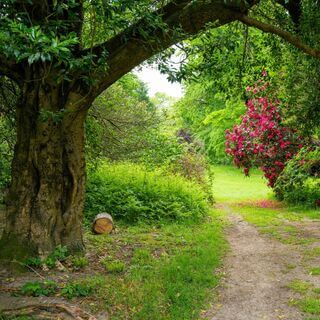
Imagine standing at the edge of a forest.
You can see the first few metres of the path,
But beyond that,
The path disappears around a bend.
You don't know what's around the corner.
Now the mind might say,
What if there's something dangerous there?
What if I make the wrong choice?
What if I get lost?
What if I can't find my way back?
And perhaps the mind keeps asking these questions because it believes that if it thinks hard enough,
It can eliminate uncertainty.
That there is a strange paradox here.
Sometimes,
The more desperately we try to achieve certainty.
The more uncertain we feel.
Because every answer generates another question.
And every reassurance we give ourselves.
Can then create the need for further assurance.
Every check can make us want to check again.
And the mind says,
Just one more piece of information.
Just one more confirmation.
Just one more look.
And then perhaps I'll be able to relax.
But often the relaxation doesn't last.
So we are not going to try to defeat uncertainty.
We're going to develop a different relationship with it.
The difference between danger and discomfort.
So one of the most important things that we learn is that uncertainty and danger are not the same thing.
Now uncertainty can be uncomfortable.
But discomfort is not necessarily danger.
Think about waiting for an important message.
There's uncertainty.
Your body may tighten.
You may feel restless.
Your thoughts may speed up.
You may want to check your phone.
These feelings are real.
But the feelings are not proof that something is wrong.
The distinction is important.
I feel anxious is not the same as something bad is happening.
The body can respond to uncertainty as though it were an immediate threat.
The heart beats faster,
The stomach contracts,
Muscles tense,
Attention narrows,
And the mind starts scanning.
And then we can become frightened by the feeling itself.
I shouldn't feel this.
I need to make this stop.
What if I can't cope with this?
Now there are two layers of difficulty.
First,
There's the uncertainty.
And then secondly,
There's a resistance to experiencing uncertainty.
Today,
We're interested in softening that second layer.
Not because we can always remove the first,
But because we can learn.
This is uncomfortable and I can be here.
I don't know what will happen and I can breathe.
I would prefer certainty.
But I don't have to have certainty in this moment.
So let's try something right now.
Bring to mind something mildly uncertain.
Nothing overwhelming,
Perhaps an unanswered message.
A decision you're considering.
Something later happening this week.
Something where you generally don't know the outcome.
So notice what happens in your body when you think about it.
Don't analyse it,
Just notice.
Where does uncertainty show up?
Perhaps in your chest and your stomach.
The throat or perhaps your face.
Maybe there's very little sensation.
Whatever is here is fine.
And now,
Rather than asking,
How can I get rid of this?
Try asking.
Can I allow this to be here for 10 seconds?
Just 10 seconds.
No solving,
No reassurance.
No predicting.
Simply noticing.
And I'm going to pause now for 10 seconds.
And perhaps you discovered something.
The uncertainty may still be there.
But you were able to be with it.
That matters.
Because tolerance isn't the same as liking something.
We don't have to like uncertainty.
We don't have to welcome it with enthusiasm.
Tolerance simply means.
.
.
I can allow this experience to exist.
Without immediately needing to escape it.
The mind wants a guarantee.
There's a very human longing underneath our attempts to control uncertainty.
We want a guarantee.
We want someone to tell us it will definitely be okay.
We know exactly what will happen.
You've made the right choice.
You won't be hurt and nothing will go wrong.
But life cannot ever offer us these guarantees.
And perhaps part of growing psychologically is learning to exchange the demand for guarantees for something more realistic.
Trust in our capacity to meet what comes.
This is a profound shift.
Instead of,
I need to know that everything will be okay,
We begin to say,
I don't know what will happen,
But I can meet this moment.
Instead of,
I need to know that I won't suffer,
We say,
I can care for myself if suffering comes.
Notice the difference.
The first approach asked life to become predictable.
Second develops our ability to live in an unpredictable life.
And perhaps that's a far more attainable kind of safety.
So the habit of checking.
One of the ways we try to escape uncertainty is through checking.
Checking information,
How someone feels about us,
Whether we made the right decision.
Checking their news,
Our phones,
Our thoughts.
Checking whether we feel okay.
And checking can be useful.
The difficulty comes when checking becomes a way of trying to obtain a feeling of absolute certainty.
Because certainty is rarely achieved.
We check,
We feel better,
And then the doubt returns.
So we check again.
The important question isn't,
Should I ever check?
It's,
What am I hoping checking will give me?
Is it information or certainty?
Because information can be useful.
Certainty may be impossible.
And sometimes the most courageous thing we can do is stop gathering information and allow ourselves to say,
I have enough information for now.
And then we get on with our lives.
Making room for maybe.
So a very useful word when working with uncertainty is maybe.
Maybe it will go well.
Maybe it won't.
Maybe this person will understand.
Maybe they won't.
Maybe I'll make the right decision.
Maybe I'll learn something from making the wrong one.
Maybe the thing I'm worrying about will happen.
Maybe it won't.
We often want the mind to say definitely,
But maybe is honest and it leaves room for reality.
And reality is larger than our predictions.
Sometimes we're trying to close the future before it arrives.
But the future doesn't need to be solved today.
We can let tomorrow remain tomorrow.
We can allow the unanswered question to remain unanswered for a while.
This isn't passivity.
It's a willingness to stop demanding knowledge that isn't currently available.
So let's move into a guided meditation.
So making sure you're somewhere where you can safely go into meditation.
Just sit comfortably.
Maybe you want to close your eyes or simply soften your gaze.
Let your hands rest easily.
And allow your body to settle.
There is nowhere you need to get to.
You need to achieve.
For next few minutes.
With simply practicing.
Being here.
Notice the support beneath you.
The chair.
The floor,
The ground.
You don't need to hold yourself entirely on your own.
Allow yourself.
To be supported.
Bring your attention to your breathing.
Just noticing as you breathe in and breathe out.
There is nothing uncertain about this particular moment.
Right now,
You are here.
There is a sensation of sitting or standing or lying down.
There is breathing.
They're all sounds.
There are sensations.
There are thoughts.
This moment is happening.
And now notice something interesting.
You don't know exactly what the next breath will feel like.
You don't know exactly what thought will arise next.
You don't know what sound you'll hear.
And yet,
You don't need to know.
You can allow the next moment to arrive.
Let the breath come.
Let the breath go.
Now bring to mind a small area of uncertainty in your life.
Something manageable.
Something that has not yet been resolved.
Notice what happens.
Perhaps there is tension.
Perhaps the mind begins producing thoughts.
Perhaps there is a desire to find an answer.
Simply notice.
And silently say,
I don't know.
Let these words be simple.
I don't know.
Not as a failure.
Not as a problem.
Just as a fact.
I don't know what will happen.
I don't know how this will unfold.
I don't have to know right now.
Notice whether the body can soften by even one tiny amount.
You don't have to be completely relaxed.
Just a little less effort.
A little less resistance.
If thoughts appear.
Let them appear.
If the mind says,
But what if?
You don't have to answer.
You might simply say,
Maybe.
What if this happens?
Maybe.
What if that happens?
Maybe.
What if everything turns out differently than I expect?
Maybe.
You don't need to complete the story.
Come back to the breath.
Breathing in.
Breathing out,
Here.
No.
You might notice that uncertainty has a physical quality.
Perhaps tightness.
Maybe restlessness.
Rather than changing it,
See if you can make space around it.
Imagine that the sensation has room to exist.
You don't have to push it away.
You don't have to hold it tightly.
Let it move.
And perhaps.
.
.
Offer yourself these words.
This is uncertainty.
This is uncomfortable.
And I can be here.
Again,
I don't know what will happen.
I know what is happening now.
Right now,
You're breathing.
You're sitting,
Lying,
Standing.
Right now,
There's a body here.
Right now,
There is this moment and you're listening to me.
The future can remain unknown.
You don't have to enter it yet.
Let the future stay in the future and come back to this breath.
And notice.
Whether you can trust something very small.
You don't need to know everything.
You only need to meet the next moment when it arrives.
One breath.
And then another.
And then a number.
Perhaps silently repeat.
I can live without knowing everything.
I can make room for uncertainty.
I can take the next step without seeing the whole path.
And now let go of the particular situation you brought to mind.
Return to the room.
Notice the sounds around you.
Notice the surface beneath you and when you're ready gently open your eyes.
Uncertainty in choice.
There's another important distinction.
Tolerating uncertainty doesn't mean refusing to make decisions.
Sometimes people imagine that acceptance means,
I'll just let life happen.
But uncertainty and action can coexist.
We can say.
I don't know what the outcome will be and I'm still going to choose.
Every meaningful decision contains uncertainty.
We don't know exactly how a relationship will develop.
How a new job will work out.
What a conversation will lead to.
Sometimes there is no perfect decision.
There is simply the decision we can make with the information available today.
And then we learn,
We adjust,
We respond.
We take the next step.
This isn't recklessness,
It's accepting the limits of knowledge.
So what we can control.
When uncertainty appears,
It could be helpful to separate three things.
What we know,
What we don't know,
And what we can do.
For example,
I know that I have an important conversation tomorrow.
I don't know exactly how the other person will respond.
I can decide how to show up.
That is enough.
This can bring us back from an imaginary future into the life that is actually happening.
Because uncertainty can consume enormous amounts of attention and every moment spent trying to predict the unpredictable.
Is a moment we're not fully inhabiting the present.
The courage of not knowing.
There's a kind of courage that doesn't look dramatic.
It looks like waiting without checking.
It looks like making a decision without a guarantee.
It looks like having a conversation without knowing how it will be received.
It looks like saying,
I don't know,
And remaining present.
And we often imagine courage as doing something despite fear.
But perhaps sometimes courage is simply allowing uncertainty to be present.
Without allowing it to dictate everything we do.
You can be uncertain and still act.
You can be anxious and still rest.
You can have and answer questions and still enjoy your afternoon.
You may not have a guarantee,
But you can still participate fully in your life.
So know now that none of us can see more than a little way ahead.
And perhaps that's enough,
Because there's light always to see the next few steps.
And we don't need to be able to see the final destination to wait until we take a movement forward.
What we can do instead is ask yourself gently.
What's the next step I can take?
Not the whole plan,
Not the whole future.
Just the next step.
And perhaps you don't even know what that step is yet,
But that's OK.
Let yourself not know.
Just allow yourself to recognize that you don't need certainty to take one step.
You don't need to know the whole story.
You can allow life to unfold as it wishes to unfold.
And when the next moment arrives,
You'll meet that moment fully and fully present.
So allow room for uncertainty.
Recognise that you can breathe alongside it.
And perhaps over time you can discover something important.
A life without certainty can still be a life of meaning,
Connection,
Joy and presence.
We don't need to know exactly what comes next in order to be here for what's happening now.
So,
For today,
Perhaps the practice is simply this.
Don't demand certainty from this moment.
Let the moment be what it is.
And take the next step.
So thank you so much for joining me here.
And I hope to meet you again.
Very,
Very soon.