Hi,
I'm Kristen from Kristen Phillips Art,
And today I'm going to take you through an exercise that might have some surprising benefits.
It's called One Shape,
Many Possibilities and all you're going to do is make a shape Any shape.
And repeat it across the page for 20 minutes.
This might sound easy,
But it does some important things.
First,
The constraints reduce the number of decisions you have to make.
And this allows you to slow down and pay more attention to what's happening in front of you.
And really,
That's what this practice is about.
It's about the quality of attention you bring to the page.
As you slow down,
There can be a shift away from the outcome of what you're making toward the process of allowing it to happen on its own.
And over time,
This kind of mindful attention can become part of the foundation of your own visual language.
I will share more as we go.
For now,
Grab a sketchbook or some nearby paper,
A pen or a pencil,
And anything you'd like to use to add color.
I will be working alongside you.
Can know that your image will not look like mine.
It will look like yours.
And that's exactly the point.
Let's get started.
Okay,
So I'm here in my art journal,
And I'm starting with a pencil.
Think of a shape.
Any shape.
It can be geometric.
It can be abstract.
It can be something you've seen before.
It can be something you make up right now.
Go ahead and make it on the page.
And then repeat it.
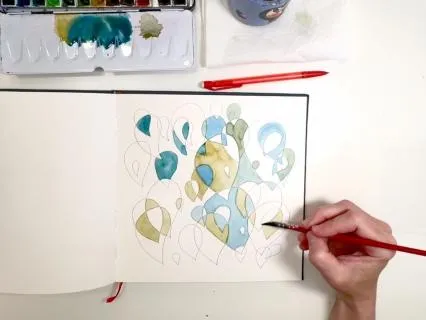
I'm drawing this circle with a little point at the bottom.
This came out naturally one of the other times I was doing this exercise.
And I liked this shape because it felt organic and easy.
It had a nice feel to it,
Almost like hot air balloons rising or upside down raindrops.
The way I'm repeating these shapes might be really different from how you choose to repeat them.
The idea is to let the hand lead the way.
Let this be less about making something impressive.
More about paying attention.
And to the best of your ability,
Try not to plan ahead.
Let your hand guide you and show you where it wants to go next.
This shape can morph and change.
It can grow.
It can shrink.
It can overlap itself.
It can become dense in some areas and more open in others.
What's most important is to allow yourself to drop in.
If you find yourself thinking or planning.
Allow those thoughts to fade into the background.
Because that's when the drawing can start to surprise you.
If you notice yourself judging the page,
That's okay.
Just return to the next shape.
The next line.
The next small decision.
Take a moment to notice how you're holding your pen or your pencil.
Do you have a really tight grip on it?
Can you loosen it maybe five or 10%?
And you can see now that even though I started with a very simple shape,
It's been repeated for a few minutes now,
And the page is starting to look like something else.
The shape itself is no longer the focal point.
We now have all of these interesting shapes in between.
The places where it overlaps.
Places where it's tighter or more open.
I've filled up this page enough that I want to add some color now.
I'm using watercolor,
But you can use anything you have on hand.
The way you add color is completely up to you.
There is no right or wrong way to do this.
Try to pick a color that feels intuitive and that fits the shape you're making.
I mixed up an earthy green-blue palette for this.
You could continue to make more shapes and colors.
Or you might do what I'm doing here,
Which is finding these new shapes that have been created in the overlap of my original shapes.
I'm finding those places to be really interesting.
So that's where I'm choosing to add color.
There's also no requirement to add color.
This could be a really interesting exercise to do just by shading certain areas with your pen or pencil.
I like to work in a sketchbook because the sketchbook becomes a container.
For these kinds of exercises.
I can review them later and look at how they change over time.
I originally created this exercise because I think a lot about visual language and how it develops.
In my own paintings right now,
I've been repeating a shape over and over for the last 10 years.
I'm not entirely sure why,
But I'm fascinated by how a visual language can develop through the simple act of repetition.
How one shape can have such a hold on me that it can persist for a decade.
Without me losing interest in it.
How it can represent a certain feeling or a place and time.
How its symbolism can change over time.
So I wanted to create an exercise that explores this.
And I found the process to be so enjoyable.
The simplicity of shape repetition becomes a mindfulness practice.
A way to drop into the moment.
A way to train myself to trust the movements of my hand.
And allow curiosity and discovery to become alive again.
And I think that's really important.
Not only for a developed art practice,
But also for people who are starting again.
Art can become heavy way too fast.
We jump to conclusions about it quickly.
We don't always give it time to unfold.
And we're often trained to be more concerned with the outcome of what we make than with the process of making it.
But the process of making is where the magic happens.
It's also where mindfulness happens.
Mindfulness as a quality of attention.
Noticing the way the water moves on the brush.
Noticing the texture of the paper.
Paying attention again.
To how you're holding your brush or your pen or whatever you're using.
Can you loosen your grip another 5 or 10%?
Can you feel your body breathing?
Your sit bones on the chair.
Your feet on the floor.
As you continue to work with this exercise,
You may find that the repetition starts to settle you.
It gives the mind something simple to return to while the hand keeps moving.
And that quality of attention can transfer beyond the page.
You may find yourself becoming less scattered.
More tuned in.
More available to what is actually happening in front of you.
If you decide you like this exercise,
I would recommend doing it many more times.
You can follow along with this video again.
Or you can set a timer on your own,
Put on a playlist for 20 minutes,
And see what happens.
Every time you do this,
You will make something new.
Something you didn't plan before.
As long as you keep yourself open to letting the hand guide the process.
New things will happen.
I'll say one quick thing about the 20 minute time limit.
I worked with different amounts of time and found 20 minutes to be the sweet spot.
Any less and you run the risk of not letting the exercise develop enough.
And when I went longer than 20 minutes,
I started to go into more of a completion mode or an analytical mode.
The page began to feel more designed and I wanted to preserve the immediacy of the work.
So the time limit is not intended to make you rush.
If anything,
It's intended to give you permission to slow down.
And then to stop.
At a certain point.
This is an art exercise designed NOT to encourage you to over-optimize.
Work in a private bound journal that's only for you.
Share it if you want to,
Or keep it entirely for yourself.
Work within a specific time parameter so it retains a fresh quality.
And just like you're repeating the shape over and over again.
Allow the exercise itself to be repeated over and over again.
And that's the end of 20 minutes.
So we can set back Take a breath.
And look at what happened.
This is a record of your attention.
Your time.
Your perception.
And your hand in this moment.
Thank you for being here with me.
I would love to know how this was for you.
Please leave me a comment and I will see you next time.