If you've ever come across Kundalini Yoga and thought,
Yeah,
I can do the breathing,
I can do the movement.
But the chanting is all just a little bit too weird,
Then this video is for you.
Once you understand why we do the repetition and the sound therapy,
And more importantly,
You realise how it makes you feel,
Then you might feel a little bit different about it.
So let's begin.
What exactly is Manchur?
Mantra is sound therapy.
It doesn't really matter what you're saying,
The sounds that you are making.
It doesn't matter if it makes sense.
In the Kundalini tradition,
A lot of the mantras,
They either come from English or they come from Gurmukhi,
The Sikh religious book.
Um But it really doesn't matter,
It can be any kind of affirmation or any kind of sound.
I mean,
Yoga itself,
Like Hatha yogi,
Often uses om,
The A-U-M sound,
Or written as O-M,
Om.
It's supposed to be,
Apparently,
The sound of the universe,
Like everything vibrating together.
And so when you make that sound,
It makes the body vibrate.
But in all honesty,
It doesn't matter too much.
What you're saying.
You can be saying.
.
.
A mantra like,
I am enough.
I am enough.
I am enough.
All is well.
Good things come to me.
It can be in English,
It can be something you understand,
Or it can be Vaheguru,
Or Sat Naam,
Or I am bountiful,
I am blissful,
I am beautiful.
It can be anything.
That's going to uplift you.
That's gonna make you feel different.
And that makes a sound.
Now I use mantra because it helps me switch my brain off slightly.
My brain needs a hook,
It needs something to hold on to and I find mantra helps.
You can still be chanting a mantra and your mind can be thinking about a million different things.
But because of the sound therapy and the placement of the tongue and we'll go into this kind of little sciencey bit in a minute but because of that you receive I receive something a bit different when I'm doing a meditation and I'm using a mantra.
Also,
What I noticed,
So we always,
In Kundalini Yoga,
We tune in with Ong Namo,
Gurudev Namo,
And I use this in all of my classes.
Both adult and children alike.
And what I notice is that with children,
It gives a point of reference.
So they know when they come into the class,
They have this familiar practice that brings them into the yoga space.
So they might have been doing phonics earlier,
Or maths,
Or they've just come in from break and been running around.
And they come into the class,
And we do the same mantra in the same way,
And it brings their nervous system to this like,
Ah,
Yeah,
This is where I am now.
I'm calming myself down,
Because I know what's coming.
I'm going to be going through this practice.
With my adults as well,
When we all tune in,
It gives us a place of where we're all on a level,
We're coming together.
Even if you're practicing on your own,
It brings your nervous system to the same thing,
Really.
Okay,
Here we go,
It's yoga time,
It's calming time.
And it tunes you in.
Because it creates the vibrations.
So I personally,
When the first time I did a meditation with a mantra,
And it was the first time I'd ever had that,
Oh my goodness,
I've been meditating.
Because you know that as soon as you realize that,
You've kind of come out of your meditation,
Haven't you?
It's impossible to get to that I'm not thinking space.
Because we're always trying to get to that I'm not thinking.
And when you're thinking I'm not thinking,
You're thinking.
There was a time when I was doing a meditation and I think it worked out it was about 18 minutes or something like that.
And the time just went.
And I realised afterwards that I had gone through that no-mind space.
And it was because I had been chanting a mantra.
I'd stopped thinking about the mantra,
It took on a life of its own and my meditation took up on a life of its own.
It was a really amazing moment and I've probably been spending the last 15 years trying to get that moment back again but that's why I use Mantra.
It makes me feel safe.
I enjoy the sound,
I enjoy the sound therapy,
And I see the effect it has on my students of giving us that regular place.
To bring the nervous system to a calm spot.
So,
As I briefly mentioned,
It gives the mind something to hook onto.
And this is especially good if you are somebody who has an overthinking mind,
To then have a mantra to hook onto.
It gives you that.
Yeah,
It gives you that hook.
It gives you that,
Okay,
I don't have to sit here and think about my breathing or sit here and think about being still.
I can think about this mantra.
My body might move with the repetition of this mantra.
I'm enjoying the sound of this mantra.
Now,
The science-y bit.
In the Kundalini tradition,
The movement of the tongue against the palate of the mouth creates difference.
Energetic responses in the brain and in the body.
Okay,
So your glands in the brain,
Your hypothalamus,
Your pituitary gland,
Your pineal gland,
They respond to the movement of the tongue within the mouth.
So it might be against the teeth,
It might be knocking up against the upper palate,
The opening and closing of the throat.
All of these things are creating an energetic shift.
That is why sometimes when you're focusing and you're focusing a third eye and you can feel this heat.
Coming through.
Okay,
The movement of the mouth.
The movement of the tongue actually creates those energetic changes.
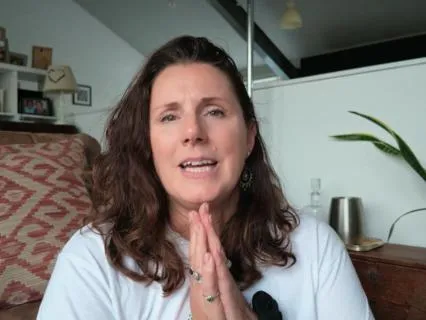
I want you to try it.
I want you to experience it.
Let me get my timer.
Okay.
We're going to do the mantra Sat-Nam and we're going to chant a long Sat and a short Nam.
If you need to know what it means.
.
.
Fine,
It means truth is my name or truth is my identity.
It's the vibration of the truth.
You are the truth of your existence,
But the meaning of it is secondary.
I want you to feel what it feels like.
So,
In a very monotone way,
We're going to chant a long sat and a short nam,
And we're going to do it for a few minutes.
So just close your eyes down.
Breathe deeply.
Eyes focused at your third eye point.
And let's begin.
Sat Naam Sat Naam Sat Naam Sat Naam Saaaaaaaam Sat Naam Sat Naam Sat Naam Sat Naam Sat Naam Sad.
.
.
Now.
Sat Naam Sat Naam Sat Naam Sat Naam Sat Naam Sadhnaam Sat Naam Sat Naam Sat Naam Sat Naam Sat Nam.
Deep breath in.
And out.
Just sit.
With the vibration.
In the body Before you decide whether Kundalini Yoga is for you,
Just take a moment to notice how you feel compared to a few minutes ago.
Your thoughts.
Your body,
Your breath.
We are all cells vibrating.
And that sound therapy.
Channels itself through the body to every cell,
Letting it vibrate and heal.
You don't have to understand.
The aspect of every mantra before you experience it,
And in fact normally,
And often,
The experience teaches you everything you need to know.
Open your eyes when you're ready.
Thank you so much for being with me today.
If you enjoyed this video,
Please leave a comment.
Let us get this science out there.
It's wonderful.
Have a wonderful day.
All my love.