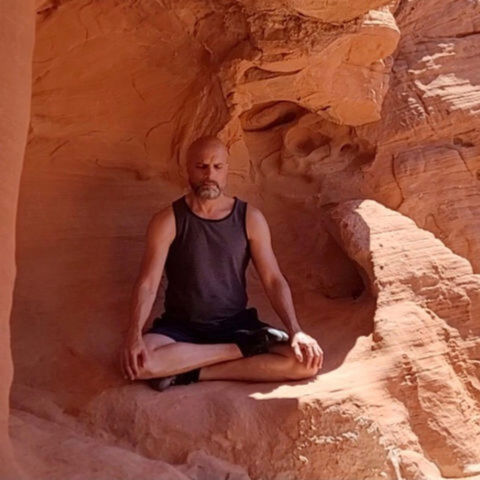
In this meditation practice,
We will concentrate on our form and pay attention to how we respond to the aha moment.
The moment of recognition when we realize the mind has wandered.
To strengthen your practice,
I thought it useful to include a few comments before we begin.
First,
Simply acknowledging mind wandering as normal,
Mutes frustration.
If on the other hand we sit to meditate with the expectation that the mind should be empty,
Calm,
Quiescent or blissful,
We trigger a dopamine reward error response if the mind is restless or busy.
Our expectations are not met,
So we think,
My mind is restless,
I must not be doing something right.
We've missed our target expectations.
A pea-sized structure in the brain called the habenula inhibits dopamine activity.
Dopamine is a neurotransmitter which affects learning,
Attention and motivation among other functions.
For our training,
It's important to emphasize dopamine's effect on learning,
Attention and motivation.
Too little of it,
We lose interest,
Attention wanders,
Motivation wanes.
The habenula is an anti-reward system.
It plays a role in aversive experiences and in making decisions so as to avoid future disappointment.
This partially explains why so many meditators quit.
They have unrealistic expectations that are not met and then they feel frustrated or disappointed.
If on the other hand I recognize mind wandering as normal and refrain recognition as a kind of victory,
A different process unfolds.
When we celebrate the aha moment,
Neurons activate in the brain's ventral tegmental area,
A place in the midbrain that secretes dopamine.
Dopamine is the signal that creates that sense of pleasure,
Helps improve attention and interest.
We're then motivated to repeat our behavior to reach that pleasure again.
The mind wanders,
I recognize it's wandered.
I return my attention to the object of focus.
Again the mind wanders,
At some point I recognize the mind has wandered,
Aha,
Got it.
This is the attitude of the skilled meditator.
We approach with a growth mindset,
Not a fixed one.
A fixed mindset says,
I just had to meditate,
My mind was busy,
I'm just not good at it.
A growth mindset says,
I just had to meditate,
My mind was busy,
I'm just not good at it yet.
But with practice and dedication I can improve.
During a focused meditation session,
Which is the technique we will practice shortly,
It's common to cycle through five intervals.
The first interval is sustained attention.
We sit,
Attention is focused single pointedly on an object.
In this practice it's going to be the touch sensation of the breath.
The executive network is active.
When we're focused on the touch sensation of the breath,
The right parietal cortex is active.
Another part that's active is the right frontal lobe,
Which is responsible for impulse control.
So you have the presence of mind to ignore distractions.
The thalamus is also active during this cycle,
It regulates alertness.
Then at some point the mind may wander.
We move to the second cycle.
This is called the default mode network.
It becomes active.
This network is associated with mind wandering,
Disruption of attention,
Autobiographical memories,
Judgment,
Self referential thoughts,
Guilt and emotional processing.
This partially explains why meditation is so difficult for beginners.
When the mind wanders and they realize the mind has wandered rather than cut and reoriented attention,
They criticize their performance,
Judge themselves,
They make self referential evaluations.
This isn't for me,
I'm just not good at this,
And simply enforce the default mode network.
It's just more chatter.
The third cycle is awareness of mind wandering.
This is the moment a practitioner realizes attention has wandered.
This is the aha moment.
The skilled meditator celebrates and reorients attention very matter of factly.
The unskilled meditator returns to the default state.
They reinforce the chatter with more chatter.
This is frustrating,
I can't do this,
I'm not good at it.
Am I doing this right?
So during this stage in the cycle,
The salience network and its functional architecture are involved in cognitive control,
Perceptual decision and error processing.
So how we process the error,
Whether skillfully or unskillfully,
Will affect perceptions,
Learning outcomes and performance.
As I said at the beginning,
If I punish myself because I've set an unrealistic target,
And I'm expecting my mind should be obedient and quiet,
And find instead that the mind is busy or restless,
I quote frustration.
I was expecting quiet,
Instead there's dissonance.
And we can sit through this with awareness as disappointment unfolds,
There's learning taking place.
Another approach is to accept that the mind has wandered.
The brain secretes thought after thought just as the glands secrete hormones.
We don't get angry at the glands for secreting hormones.
So with that same acceptance,
Bordering indifference,
We can approach mind wandering.
The mind wanders,
So what?
When I recognize the mind has wandered,
I give myself a reward,
A small pulse of dopamine.
Yes,
You got this.
For five minutes,
I was daydreaming,
But in this moment I caught myself.
I'm learning.
Dopamine helps consolidate learning,
It helps you with attention.
So the mind may wander off again.
Several minutes later you're aware,
You bring the mind back,
The way an expert trainer handles an adorable puppy.
We're gentle but firm,
Patient and encouraging.
This is self-love,
Self-respect,
Kindness.
You deserve this.
So give yourself this gift over and over.
Recognize,
Celebrate,
Then cut,
Let go,
And reorient your attention.
In this way you strengthen the neural networks that mediate attention.
You develop greater cognitive control.
You maintain your motivation and can sustain your meditation practice over time.
I hope these instructions are helpful for you.
Not only in this practice but in any meditation practice.
So let's begin.
Sit comfortably and close your eyes.
We can recognize the benefits of this practice.
Regardless of whether the mind is focused or wandering,
Quiet or busy,
Responsive or difficult to control.
We're cultivating many wonderful qualities.
We made the intention to meditate and now we're sitting and celebrate that effort.
It takes self-discipline,
Motivation,
Commitment,
Organization,
Self-respect.
Self-respect says I honor the power of my mind which orchestrates my life and that mystery that dances within me.
I'm cultivating awareness,
Strong powers of concentration.
I'm developing cognitive flexibility,
Emotional balance,
Insight into how my mind works,
Patience,
A host of other beautiful qualities.
And this is regardless of how I perform during this meditation.
To continue settling into this present moment,
Simply be accepting whatever sensations,
Sounds,
Thoughts or emotions arise in awareness moment by moment.
Now bring the attention to the breath.
Simply notice the breath at the entrance of the nostrils.
Notice as it comes in,
As it goes out,
Without trying to control it in any way.
Much more.
.
.
.
.
.
.
.
.
.
.
.
.
.
.
.
.
.
.
.
.
.
.
.
.
.