Music Find a comfortable position.
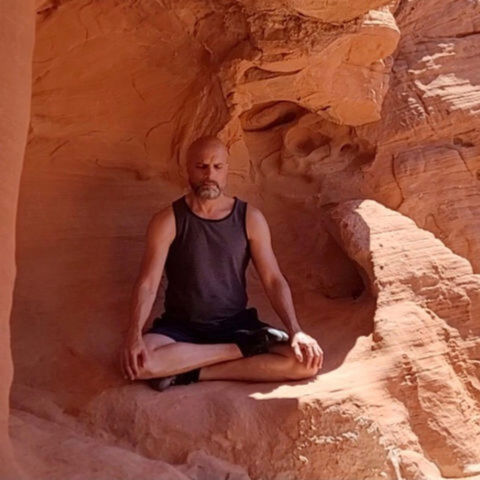
Try to maintain this posture for the duration of this meditation which is an hour long.
If you feel you must move be aware of this intention before you move and adjust your position slowly and mindfully.
However you will appreciate the value of this technique if you can sit through discomfort and approach this as an athlete in training who accepts the fatigue and soreness.
In this technique we welcome unpleasant sensations if they arise.
After 30 minutes of sitting we may begin to tire.
We use these unpleasant sensations as a tool to break the habit pattern of reactivity.
If there's an itch we don't scratch we just observe the rising and passing away of sensations.
If there's numbness in the leg after sitting for so long or soreness in the back experience numbness soreness and sit with it as it arises and passes away naturally.
Settling into this present moment try to be as comfortable as you can whether sitting or lying down and simply be accepting whatever sensations sounds thoughts or emotions arise in awareness moment by moment by moment.
Now bring attention to the breath.
Simply notice the breath as it comes in,
As it goes out,
Without trying to control it in any way.
Notice how the breath moves in and out automatically,
Effortlessly.
Notice how the breath moves in and out automatically,
Effortlessly.
Notice sounds arising,
Thoughts arising,
Emotions arising,
Passing without the need for censorship.
No need to eject any of this.
No need to view any of this as a distraction,
Simply allowing whatever enters the field of awareness to be lightly touched and let go.
Notice how the breath moves in and out automatically,
Effortlessly.
Notice how the breath moves in and out automatically,
Effortlessly.
Notice how the breath moves in and out automatically,
Effortlessly.
Notice how the breath moves in and out automatically,
Effortlessly.
No need to hold on to anything.
No need to push anything away.
No need to censor the mind.
To further calm the mind,
Practice observing the breath at the nostrils for a few minutes.
Observe the incoming breath as incoming breath.
The outgoing breath as outgoing breath.
Remaining alert,
Constantly aware of the incoming breath.
Attentive as the breath goes out,
As it goes out naturally.
As soon as you notice the attention has wandered from the breath,
Gently but firmly bring your attention back.
If your mind wanders off ten times or a hundred times,
Bring it back ten times or a hundred times.
Bring it back into mind wandering.
This quality is called hardency.
As soon as you realize the mind has wandered away from the breath,
Bring it right back.
Very matter-of-factly,
Without self-criticism,
Without judgment.
This is the work.
Thank you.
Thank you.
Thank you.
Thank you.
Thank you.
Thank you.
Remain aware of the entire length of the incoming breath,
The entire length of the outgoing breath from beginning to end.
The breath has started coming in and you're aware it's coming in.
There's a slight pause.
The breath has started to go out.
You're aware it's going out.
There's a slight pause as you take yet another breath in.
It's like this for each breath that comes in and for each breath that goes out.
Now we begin the practice of the Pasana.
It's a body scan.
We'll start scanning from the top of the head down to the toes and from the toes back up to the head.
Passing our attention over each part of the body,
Feeling different sensations along the way.
Observing each sensation as you experience them.
Moving your attention from head to feet and feet to head.
A sensation,
A feeling,
It's anything you experience.
It could be pressure,
Tightness,
Tension,
Release,
Coolness,
Warmth,
Softness,
Hardness,
Tingling,
Itching,
Burning,
Stinging,
Pulsing.
It could be throbbing or numbness.
So beginning with the top of the head.
Continue scanning down to the forehead,
The eyes,
Nose,
Cheeks.
Bringing the attention around,
All the way around the head 360 degrees to the back of the head.
Where the ears in space.
The jaw,
Mouth.
Scanning down the neck.
Aware of any sensations.
It can be the touch of the atmosphere,
Touch of the hair on the skin.
Tingling sensation.
Tightness.
Weirdness around the eyes,
Dryness,
Coolness,
It doesn't matter.
Any sensation once you've experienced it,
Continue scanning down.
If you come to an area where there's no sensation,
Simply sit there.
You may notice the sensation rises.
If after a few seconds it doesn't,
You can continue scanning.
Neck,
Shoulders.
You may feel the touch of the clothing if you're wearing a shirt.
You feel obvious sensations and maybe more subtle ones.
You can note both the obvious ones and the subtle ones as you continue scanning.
Shoulders.
Upper arms.
Elbows.
Forearms.
Wrists.
Hands.
Thumbs.
Index fingers.
Middle fingers.
Ring fingers.
Pinkie.
Noticing any sensations.
In my case,
My hands are resting on my knees.
I can feel the warmth of the knee,
Warmth of the skin.
There are more subtle sensations of the fingertips tingling.
At the top of each finger,
It's a different temperature than it is the palm.
If I pay more attention to the tingling,
I'll notice that it begins at the knuckle and it radiates out a little bit.
That level of detail you're trying to observe,
Very matter-of-factly,
Is if you're explaining something to a doctor.
Explain how deep it is,
How deep the sensation goes,
How far out it radiates its quality.
Its intensity.
So continue scanning down the trunk.
Chest.
Heart center.
Feel the ribs expanding and contracting.
Scanning down to the abdomen.
And you may feel obvious sensations like the pressing of the skin against the waistband.
You may feel more subtle sensations.
Some sort of vague movement of food being digested or whatever it is you may experience.
It's far more subtle.
The sensations you experience may not be nameable.
So long as you experience something,
You notice a sensation.
Continue scanning down.
Some scanning down to the genitals and the perineum,
The southernmost tip of the trunk.
And scan from the top of the neck back this time.
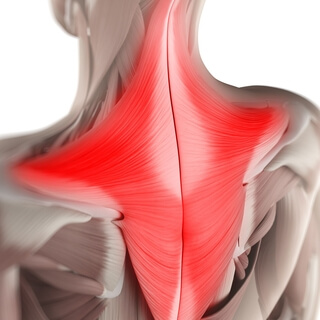
The trapezius muscle.
Upper back.
Noticing any sensations.
In my case,
The most obvious ones are the touch of the clothing on the skin.
Rising and falling of the shoulders.
There's a more subtle sensation which is not nameable.
It's a quality of aliveness.
Continue scanning down to the middle of the back.
Where the spinal column,
Lower back.
Gluteus muscles to the seat.
You have obvious sensations like the weight of the body in the seat.
More subtle sensations.
A sensation of heaviness,
For example,
In my case.
I continue scanning down to the legs,
Hips,
Thighs.
I'm scanning the entire cylinder that is the upper thigh.
Front,
Sides,
Back.
Kneecaps.
Calves and shins.
Ankles.
To the feet.
Heel.
Soles.
Arches.
Balls of the feet.
Toes.
Then from the tips of the toes,
I'll continue scanning like this to the top of the head.
Tips of the toes.
Balls of the feet.
Soles.
Arches.
Heels.
Top of the feet.
I'm sitting cross-legged,
I can feel more pressure on one foot than on the other foot.
And it's like this,
Just observing.
Ankles.
Calves and shins.
Scanning each and every part up to the knees.
Thighs.
Hips.
Gluteus muscles.
Then up the trunk.
You can start with the back,
The lower back.
As I'm revisiting areas,
You may notice some sensations may have arisen,
New sensations may have arisen,
Others may have passed away.
You may have grown in intensity,
Or they may have disappeared altogether.
And whatever it is,
Just experience these movements.
Continue scanning up the back.
Interbrite.
Mid-back.
Upper back.
Trapezius muscle.
To the neck.
Scanning the front of the trunk,
From the perineum,
Genitals.
The abdomen.
Chest.
Shoulders.
In my case,
I noticed a little bit of tightness in the shoulders,
And I just relaxed.
Continue scanning down.
Upper arms.
Elbows.
Forearms.
Wrists.
Hands.
Palms of the hands.
Tops of the hands.
Thumbs.
Index fingers.
Middle fingers.
Ring fingers.
Pinkies.
I'm scanning the neck.
To the head and face.
The jaw.
Mouth.
Lips.
Cheeks.
Nose.
Wherever the breath is,
It's coming in,
Going out.
Touch sensation of the breathing.
Eyes.
Scanning 360 degrees around the head,
Back of the head.
Ears.
Temples.
Forehead.
Scalp.
And back to the top of the head.
So that was one relatively fast pass.
You can pass like this again.
You can pass even more slowly.
Go into more detail.
Scanning like this,
But then going deeper.
You can go inside,
For example,
As you're feeling the eyeball.
To give an example,
If I go inside,
Feeling the eyeball,
Touching the back of the eyelid,
For example.
Or I'm aware of the muscles behind the eyes.
And I'm aware of the sensations there.
Or if I'm scanning the nose,
I'm aware of the touch sensation of the breathing of the nostrils,
But I'm also aware of the breath coming into the nasal cavity.
And the quality,
The sensations that I'm feeling as the breath comes in.
As the breath goes out.
As the breath comes in,
I can follow it all the way in.
See how far in I can go as it goes down the air passage.
Or if I'm going into the mouth area,
For example,
I can start scanning from the surface of the skin.
Inside.
Journeying inside from outside of the lips,
Which may feel something moist or dry.
And then I come inside the mouth.
Aware of all the teeth,
The tongue,
The palate.
Heart palate,
Soft palate,
Tonsils,
Everything.
With as much detail as I can,
I continue scanning down.
Also be aware that your body is running many processes in this moment.
From heartbeat to breathing.
It's regulating all kinds of levels,
Electrolyte levels,
PH balance.
All of your organs have the functions that they're performing.
So I may not feel,
For example,
The digestion of my food,
But I may feel something in my abdomen area.
I may not feel liver doing its functions,
But I may feel some tingling or throbbing.
And that's what I'm paying attention to.
All these sensations are impermanent.
They rise and they pass away.
As I'm scanning,
I'm understanding this reality at the experiential level.
Also,
You may choose to scan more each arm separately.
Passing over the right arm,
The left arm,
Right leg,
Left leg.
But maintain the same pattern.
So from the top of the head,
You continue scanning down the trunk,
Legs to the toes,
And the toes up to legs.
Maintain the same pattern.
You may feel unpleasant sensations throughout the body or on certain parts of the body from time to time.
When you come across unpleasant sensations,
See that you don't react with aversion.
Otherwise,
You'd be strengthening that habit pattern of reacting with aversion.
What we're trying to do instead is strengthening equanimity,
Remaining balanced,
And just experiencing sensations as they are.
We also find it helpful not to label sensations with loaded words,
For example,
Pain.
Instead,
Feel it as a throbbing,
As a warmth,
As a heaviness.
Without words at all and just experience how deep it goes,
How far out it goes,
The quality of it.
And know that however unpleasant a sensation may seem,
It won't last.
They all have the characteristic of arising and passing away.
It arises,
It may linger for some time,
It may even grow in intensity,
But sooner or later it will pass away.
You may feel pleasant sensations throughout the body or on certain parts of the body.
Whenever you experience such sensations,
See that you do not start generating craving or clinging towards it.
A quality that says,
Oh,
This is very beautiful,
I want more of it.
Otherwise,
You're strengthening the habit pattern of craving.
So maintain equanimity,
Free from craving,
Free from aversion.
So continue the work for the next 30 minutes of scanning,
Noting sensations.
Scanning from the top of the head to the tips of the toes,
And then from the tips of the toes to the top of the head,
And back from the top of the head to the tips of the toes.
Noting sensations all along the way.
Thank you.
Thank you.
Thank you.
Thank you.
Thank you.
Thank you.
Thank you.
Thank you.
Thank you.
Thank you.
Thank you.
Every unpleasant sensation is welcome.
It's only when you experience unpleasant sensations that you get the wonderful opportunity to practice experiencing the mind's tendency to react with aversion.
This is the opportunity to break that habit pattern.
We strengthen the habit pattern whenever we react to unpleasant sensations with aversion.
We're strengthening our bondage and our misery.
So we make use of the unpleasant sensations to break the bondage of aversion and hatred.
So welcome.
Welcome every unpleasant sensation.
Welcome whatever comes.
We maintain a friendly attitude to whatever is inside of you.
Every time you experience an unpleasant sensation,
Make use of it to break the old habit pattern of aversion.
Every time you experience a pleasant sensation,
Make use of it to break the old habit pattern of craving.
Thank you.
Thank you.
Thank you.
Thank you.
Thank you.
Thank you.
Thank you.
Thank you.
Thank you.
Thank you.
Thank you.
Thank you.
Thank you.
Thank you.
Thank you.
Thank you.
Thank you.
We don't have preference for any particular sensation or prejudice against any particular sensation.
We don't give any evaluation to sensations,
Whatever they may be.
Simply experiencing them with an open mind.
All of these sensations have the same characteristic of a rising and passing way.
With this realization the mind is no longer in conflict and becomes balanced.
This is what we call equanimity.
If you experience extreme discomfort,
See if you can just sit with it.
With the numbness,
The throbbing,
The heat,
The tightness.
Without the secondary pain of emotional distress and the aversion to it.
See if you can simply sit with the primary discomfort with equanimity.
Accepting what is.
If aversion does arise as irritation,
As frustration,
Anger.
Simply observe and notice how the mind and body become agitated.
The body becomes tight,
Tense,
Generating further discomfort.
Over time,
By simply observing movements of mind and body and remaining equanimous,
You cultivate non-reactivity and a higher threshold for discomfort.
If later you find yourself suffering from a chronic condition,
This technique will prove very helpful for you.
So continue the practice.
Conversely if you experience very pleasant sensations,
Again simply observe.
Avoid craving and clinging,
Which only invites suffering.
If next time you sit you do not experience pleasant sensations,
You begin to feel disappointed,
Agitated,
Frustrated.
So continue the practice.
Maintaining perfect equanimity.
Sitting with whatever arises as it arises.
Keep working patiently,
Persistently.
Being gentle with yourself.