Bell sound In this practice we will survey the landscape of the body intentionally relaxing muscles along the way receptors in your skin joints muscles ligaments and connective tissues are relaying information about body position temperature pressure even now as you sit or as you lie this data is sent through the spinal cord to the brain in this practice will pay attention to the data and consciously send signals down from the executive seat of the brain to the muscles we'll experiment and observe as objectively as we can whatever arises as it arises sitting or lying comfortably you trust the body to interpret the meaning of the word comfort allow the muscles of the face neck shoulders and back to embody comfort head to toe comfortable close your eyes if you care to and relax embodying relaxation not interfering with its unwinding trust the body to find its resting states bringing your full attention into this present moment accepting what is at this moment trust the body to find its resting state giving it the space and time to decompress it does not relax on command but gradually may take a few minutes for the chemicals that keep the body hyper alert to dissolve back into the body but by exercising patience and trusting the body we learn to enhance our innate capacity for self-regulation we can change our body's metabolism releasing tension slowing the breath heart rate and other metabolic functions gradually at first but more skillfully with practice and regular training use the mind intentionally to assist in this process with three minutes of deep diaphragmatic breathing so when you're ready to take a deep breath in allow the abdomen to rise ribs to expand the chest to lift hold the breath and exhale slowly let the exhalation be twice as long as the inhalation expelling all the air in the lungs allow a slight pause before taking yet another deep breath allowing the abdomen to rise the ribs to expand and the chest to lift hold the breath and exhale slowly let the exhalation be twice as long as the inhalation expelling all the air in the lungs allowing a slight pause before taking yet another deep breath continue like this for several breaths now bring your entire body into your awareness as you take another deep breath as you exhale release any bodily tensions you may notice in awareness another breath in holding relaxing as you exhale with each exhalation allowing the body to settle deeper and deeper into relaxation with each exhalation releasing obvious tensions than the more subtle blockages of which we are aware breathe naturally allowing the breath to find its own natural rhythm bringing attention to the nostrils and the body to the surface just feel whatever sensations arise as you breathe in and out whether pressure of pressure coolness of coolness softness or hardness tension or release just notice sensations arising passing away exhalation exhalation exhalation Now bring your attention to the scalp and rest your awareness on the top of your head.
Bring your attention down to the forehead.
Relaxing the muscles that raise and depress the eyebrows and wrinkle the forehead.
Smoothing and relaxing the muscles of the forehead.
Now pass your attention over the muscles that elevate and close the eyelids.
And allow your attention in.
Feel the eyeball touching the back of the eyelid.
Feel the eyes in their sockets.
Relax the muscles around the eyes.
Let your attention sweep over the eyelids and the muscles of the eye and around the eye.
If you're in a state of hyper alertness you may notice movement in the eyes.
That's okay,
Stay in noticing.
Simply observe.
Now pass your awareness over the ears.
Just map out where the ears are,
Their position in space.
Relative to the eyes,
The forehead.
Now bring your attention to the nose.
The bridge of the nose.
Following the angle of the nose to the nostrils.
Feel where the breath touches inside the nose.
Bringing your attention again to the rings of the nostrils.
Feeling the touch sensation of the breath as it goes in and out.
Notice the touch of the breath as it goes in.
Compared with the touch sensation of the breath as it goes out.
Notice any temperature variations as the breath goes in,
As the breath goes out.
Notice any sensations you experience in the limited area just below the nostrils.
Feel the touch sensation of the breath as it goes in and out.
As the breath is expelled,
It is generally experienced as more moist,
More warm.
What do you detect?
What do you notice?
Follow your breath as it enters the nostrils,
Filling the nasal cavity.
Notice how the breath is pulled in.
You're being breathed.
As you go deeper,
You can settle in to that power that is breathing you,
Trusting in that,
Relaxing into that.
The breath is pulled in,
Flows past the tonsils,
Down to the nasal pharynx,
Passing the vocal cords,
Laryngeal cartilages,
Which you might experience very subtle sensation in the back of the throat as you breathe in and as you breathe out.
If you care to,
You might want to try humming gently on the exhalation,
Feeling the vibration in the throat,
And paying attention.
To the placement of sound,
To the feeling of sound,
How far it extends within the throat as you hum and exhale.
For several exhalations,
You might also experiment with deeper than usual breaths to produce remaining aware,
Still relaxing on each exhalation.
Again,
Allowing the breath to return to normal,
Surveying the body,
Relaxing any tension.
Bring your awareness to the muscles of the mouth.
They're muscles that elevate the lips into a smile,
That depress the angle of the mouth,
Which elevate the upper lip.
They're muscles which draw the angle of the mouth upwardly,
Laterally,
Which wrinkle the skin on the chin.
Muscles which compress the cheeks against the teeth to blow,
To pucker the lips,
To draw them back.
Without knowing the names of any of these muscles or the placement of any of these muscles,
Just be aware and relax the muscles around the mouth.
Relax the muscles of the jaw.
Draw your attention within.
Feel the entire mouth,
The teeth,
The buccal cavity or the back of the lips and cheeks.
Be aware of the palate,
The ducts,
The gums,
Incisors,
The canines,
The molars.
Be aware of the tongue.
You have muscles which depress and elevate and retract and raise the tongue.
Notice any sensations you feel within the mouth.
Moisture.
Heaviness,
Lightness,
Warmth or coolness,
Anything.
Notice any processes arising.
The deeper you fall into relaxation,
For example,
You may notice an increase in saliva,
An increase in swallowing or yawning.
Pay attention to these processes,
To the onset of the arising.
Pay with any physiological movement that occurs.
For example,
If swallowing,
Notice how the mouth moistens.
Pay attention to the movement of the jaw,
The throat,
The tongue,
The lifting of the hyoid bone.
Notice how the breath is suspended as you swallow.
Any details you experience,
Just notice.
Once again,
Pass your attention and your awareness over the entire face.
Top of the head,
The forehead,
The eyebrows,
The eyes,
The nose,
The cheeks,
The ears,
The mouth,
The bones of the face.
Relax the muscles of the neck.
Muscles which extend and rotate and laterally flex the head.
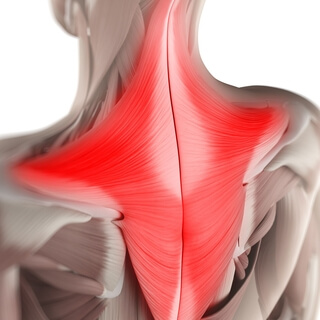
Relax the trapezius muscle that starts at the neck.
Tension tends to nest here,
So we want to deliberately relax this muscle.
It's common for teachers to begin a practice by inviting participants to intentionally raise this muscle during the inhalation and lower,
Relaxing the muscle during the exhalation.
If you care to,
You can gently raise your shoulders to your ears during the inhalation.
Dropping the shoulders,
Relaxing completely during the exhalation.
From the shoulders,
Move your attention down to the upper arms,
The armpits.
Notice any temperature variations.
Come down to the forearm and to the muscles that flex,
Extend,
Abduct,
Adduct and pronate the forearm.
Now bring your attention to your wrists.
You may feel a pulsing at the wrist.
But you feel what you feel.
It's important that we experience directly.
We're not imagining anything,
Wishing for this sensation or that sensation.
Move your attention to your hands.
Relax the muscles of the palm,
The muscles between fingers,
The muscles of the thumb.
Care of any sensations in the hands.
Once again,
We'll survey the face,
The shoulders,
The arms,
The hands,
Relaxing any tension.
From the neck,
Scan down the front of the trunk.
Bring your attention to the clavicle.
Pass your attention down to the muscles of the chest.
Noting any sensations you may feel.
Throbbing,
Pulsing,
Contracting,
Expanding.
Just be aware.
Rest your attention on your heart center.
Focus here as you breathe in and out of the heart center.
And back.
Communism.
Religion.
.
.
.
.
.
.
.
.
.
We'll continue scanning down.
Pass your attention over the muscles of the abdomen.
See if you can feel the different muscles involved in inspiration and expiration.
.
.
.
.
.
.
.
.
.
.
.
.
.
I'll bring your attention to the upper back.
.
.
.
.
.
.
.
.
.
.
.
.
.
.
.
.
.
.
.
.
.
.
.
.
.
.
.
.
Relax the gluteal muscles.
.
Relax the muscles of the thigh.
.
The muscles of the lower leg.
.
Relax all the muscles of the feet.
.
.
.
The muscles from your glutes to your toes relaxed.
.
.
.
.
.
Relax any tension on each exhalation.
.
If you notice any discomfort.
See if you can relax into the discomfort.
No resistance,
No struggle,
No judgment.
Simply relaxing into it,
Experiencing it fully.
Without aversion,
Without wishing for it to be different.
.
Relaxing into it,
Surrendering into it.
.
See if you can relax into it without interpreting it.
Making a judgment about it,
This is bad,
I don't like this,
I hate this.
Rather,
You might feel it as a throbbing,
As a tension,
And relaxing into it.
.
Just allowing it to be,
And staying with it.
.
Staying with the sensations.
.
Staying with the sensations no matter how unpleasant.
.
Relaxing into the discomfort,
This is true mindfulness.
Non-reactive.
Not judging,
Not resisting,
This only causes mental and physical agitation.
.
And you can observe this within your own experience.
.
If you notice something like pain,
That is primary,
It's just a throbbing,
It's just heat,
It's just tension,
It's just a stabbing pain,
A tingling pain.
.
If the mind begins to resist,
Then you create a secondary pain.
.
The body may become more tense,
And without rejecting any of this,
Let it teach you,
Relax into it.
.
.
.
Scanning head to toe,
Releasing any tension in the body.
.
As this meditation comes to an end,
See if you can keep your awareness in the body,
Even as you intend to open your eyes,
As you intend to adjust your posture,
To stretch,
To move.
.
.
Feeling the muscles of the eyes opening,
The muscles of the eyes adjusting to the lights.
.
Blinking,
Swallowing,
Raising an arm,
Moving a leg,
Stay with the process,
Stay with the body,
Even as you enjoy the fluidity and flow of energy,
The movement of your body.
.
.
.
.
.