Welcome.
If you're here,
You probably need a little rest and recovery.
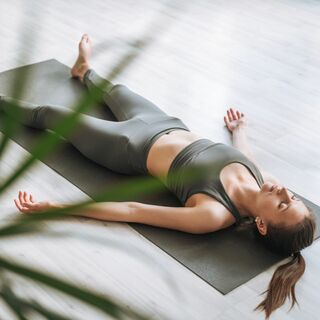
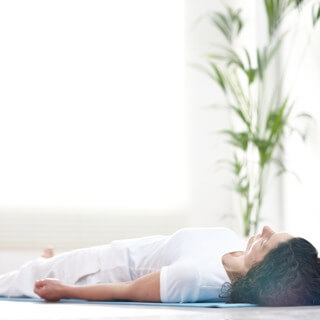
So I'm going to give you a passive relaxation technique where you can just relax your body into a static position.
It helps you open your heart center.
It helps relax your spine and relax your entire spinal cord and nervous system.
It can help you breathe easier so that you're more likely to stimulate your parasympathetic that we talk about a lot and just relax yourself down into that state of release.
Staying in this position is very healing because it sort of acts as a meditation for your body,
Somatic meditation.
You're not trying to control your breath in any way,
This is not a breathing exercise,
But just being in this position where your ribs are extended,
Your spine is lengthened,
And your heart is lifted,
And you're completely passive.
Just letting gravity take you down,
It helps your breath settle into an extremely relaxed state.
So that is helping to cue your brain to shift down into one of these brainwave states where you're in either a deep relaxation,
Like a meditative state,
Or getting close even to a sleep state where a lot of regeneration and rejuvenation happens.
So if you like,
You can set a timer.
But usually you'll know when to come out.
And you can use lots of different props.
Lying on the floor is the best.
On the floor,
On a yoga mat,
But you can also do this on your bed especially if the bed is a little bit firm.
Today I'm going to use two yoga blocks.
And I'm going to use a wool blanket.
So you can use things like more firm cushions,
Even couch cushions,
Bolsters,
Other rolled up blankets or towels.
You could use a couple of books with a cushion on top,
A chair cushion,
Something to soften it,
Or even a foam roller.
So what we're going to do is find a position where our heart is lifted because our back is supported.
Sometimes this is called supported fish pose.
If you've ever practiced yoga asana,
There's a fish pose where you press up into this position on your back,
Lifting your heart and dropping your head back.
But this one is totally supported.
So you're just releasing and allowing your body to give itself over to gravity.
So it's a much different effect.
So one of your supports,
Your block or your bolster,
Something a little more firm,
Will go under your spine,
Right behind your heart.
And it looks like this.
If you can,
It's going up and down the spine,
Sort of between the shoulder blades,
Not too low,
Not too high,
But you'll feel that there's only one or two spots where it feels pretty comfortable.
So you'll know right away.
If you're using a foam roller,
You might take it horizontally across the back behind the heart.
You'll have another block or cushion or folded towels or blankets at the very top of the mat for your head to use as a pillow.
So we don't want the head just hanging loose.
We want everything nicely supported,
Feeling safe.
So I'm going to turn one in this lengthwise position,
And the other one is here,
Ready to be adjusted to any setting,
Any height,
To support my head.
Now,
For some people,
This is fine,
Just resting onto a block or a foam roller,
But to make it even more comfy.
I suggest stacking.
A blanket or a thin cushion of some sort.
Right over top.
And then you'll turn.
Scoot your hips back so you're close.
And you can kind of hold on to this as you slowly lower yourself down.
And this may take a couple of tries.
The legs are going to come down right away to ground you.
You'll find You can adjust.
The most comfortable spot.
Let your legs roll out to the side,
Reach behind you and find that pillow.
So you can see my head's pretty high.
I'm going to bring this up.
To a high setting.
So I can really rest my head.
But if you have something back here or you're just more flexible and you want to go all the way back,
You can do that as well.
So lots of variations of this.
Play with what you have,
Play with your own props that you already have,
And find what feels best for you.
It should feel like you're getting a little stretch.
You're definitely getting a big opening of the chest,
But it's also really comfortable.
There's no strain.
So in that first,
You know,
20,
30 seconds,
As you're letting your body weight sink down and settling,
You may need to make a couple of little adjustments.
And then with arms away from the body,
Palms up,
Legs rolling out,
You'll close your eyes.
Take a couple of full breaths and on those exhales,
Let your body relax deeper.
Exhaling getting heavier and just sinking into this support system.
You might notice that your breath does change,
But you're not changing it consciously.
The breath is changing based on the position of your spine,
Your ribs,
Your lungs having more space.
Soften your jaw if there's any tension.
You can actually open your mouth a little bit.
Rest the tongue on the upper palate.
While you're here,
You're welcome to listen to any guided meditation or singing bowls or anything that helps you feel calm and relaxed.
Kind of paying attention to the release in your body.
If you're noticing any areas still holding,
I like to send a breath to that area.
Really imagine you're breathing down to that part of the body to create some space.
Every exhale allows you to let go more.
You may find that after you're here for a few minutes,
You might want to make an adjustment,
Especially with your head as your neck relaxes,
Your throat and your face and jaw soften,
You might be able to come back a little further.
Remember,
There's no tension in the hips.
The pelvic region.
It's all heavy down to the mat.
After you've been here for.
.
.
A few minutes or 10 to 15 breaths,
Whatever feels right for you.
Just tune into your body's needs.
You'll know when it's time to come out.
When it's time to come out,
You're going to use your arms first to support you.
Bring your legs together.
Bend your knees so your feet are grounded down.
Support your head with your hand if you need to or lift.
And then roll to one side onto your arms.
Staying really soft.
So.
To find.
Whole spine again.
And as usual,
Take a moment or two just to check in and notice how you feel.
Noticing the shifts after we do a practice or an exercise is just as important as doing the exercise because it cements into our brain,
Into our neural circuitry that we have felt a change.
A change has happened.
A shift is possible and it encourages us to do the practice again and look for more of that well-being and balance.
So I hope you'll use this.
Experiment,
Play.
This does not have to be a very high lift.
This can be very subtle.
There are so many variations of this.
Maybe you just need a rolled towel and a little cushion under your head for a slight lift of the heart.
So play with this and see what feels right for you and use this before bed or use it when your nervous system is just totally taxed.
This is something that's going to feel really good to your whole being.