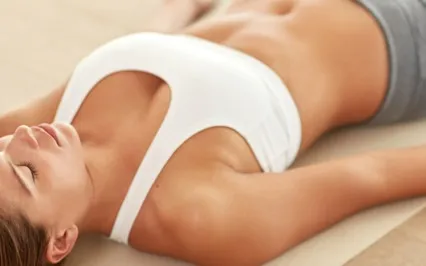
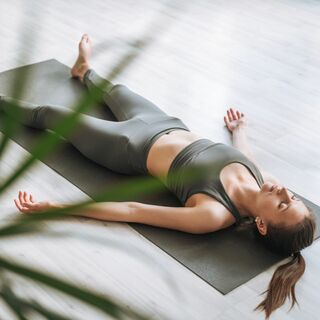
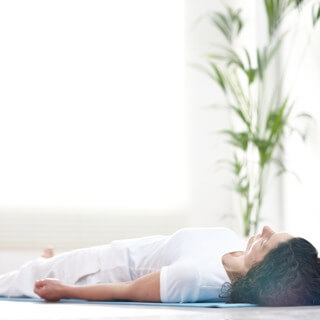
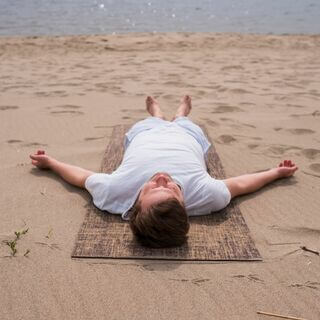
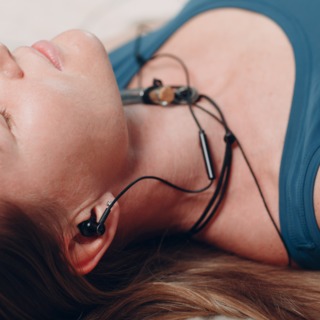
Relax all of the points of contact or pressure with the ground.
Let all of those points,
Those places that are touching your bed or your floor,
Just feel like they're melting right into the surface.
Try to feel and cultivate a deep sense of relaxation.
And now begin to shift your focus over to your breath.
Just watching the natural flow for a moment,
Watching the air come in and out.
Notice where the breath is moving.
Where is the air flowing inside the body right now?
Just keep following the breath with your attention.
Notice the details.
Notice what it feels like.
In this exercise we're going to use our diaphragm,
Which is our largest breathing muscle.
We're going to use the diaphragm to help extend and deepen the breath and to attain smooth control of the inhales and exhales.
We'll soften the abdomen so that the diaphragm can move downward and create a massaging pressure on the organs.
You can imagine that there's a balloon in the lower abdomen and that with every inhale you're fully filling the balloon up,
Allowing the belly to round out completely.
And then with every exhale you're slowly letting that air recede and leave the body.
So you're deflating that balloon little by little,
Smoothly and consistently.
We'll be inhaling and breathing to a count of 10,
Although the pace will feel different for every individual.
So depending on the speed and the rhythm of your natural breath,
Depending on your emotional state,
How much stress is engaged with your system right now,
You may want to adapt that count.
So let's begin together now that we're relaxed.
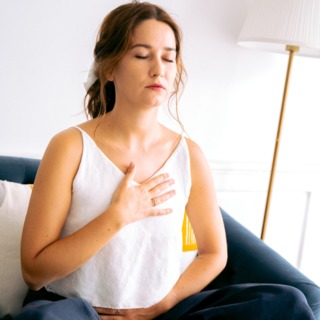
Go ahead and place the palms of your hands on your abdomen,
Right below your ribcage.
And counting to yourself,
We'll begin together.
Inhaling through the nose,
Right down into the base of the belly,
Filling it all the way up,
Gently pushing the air into the lowest abdominal region.
And then exhaling for 10,
Smoothly and consistently,
Allowing the abdomen to soften back down and letting the navel fall back towards the spine.
Try to keep the inhales and exhales the same length,
Counting to 10 or adjusting that count if you like.
Inhale again,
Fill the lowest part of the body all the way up.
And then allow the belly to soften and relax as the air floats out again continuously.
Continue breathing in this way,
Trying to very consistently control your breath.
Think about the diaphragm right underneath the palms of your hands.
The muscle that's attached underneath the bottom ribs,
Just underneath the lungs,
Expanding and pushing downwards as you inhale,
Giving you a sensation of filling up the belly with air.
And then notice with control,
The diaphragm muscle contracting back up underneath the bottom ribs as the pressure is increased in the abdominothoracic region,
Expelling the air out naturally on every exhale.
Continue counting,
Equal length inhale and exhale,
Focusing on the rhythm and the steadiness of the diaphragm muscle,
The smoothness of the execution of the in and out breaths.
Visualize your diaphragm extending down into the abdomen and massaging the internal organs,
Detoxifying the internal organs.
This stimulates the vagus nerve and it sends a message to the nervous system to slow down,
To stop releasing stress hormones,
And to prepare the body for sleep and deep healing.
Continue on just like this for a couple more minutes.
And gradually now just letting this breath fade away slowly.
Let the breath return to normal and watch that natural breath again entering and exiting all by itself.
With this exercise,
You can gain more control over your nervous system and your own personal healing just by toning and becoming familiar with your diaphragm by being mindful of how the breath is controlled.
When you're ready,
Go ahead and open your eyes,
Bring yourself back into the room.
Notice the difference in your mood,
In your thoughts.
You're welcome.