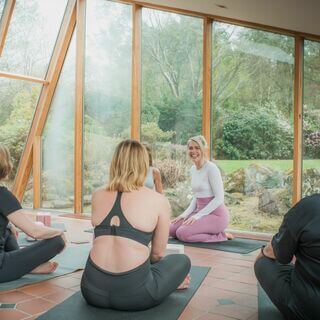
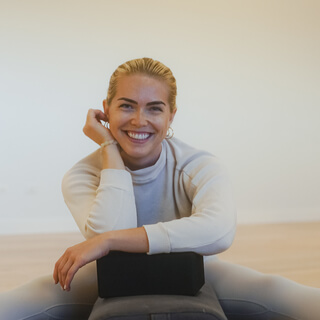
Hello and welcome to day number one of your retreat with me,
Jax.
Over these next three days,
We're going to move our body.
We're going to breathe.
We're going to meditate.
We're going to journal.
We're going to do some yin.
And today,
Specifically,
For day number one,
We will focus on grounding and resting.
Today's yin class is all about creating a space where you can slow down.
And connect deeply with yourself.
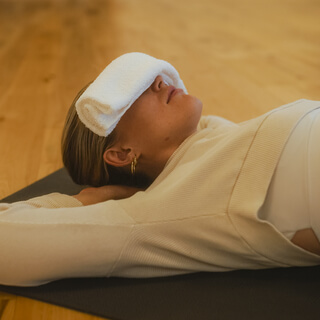
For this yin yoga class you'll need a yoga mat an option to have any props like blocks bolsters blankets eye masks pillows.
Yin yoga is all about surrendering into the postures and allowing the body to open and release.
And this release can be emotionally,
Physically,
Mentally,
Spiritually.
We all come to the practice for a different reason.
So let's go ahead and set an intention for this class.
What is something you'd like to cultivate or focus on during our time together?
It's okay if no answer is arising for you.
That's what these three days is all about.
To unearth discover,
And come home to you.
Let's start with butterfly pose.
So come into a seated position.
Bring the soles of your feet together and let your knees gently fall out to the sides.
The feet can be as close or as far away from the hips feels comfortable.
You can sit up on a blanket if that also is a little bit more supportive.
Let's inhale together,
Lengthen up through your spine.
And as you exhale,
Fold forward from the hips.
Letting your upper body soften over your legs.
You may rest your hands on your feet or your thighs or extend them in front of you.
Whatever feels most comfortable.
Start to take a couple of breaths here to transition into the posture.
There's no rush to get into the poses.
And when it comes to Yin,
For some of us,
We might be able to go all the way down.
With our head or our forehead.
But what would giving 40% look like in this pose?
So instead of needing to go all out,
What we're doing less look and feel like.
So maybe your breath starts to slow down.
And with each exhale,
Maybe your body starts to soften a little bit more.
Softening in the shoulders and the hips.
And yin is such an internal practice,
So we'll have lots of moments of silence today.
You We have three postures today,
And in each one of the postures,
We're going to talk about the three different principles of a yin yoga practice.
So the first principle is to come into the pose to an appropriate depth.
So only go to the point where you feel a little bit of resistance in the body.
So not trying to go as deep as possible right away.
Instead,
Just giving your body a chance to open.
And an invitation to go deeper.
Listen to the body and respect its requests.
And you can kind of consider your will and your body like two dancers.
Moving in total unison.
So this isn't a wrestling match.
We're not forcing our body into the postures.
Especially if the body is resisting it.
Instead,
In a yin practice,
We're yielding We're accepting our body the way it is and what it needs.
And part of the yin practice is learning this yielding.
So I'm going to go quiet now.
And just know.
That if you're feeling it,
You're doing it.
You don't need to go any further if you're already feeling a significant stretch or compression.
Going further is a sign of ego.
Staying where you are is embracing yin.
Let's start to come out of the posture.
Gently lifting your upper body back to center.
Slowly,
Gently.
Take a deep breath in.
The soft breath out.
Let's go ahead and bring both knees together,
Wrap your hands around your shins,
And then just curl up into this little ball shape.
Here for 10 breaths.
You Alright,
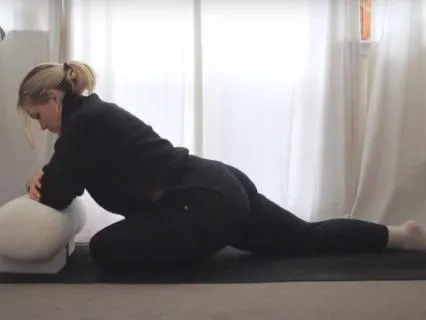
Now we'll move into sleeping swan pose.
This is a deep hip opener with a little bit of a backbend.
Let's start by coming on to all fours.
And bring your right knee forward behind your right wrist,
Gently extending your left leg behind you.
Untuck the toes.
And as you settle into the pose,
Begin to lower your upper body down onto the mat.
You can rest your forehead on your hands,
A block,
A bolster.
And if this is feeling really intense in the hips,
You can always place a block underneath the hips.
You can bring your foot a little bit closer to your hips or do anything that feels a little bit more supportive.
If you feel like your knees are complaining,
You can also do this posture on your back.
So you can either lie down and then lengthen your left leg out long and bring your right ankle on top of the left thigh.
So start to come into the posture if you haven't already.
And with each inhale,
Feel the breath move into the back body,
Expanding the space around your lower back.
As you exhale,
Allow your hips and lower back to soften and release.
So the second principle of a yin practice is to resolve to be still.
So once we found the edge,
And your edge is this wall of tension or resistance,
Once you find it,
Start to settle into the pose.
And we wait here in this posture without moving.
This is our commitment.
No matter what urges arise in the mind,
No matter what sensations arise in the body,
We remain still.
But there's two exceptions to this advice.
First,
If you feel pain or you're struggling to stay in the pose,
Please modify and adjust.
And the second is that sometimes the body starts to open up even more and it invites us to go a little bit deeper.
So stay still in the body.
So make sure those muscles aren't active.
Every time we move,
We engage our muscles,
And our muscles naturally want to take on any stretch in the body.
And in yin,
We're actually moving away from the muscles and we're getting a deep stretch in the joints and the fascia and the ligaments.
So allow that stillness of the body to set in.
Allow that stillness of the breath,
Slow deep breaths to set in.
And then finally start to invite a stillness of the mind.
To still the mind,
The breath must be calm.
To calm the breath,
The body must be still.
I'll let you know when we're coming out of this one.
Here for three more breaths.
If you're on your back,
You'll bring both knees into the chest.
If you're on your front,
Let's go ahead and push ourselves up into a tabletop position.
And then we'll take a little rest by lying down on our stomachs.
Make a pillow with your hands.
And we'll be here for 10 breaths.
All right,
Let's go ahead and take this on the other side.
So this time we're going to go ahead and bring the left knee behind the left wrist,
Lengthen the right leg out long.
Or if you're on your back,
Lengthen the right leg out long and the left ankle on top of the right thigh.
We'll go quiet for this one.
Take your time getting into the pose.
Find that commitment to stillness in the breath and the body and the mind.
And just let yourself be that silent observer watching everything unfold.
Here for three more breaths.
If you're on your back,
You'll bring both knees into the chest.
If you're on your front,
Let's go ahead and push ourselves up into a tabletop position.
And then we'll take a little rest by lying down on our stomachs.
Make a pillow with your hands.
And we'll be here for 10 breaths.
Let's start to find our way into a tabletop position and then a seated position as we take our final posture which is going to be dragonfly pose.
So go ahead and extend your legs wide apart in front of you.
And there's no need to go too far.
Just find a comfortable distance.
So you might actually have a blanket to sit up on that can feel really nice.
If this traditional posture doesn't work for you,
Then that is a-okay because we don't follow traditions.
We follow what feels good in the posture.
Yin yoga is not about aesthetics at all.
It's about how it feels.
So you might actually take this variation where you have a big bend in the knees,
Soles of the feet on the floor.
Wherever you're at,
On an inhale,
Sit up tall,
Lengthen through your spine.
As you exhale,
Start to fold forward allowing your torso to soften.
Now you might stay upright with your hands resting in front of you on a bolster or props or blocks.
Or you might really start to round here.
And as you start to melt into the pose,
Let go of any expectations.
Yin yoga is not about how far you can go.
It's about surrendering Yielding.
Softening,
Being passive.
Which is fitting for the last principle of yin,
Which is just a surrender.
To hold the pose for the time it's meant to.
To soften,
To breathe.
And let your breath carry you through any resistance,
Mentally,
Physically,
Emotionally,
Spiritually.
You So all you have left to do is stay.
The yin tissues that we're exercising are not elastic tissues.
They don't respond well to constant movement.
They're plastic tissues.
And this requires long holds,
Reasonable amount of traction to be stimulated properly.
I'll let you know when we're coming out of this one.
We're here for three more breaths.
Start to tuck your chin.
Start to slowly lift and lengthen up.
And then finally we'll come into a seated posture as we come to a close.
No rush to get there.
As we come to the end of this practice,
I want you to just come back to that intention.
What reason are you doing this at home retreat?
And just acknowledge that you've become this retreat by creating space.
Space in your hips,
In your breath,
In your awareness.
So remember the intention you formulated at the beginning.
And carry it with you,
Not just the rest of the retreat,
But the rest of the day.
Let's close with three rounds of the psychological sign.
Give me two slow,
Deep breaths in through the nose.
Open mouth exhale.
Two more.
May you be happy.
May you be healthy.
May you live with ease.
May I be happy.
May I be healthy.
May I live with ease.
And may all beings everywhere be happy,
Healthy,
And live with ease.
Thanks for showing up today.
And just know,
You're exactly where you need to be.
And I can't wait to enjoy the rest of this retreat with you.
Peace.