Hello,
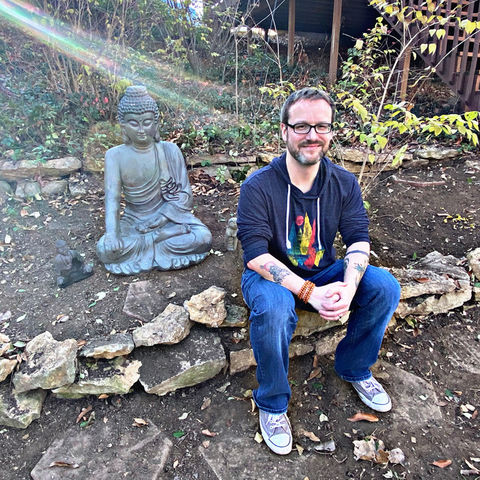
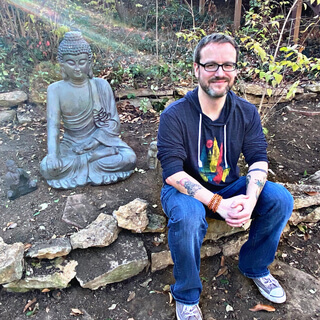
I'm Daniel.
I'm going to give a talk today,
And my talk is from this.
.
.
I'm going to read a passage from this text called Trust in Mind,
Which I like very much,
And then I'm going to comment on that passage,
And following that I'm going to lead a meditation.
I have noticed in in-person events I always will lead the meditation first and give the talk after,
And for some reason when I do virtual events like this one,
When I do online work,
I really want to give the talk first.
I don't know why that is,
But that's just how it is,
And if I.
.
.
If.
.
.
I say if when I get back to in-person events,
In those events I'll probably do that thing I used to do where I do the meditation first,
But that being said,
Here we go.
We get to have the talk first.
So this is the text,
Trust in Mind,
And sometimes this text is called Faith in Mind,
But this version is the one I like the most.
It's called Trust in Mind,
Okay?
Okay,
And I'm going to read this passage,
And then I'm going to comment on it,
And then we'll talk about that for a little bit,
And then we'll go to the meditation.
Okay.
Live neither in the entanglements of outer things,
Nor in inner feelings of emptiness.
That's it.
I'll read it again though.
Live neither in the entanglements of outer things,
Nor in inner feelings of emptiness.
So,
First of all,
Entanglements of.
.
.
This is pretty heavy,
Isn't it?
So,
Entanglements of outer things.
What are we talking about here?
What we're talking about is all those things that we think will make us happy.
All those things that we think will make us happy.
Like,
What?
Like when we think,
When I get the right car,
I'm going to be happy.
When I get the right partner,
I'm going to be happy.
When I get the right advancement in my career,
Then I'm going to be happy.
Or when I make this much money,
Then I can finally be happy.
What are we doing?
We're waiting to be happy.
That is what living in the entanglements of outer things is.
It is thinking,
I can't be content with myself.
I need this fulfillment out here.
This fulfillment that is external to me is what I need.
And I need it badly.
And I'm really unhappy if that is not fulfilled.
If this outer thing that I want,
Whatever it is that I'm obsessed with,
If that's not fulfilled,
I'm going to be unhappy.
I'm going to be unhappy.
And we don't even think about how,
Like,
We have so much access to material things that people in the past didn't have.
But are we happier?
I don't,
I tend to think we're not any happier,
But we have so much more access to material things that people in the past had.
And we don't really realize a lot of the time,
But I have,
I mean,
I have a computer in my pocket,
Right?
I have a computer in my pocket.
People in the past didn't have that and access to different kinds of food and what else?
Like more books than anyone has ever been able to have in the past,
Right?
We have so much access,
But we're still unhappy.
And things are so amazing in many ways,
In other ways they're not,
But in many ways things are so amazing,
But we still cannot settle and be content.
And a lot of the time we're just waiting for our chance to be happy.
I'm reminded of,
Gosh,
There's this movie that I don't like and I almost,
I really didn't want to bring it up,
But I'm really thinking of it a lot.
It's a movie I don't like.
It's called Click and it stars Adam Sandler.
And in this movie he is an architect or something and he works at a firm and he has a family,
He has a wife and children that he loves very much and he's obsessed with moving up in his career.
He is working,
Giving all of his life to his job because he's thinking at this X point in the future,
Then I'll be in management or whatever and then I can relax and spend time with my family.
Once I advance to this certain point,
Then I'll be there,
Then I can spend time with my family,
Then I can give my wife the love she deserves,
Then I can give my kids the attention they need.
And because he's thinking that way,
He's missing everything.
And there's a,
The movie's about a sort of a magical remote,
A TV remote and he can use it to fast forward time.
And so he quickly discovers like when he gets this,
He's fast forwarding through his whole life and he's missing everything.
He's missing everything and he's ruining everything.
And it's,
I think we can take that as a metaphor.
We're not going to get magical remotes,
Right?
But we are missing everything.
We are missing everything because we're spending so much time thinking about the past or the future or things that haven't happened,
Daydreaming,
Fantasizing instead of being here where we are noticing what's here and being present with it,
Being present with it.
And we could continue to do what we do,
Which is when something bad happens or,
Or when something good that we want doesn't happen,
Which is just like something bad happening,
We could think,
Why me?
Why?
Right?
We could think that way and that doesn't serve us very well,
But I want to suggest we could instead of thinking why we could think,
And I always say this right now it's like this,
What can I do?
Right now it's like this,
What can I do?
And there are some horrific current events going on right now and it can be easy to get caught up in negativity and think,
Why is this happening?
Why is the world so bad?
Or we can instead try to shift our minds and instead think,
Okay,
This is what's happening right now,
It's like this,
How can I make this better?
What can I do instead of just being miserable thinking about this,
What can I do to make a difference?
Because the truth is,
There's always something you can do.
There's always something,
Rarely in life are we totally powerless.
We might have a lot less power than we would like,
But rarely in life are we totally powerless.
You can do something,
Even if that is just seeing the misery in the world and saying something kind to your neighbor,
That is doing something,
That creates an effect,
That makes your little corner of the world a better place.
And I think we need to reflect and think about,
Well what can I do when it seems like the world is going to hell and it seems like we can't do anything and we're unhappy about it.
We can just ask,
Okay,
What can I do?
What can I do?
Is there something?
And sometimes it really feels like there's not something we can do,
But just being nice,
Being nice makes a big difference.
It does.
We think it doesn't,
But it does.
So that was living in the entanglements of outer things.
That is just being obsessed with what's out here when the truth is that calm and peace are within.
They are within.
I saw,
Maybe it was the first meme I ever saw,
I saw a meme that said peace,
Period.
It doesn't mean being in a place with no struggle or hard work.
It means being in the midst of those things and remaining calm.
Being in the midst of those things and remaining calm.
It's equanimity.
It's a quality that I like to talk about that we've been thinking about where we learn how to sort of weather the storms of life and not fall apart when things get hard.
And it's a challenging thing to do and I think it's the most,
Maybe not the most,
But one of the most important things that comes out of our meditation practice is equanimity.
You have to meditate for a while and you have to do a lot of meditation,
In my experience.
To have any feeling of equanimity,
You have to meditate a lot or for a long time rather,
But it's there.
It's there.
And when we talk about meditation,
We often talk about focus and clarity and awareness and compassion as well,
But we don't talk about equanimity enough and I think that's really what helps people the most.
It's what helps me the most.
I think it's what helps people the most.
It's just learning how to be in this state and accept the moment you're in and that's very hard to do at times because we often want anything to be different.
And it sort of sometimes feels like we're hard wired to not be content ever.
To not recognize what we have and to always want more and I think that's probably an evolutionary thing.
Like our ancestors had to have constant wanting or they would starve,
But we in the modern world,
We don't have to have constant wanting and we can learn how to get that under control,
Under some measure of control.
That's not to say I can give you a situation where you're not going to want anything and you're just going to be,
Oh I have a calm and even mind.
I'm pleasant,
Right?
It's not to say that,
But it is to say what we can learn how to do is mitigate some of that struggle we have from always wanting more.
I tend to think,
And I'm sure I've said this before,
But I tend to think that the reason there are instances of rock stars overdosing or killing themselves or taking incredible risks is one of the reasons rather that that happens is because they attain all their goals.
They get the fame and fortune that they really desperately wanted and the adoration of fans that they desperately wanted and I know I'm painting with a broad brush right now,
But they get critical acclaim and they get fame and fortune and then they realize that didn't make them happy.
Not like they thought it would.
Not like they thought it would.
And I think that is why we see that happening again and again in history is,
And there are other reasons why that happens.
I don't want to just say that's the reason,
But I do want to say that I think of that when I hear about a wealthy famous person,
A person who we think has everything to live for not being happy because the truth is they get there and they realize this wasn't what I expected.
The truth is things are not what we expect usually.
So that's what I wanted to say about that.
And then also,
Also don't live in feelings,
In inner feelings of emptiness.
What is that?
What is an inner feeling of emptiness?
So there's two ways I like to think about this and one way is an inner feeling of emptiness is that feeling that I have a void in myself that I need to fill.
That is my inner feeling of emptiness.
So I think I'm not good enough or I think that I need,
I have this empty spot inside me and I need to fill it with food or sex or shopping or drugs or whatever.
I have a hole inside me that I need to fill.
That is what I think of as the inner feeling of emptiness and the truth is you don't.
You don't.
There's not a hole inside you you need to fill.
And unfortunately that's a feeling so just me telling you that maybe doesn't cut it because it's a feeling.
It's not a rational thought.
I don't think,
Oh there's a hole inside me I have to eat more ice cream to fill it,
Right?
But it's a feeling.
It's a feeling that I need to consume more of whatever in order to be complete.
In order to be complete.
I'm not a complete person unless I fill this void,
This constant wanting.
Constant wanting.
That's what I take the meaning of that.
But that being said,
I think the writer of this text,
He was sort of thinking when he thought of inner feelings of emptiness,
I think he was thinking of something else.
I think he was thinking of sort of nihilism.
That is the belief that nothing we can do matters.
Nothing makes a difference.
That really negative attitude that everything sucks,
Everything's horrible,
There's nothing we can do.
Just don't try.
That's what I think he was getting at with that inner feelings of emptiness.
It's just man,
Nothing matters.
Nothing matters.
And I have to say,
And people usually don't believe me when I tell them this but I was,
Before I started practicing Buddhism and a little bit at the beginning of my practice as well,
I was a very negative person.
I had that kind of inner feeling of emptiness.
I thought this world is shit,
I hate everything.
I was that person that goes to the movies and goes to a movie and then leaves the movie and thinks that had a happy ending that was bullshit.
I was that guy and I did not like myself very much and I don't think other people liked me very much either.
But what I found with meditation and with Buddhist practice is joy in life,
Contentment and joy in life.
And that helped me a lot and I don't know where that path of negativity would have taken me but like,
I think people that I spent a lot of time with 20 or 15 years ago don't know me very well now because of that.
Because I was that person and I'm not that person now.
I'm really positive and pleasant and sunny.
I'm a delight and I think I struggled with that exact inner sense of emptiness,
That nihilism,
That nothing matters,
Everything sucks,
The world is shit.
And I'm really glad I got out of that because that was not a good life.
That was not a good life for me.
So,
That being said,
That concludes the talk and now I'm going to lead a meditation.
I'm going to lead a meditation.
I want to lead a mindfulness of breathing practice today.
That's it.
Just the mindfulness of breathing.
Sometimes I like to lead mindfulness of breathing leading into open awareness and sometimes I just like to lead open awareness and sometimes I just like to lead mindfulness of breathing.
So,
Today I'm just going to lead mindfulness of breathing.
So,
I want you to find your comfortable position.
If you're sitting,
I want you to make sure your back is straight.
I don't think it's good to just slouch and lounge around and meditate.
So,
Make sure your back is straight if you're sitting.
If you like to lay down,
Lay down on your back.
And if you're the rare person that likes to stand and meditate,
Just stand up straight.
Have really good posture if you can.
And we will begin by taking some deep breaths.
Oh,
First,
Your hands.
It's important that you have a plan for your hands.
I like to recommend one of two different things.
One is what I call the bowl.
One hand on top of the other,
Thumbs gently touching,
Resting in your lap.
One hand so the thumbs make a kind of circle.
And a lot of people say that one hand or the other being on top makes a difference and is important and I don't agree with that.
I think it doesn't matter.
So,
I call this the bowl and fancy people who are into fancy terminology call this the cosmic mudra.
Mudra means hand position and I think that that's too heavy of a term.
It makes it sound hokey.
So,
That is one hand position I recommend.
The other one is called relaxation mudra or relaxation hand position.
That's just hands on your legs,
Not quite on your knees but almost on your knees,
Just resting.
The point is that we have a plan for what our hands are doing because if we don't have a plan,
Then they can easily be a point of fidgeting.
And lastly,
Second to lastly,
If you're in a chair,
Firmly plant your feet on the floor and if you're sitting on a cushion on the floor,
Sit cross legged.
Whatever cross legged position is going to make your feet not fall asleep.
And this is an eyes open practice.
So,
I'm going to practice with my eyes open.
I'm going to put my attention on a wall that's behind my computer here and if you have a wall like that,
I think that's great.
What we want to find is something we can look at that is sort of boring and not going to distract us.
So,
I recommend looking at a wall or if you don't have a wall like that,
Look kind of a,
Put your eyes downward and look at the floor just a little bit of a down angle and look at the floor.
So,
Hands,
Legs,
Okay I covered everything.
So,
I'm going to ring my bell and we're going to take three deep heavy breaths and then I will give the instruction after that and then I'm going to ring it three times now and at the end I'll ring it two times to bring an end.
So,
We will just sit for a while.
Here we go,
I'm ringing it now.
Okay,
Begin by taking three deep heavy breaths.
And then following that we want to just breathe normally.
We don't want to try to breathe slow or fast,
We just want to breathe and I want you to bring your attention to your breath.
This is going to be our focus for our meditation practice,
Our anchor.
So,
When we bring our attention on the breath then whenever something comes to distract us or take us out of the meditation,
We're going to just bring our attention back to the breath.
So,
I start thinking about what I'll do later,
I notice I'm thinking,
I bring my attention back to my breathing.
I start thinking about something that happened today,
I notice I'm remembering and I bring my attention back to my breathing.
The breath is always there for us to return to.
The reason why we say the breath is a good anchor is because it's something that is always with us and unless we have a problem,
We don't think about it that much.
It's always with us,
It's happening all the time but unless there's a problem,
We're not bringing attention to it.
So,
That's why it functions well as an anchor.
So,
Bring your attention to the in-breath and just notice your breathing in and then notice your breathing out.
In,
Out,
In,
Out.
And there's two different options for how to focus on the breath and one is to pay attention to the way it comes into and out of your nose and if that's really difficult another option is to pay attention to the way your belly rises and falls.
It's rising and falling with each breath but unless we're paying attention,
We don't know it.
And even if both of these are very hard for you,
You can kind of rest your hands on your belly and that'll help put the attention there.
That's what,
When I meditate with my kids,
That's generally the practice they want is to put their hands on their belly and actually physically feel it both ways.
Basically,
Feel the expansion in their belly but also feel it rising and falling with their hands and I think that's a good practice as well if you have a lot of trouble.
And a lot of people like to do the practice of counting and that is where you mentally note one on the in-breath,
Two on the out-breath.
In one,
Out two.
In one,
Out two.
So,
In this way,
Every time you start daydreaming,
Every time you have a thought or a memory or a feeling,
You just go back to one on the next in-breath.
We don't want to beat ourselves up when we struggle because we're always going to struggle.
We just want to go back to one on the next in-breath.
That one is always there.
So,
In one,
Out two.
In one,
Out two.
In one,
Out two.
And we will just sit here breathing together for a little while.
I'll mind the time and I will ring my bell two times when we are done following our breath.
In one,
Out two.
In one,
Out two.
In one,
Out two.
In one,
Out two.
In one,
Out two.
In one,
Out two.
In one,
Out two.
In one,
Out two.
In one,
Out two.
In one,
Out two.
In one,
Out two.
In one,
Out two.
In one,
Out two.
In one,
Out two.
In one,
Out two.
In one,
Out two.
In one,
Out two.
In one,
Out two.
In one,
Out two.
In one,
Out two.
That is all for today.
So I hope you have gotten something out of sitting and doing that breathing meditation with me.
Thank you for taking the time to sit with me and have a good day.