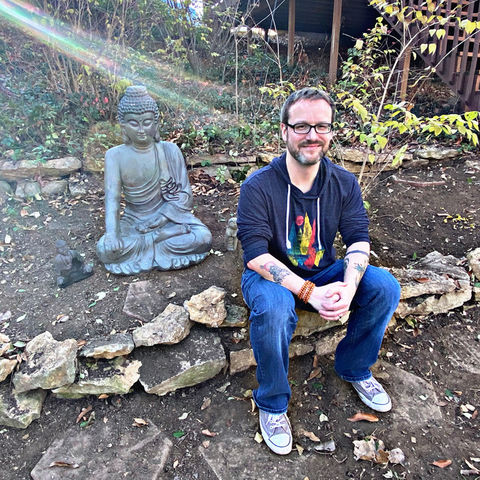
This talk was recorded at One Mind Zen.
I was invited to give a talk here and I was thinking,
What am I going to talk about?
And I read something that really inspired me.
So if it's all right,
I would like to share a short reading with you and then a longer commentary on that reading.
And because not only did this passage really inspire me,
But also I found it really powerful and relatable to the way things are going all the time really,
But the way things are going right now for me.
And that is a little passage from this text called The Method of No Method by Chan Master Sheng Yan,
And I'm going to read to you this short passage and then I'm going to comment on it because I think it's really helpful and important.
And this passage is on the subject of impermanence.
And this is what Master Sheng Yan has to say.
Impermanence is a fundamental teaching in Buddhism that you can use to attune and refine your mind.
There are three aspects to impermanence to understand impermanence of the environment,
Impermanence of the body and impermanence of the mind.
Without considerable practice,
It's difficult to experience the transient impermanent nature of your mind,
But it's much easier to begin by understanding impermanence in the environment.
Through gradual steps,
We can come to understand the impermanent nature of the environment,
The body and the mind.
The environment is constantly changing and your body changes with it.
As the environment moves and changes,
Your body also moves and changes.
Since there's no fixed unchanging reality in the external environment,
Your body,
Which is part of the environment,
Is also not fixed or unchanging.
As the body moves through the environment,
It will cause your perception of the environment to change too.
The body is constantly going through changes,
So when you experience physical discomfort or pleasure,
There's no fixed nature to that feeling.
After some time,
It will pass.
The physical body also feels hunger,
Thirst and other sensations.
All of these are also transient and they too will change along with the body.
All of these changes impinge on your body as sensations and thus influence your mind.
Understanding all this gives you a point of entry into the practice through becoming aware of your own sensations of changes around you and in you.
We're very attached to our body.
We cherish it and cannot easily give it up.
However,
Becoming keenly aware of the body's changeable nature and inevitable decay will help us be less attached to it.
We can free ourselves from its limitations or restraints.
We can become more detached from its workings,
Motions and sensations.
It's very difficult to experience the impermanence of the mind without a practice method.
If our thoughts were permanent and unchanging,
We would not be afflicted by a mind in flux.
When we are not at peace with ourselves,
We are ill at ease and agitated.
In such a situation,
We need a way to calm our mind to become aware that thoughts come and go beyond our control,
Rising and falling,
Only to be succeeded by others.
One method for calming the mind is to contemplate the transient nature of thoughts.
When you're aware that your thoughts arise and perish of their own accord,
There will be no need to be ruled by them.
Your mind will settle into observing them.
So I just wanted to read that to you because I really like it a lot.
I really like what Shen Yan has to say.
But I want to talk about impermanence today.
I think it's really a fundamental teaching in the Buddhist path is that teaching of impermanence.
And to me,
A big part of what it represents is,
Of course,
Change.
Things are always changing.
And Shen Yan kind of expresses that he thinks that impermanence of the environment is the easiest one for us to detect.
And in a sense,
I agree with that,
Except that I'm 40 years old.
And as I have gotten older,
Impermanence of my body is way easier for me to detect than impermanence of the environment.
So I think when I was 20 or 25 or 30,
Probably the environment impermanence was easier for me.
But now,
No,
It's my body.
Certain body parts don't work as well as they used to,
And I'm slower.
And when I get sick,
It lasts way longer.
And so I can only look forward to being 50,
60,
70 and seeing how that progresses because I think I know exactly how it's going to go.
But although in the environment,
I could say,
I think when I was a young man,
I noticed,
Of course,
Like pets die.
Your car wears out.
All sorts of things are changing in the environment all the time,
Changing in ways of decay and changing in just random ways as well.
But I think the getting older,
I think the older I get,
The more clear impermanence is to me.
I've got gray in my beard and things don't work as well as maybe they used to.
And I sometimes I get tired and go to sleep at nine o'clock.
And that's just because I'm 40 and as a young man,
It was stay up all night.
So it's a real change.
But I want to talk about also a very personal thing.
And that really relates to impermanence.
It's really what I immediately thought about when I read that passage in this.
Again,
This is a book I really like and I will tell you the name of it again at the end.
This is a personal story.
My nephew,
My brother's son,
It was discovered he had something called Brugada syndrome,
Which is a heart condition,
Which is a very deadly heart condition.
And I'm telling you that he's 18 years old and he passed out and they ran some tests on him and they discovered that he had this.
And the problem with Brugada syndrome is it is genetic.
So what did I have to do?
I had my brother first,
My brother took a genetic test and he found out he has the gene for this Brugada syndrome.
So it was not his wife that gave it to their son,
But rather it came from my brother.
So what does that mean?
What means I had to go get this genetic test and I have the gene as well.
So what does that mean?
That means that I have maybe very likely been carrying this deadly genetic heart condition around my whole life and nothing ever happened.
So I didn't know.
And my brother now is wearing a heart monitor and to see if he needs a pacemaker,
Which is what his 18 year old son got a pacemaker,
Which sounds crazy to me.
But also,
Man,
I wouldn't want to get surgery right now.
So my brother's wearing a heart monitor to see if he needs a pacemaker.
And I'm waiting for my appointment with a cardiologist because doctors are very busy right now.
So I just have that and I've been waiting.
It's going to be late December when I have that appointment.
So impermanence,
Right?
I have the genetic marker for this condition that literally it just makes your heart stop and you die.
It's just gone.
And often no warning signs at all.
And that is right.
That's very scary to know that I have to wait to see a doctor.
But of course,
I've gone through 40 years of my life without knowing I have this.
And of course,
Even the scarier thing is my kids are going to have to be genetically tested.
I have four kids and two of them are genetically mine,
Which means they're going to have to get tested and see if they have this gene as well.
It's a Brugada syndrome.
You can look it up.
It was just discovered within my lifetime.
It was discovered 30 years ago.
So not that much is known about it.
But I'm telling you all that just to tell you that it has really put things in perspective for me to realize,
Oh,
Life is really fleeting,
Right?
This is a situation where I could just be gone one day seemingly for no reason.
And we don't know yet if it came from my mother or my father.
We're asking our aunts and uncles to get tested for this.
My mother and father have passed.
They were cancer victims.
And so whichever one of them had this,
The cancer got them first before the deadly heart condition.
But if you look up Brugada syndrome,
It really freaked me out when I looked it up because it says symptoms,
Sudden death.
So wow,
That's really scary.
And that just really tells me that my life is fleeting.
And if I didn't have my practice,
I think I'd be an anxious mess because I started my practice because I had serious anxiety problems.
And what is more serious than,
Oh,
You could die basically for no reason,
Right?
So I'm telling you all that to tell you that it made me realize how fleeting life is.
But also,
Yes,
Life is fleeting for me because I have this health condition.
But also,
The truth is that we know when we think about it,
Life's really fleeting for everybody,
Right?
Because yes,
This heart condition,
The other kind of broken heart,
That's what I call it.
This heart condition could kill me,
But also anybody can get in a car accident at any time and just die,
Right?
And also right now,
There's a pandemic going around.
And apparently,
Sometimes people get it and they get really sick and they fall apart and they die or they have to be on a ventilator for a while or go to the hospital or whatever.
And sometimes people get it and just nothing happens,
Right?
And in that way,
Life is fleeting too.
I've heard of people with no previous health conditions who just get this COVID and they're just dead.
And that's really a fleeting aspect to life as well.
But still,
Car crashes are probably the most likely thing to kill you in a regular day-to-day life,
But there's all sorts of things that can kill you.
And I think we have to be reminded that our lives are very,
Very,
Very fragile.
And we forget that sometimes.
We tend to think that something silly and random is not going to kill me,
Right?
But it could,
Of course.
So what can we do is the question.
And I think this path,
This Buddhist meditation path is about taming our minds,
Learning how to become more aware and living more fully.
At least that's a huge aspect of what it's about.
Maybe that's not everything because we're talking about real enlightenment that's up here,
But the little awakening is just learning how to control our minds a little bit,
Learning how to be aware of the world around us and live more fully and see things more clearly.
I like to say.
.
.
I'm saying I like to say this,
But there's this adage,
You can't add more years to your life.
You can't always add more years to your life,
But you can add more life to your years.
If we pay more attention and we learn how to be present,
Then we get essentially more life.
And because if we're not present,
It can tend to happen that our life goes by faster.
I've heard.
.
.
You hear people say sometimes like,
It seems like my kid was just born yesterday and now she's driving a car,
Right?
People say things like that and that's because life's passing us by.
It's passing us by all the time.
And that's because the nature of things is impermanent.
Everything is impermanent,
Right?
Even things that we think last forever,
Like mountains or stars,
Even those are impermanent.
Everything's impermanent.
There may be a different timescale,
But everything's impermanent.
Sometimes we think,
Oh,
But not me,
Right?
We think in some way we are less impermanent than everything else.
And the truth is our bodies and minds remind us.
I failed to mention the mind before and I said,
My body's slower.
Some parts don't work as well as they used to,
But also I think slower too.
And I think that's pretty common.
And that's another manifestation of impermanence is I think a little bit slower than I used to.
So now I want to talk about impermanence of mind.
And that's maybe it's a little bit subtler than impermanence of body and impermanence of environment.
Oh,
I don't like the word subtler,
But the truth is it's a lot more obvious.
And we realize it's a lot more obvious through our meditation practice.
We realize how fleeting our thoughts and feelings are.
These things just come and go like clouds in the sky and we have a thought and then it goes to another thought and another thought and another thought.
And until we learn to really pay attention to our thinking,
We don't always realize that.
And sometimes I have found that I realize,
Oh,
Why am I thinking about what I had for breakfast three days ago?
This is not relevant to my experience,
But it's just because our minds are fleeting and our minds just take us places.
And that's the impermanence of our minds is really that we don't really know where it's going and we don't always have control.
These thoughts just,
They just come and go.
It's especially true.
Something I really like to think about is feelings because I think we have this idea sometimes that when a feeling comes,
We have this idea that the way we're feeling now is how we will always feel.
So that's why really the negative feelings like anger or just a deep sadness can be dangerous because we start to feel angry about something and then we can't imagine that anger coming to an end because we're so mad and we don't think the truth,
Which is right now it's like this,
But this is going to pass.
Everything passes.
That's the important thing about impermanence is that the good things are going to come and go and the bad things are going to come and go and the environment and in our minds too,
The good feelings are going to come and go and the bad feelings are going to come and go.
But the truth is I think most of our experience is more neutral,
But we pay a lot of attention to the good or the bad.
We pay a lot less attention to the neutral things,
But I think the truth is that for most of us,
Almost every experience we have is neutral and almost every feeling we have is not something we would label good or bad.
The mind's nature is impermanent,
But without a diligent,
Dedicated meditation practice,
We don't always see that.
Our thoughts and feelings change more than anything.
We can talk about how our environment changes and how our bodies change because they do.
It's very clear,
But our thoughts and feelings change more.
The last thing I want to address is without impermanence,
We can't get better.
We can't improve ourselves without impermanence and bad things can't pass without impermanence.
In a way,
We can try to see impermanence as a good thing or at least as a neutral thing,
Even though getting older is kind of scary and having the things we love go away from us,
That's kind of scary too,
But at the same time,
The bad things can't go without impermanence.
The COVID crisis we're in,
That can't go without impermanence.
When we're mad or upset,
That can't go without impermanence.
In a sense,
We can say impermanence is a good thing or at least a really necessary thing because we can't get better without impermanence.
We can't improve ourselves.
We can't change our situation for the better without it.
In that sense,
I think impermanence is a good thing if we can put a label on it.
That's my talk.
Thank you for taking the time to listen to me.
Thank you so much for listening.
Have a great day.