Welcome.
So retreat,
It's such a good time.
This time of year was solstice on Sunday,
And I really like to take retreats with the seasons.
So I take four retreats a year,
And then I lead retreats.
And each retreat has a different theme or quality to it.
In the fall,
I take a retreat for my birthday,
And that's usually a silent solo retreat.
And in the summertime,
We take a family retreat,
And I take my boys to Bordeaux to Plum Village,
France,
Which was Thich Nhat Hanh's monastery.
And they've been going there for five years now.
So I asked my son last night,
We were watching soccer,
And I said,
Why do you think we go on retreat,
Honey?
Like,
Why do you think we do this?
He's 13.
He started when he was eight.
And he said,
Oh,
Well,
The first time you go,
You go to learn.
And then after that,
You go to remember.
And I was like,
Yeah,
That's it.
Like you go to learn and then you go to remember.
But many of us have already had experiences of retreat,
Never been on a formal retreat.
When you were a kid,
Maybe you created your own retreats.
You had that place that you'd go on the weekend or after school.
You'd have time with yourself.
Maybe you would read,
Or maybe you'd go into nature and look for things and collect things.
And you came back to more of who you are.
So that's what retreat is about.
It's sort of a pulling in of yourself to remember.
And then maybe there's some things that percolate while you're on retreat.
The word retreat comes,
It's a Latin word,
But it was used in French,
Speaking of the French countryside,
In France the word retreat was used for when they were in battle.
And it was to pull back from battle and regroup,
Right?
So think about that from in your life,
The battles that you're in.
I was,
This morning I was leaving my house and the trash truck parked right there,
Like behind my car.
And so I had to do one of those,
Like you have to pull your car up a few feet and then back it up and then pull it to try and get around.
And every single move that I made,
My car was going beep,
Beep,
Beep.
And I was like,
This is the most irritating sound.
But we have that all over the place.
Like our nervous systems are constantly getting overstimulated,
Those little beeps.
And a retreat is a time to.
.
.
Remove yourself from the battle.
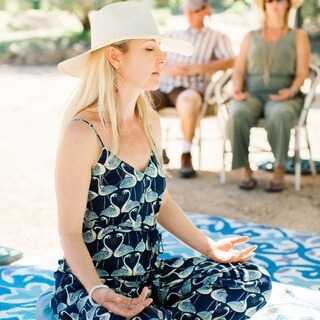
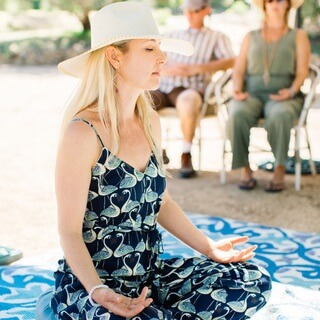
So I wanted to talk today about sort of what happens on a retreat and then how maybe you could create your own if you wanted to do a half day or a morning.
Create your own summer retreat,
But then also just what's sort of happening in these sort of layers of deepening.
So one of the first things that you may notice when you're on a retreat is there's a physical restoration that happens.
And some of that physical restoration just happens from removing yourself from the beeps of life,
But also by nature,
Usually if you're going to a retreat center or you're designing a retreat for yourself,
You're eating in a certain way,
You're sleeping in a certain way,
You're moving your body,
You're in nature,
And your body will start to actually,
Like at the cellular level,
Start to restore itself.
My good friend Alyssa Apple did this.
She does like the coolest studies She always does she studied Wim Hof breathing with Wim Hof But she did a study with Deepak Chopra before he was determined to be who he is So she did a study with Deepak Chopra where they had people at the Chopra retreat center randomly assigned to either seven days of just being at the retreat center on vacation or seven days of a retreat with meditation and mindful walking and reflection,
Journaling,
Time in nature.
And post-retreat,
Like right afterwards,
They saw significant,
You know,
Everyone felt better,
Improvements in stress and improvements in well-being.
But what was interesting is that 10 months later,
They were taking these people's blood.
So one thing about Alyssa Apple,
Who's at UCSF,
Is she looks a lot at stress response at the gene expression level and at the cellular level.
And 10 months later,
Those that did the retreat condition,
That were randomized to the retreat condition,
Showed significant differences in terms of stress markers,
Like interleukin-6,
Which is a cytokine,
And changes in gene expression in the immune pathway.
So just seven days of doing retreat has these long-lasting effects.
Restoration.
And then there's sort of like a habit reset that you can engage in.
So say you do a half-day retreat,
You may choose to put your phone away for half a day,
Or you may choose to go off coffee for a few days,
Or you may choose to just notice some of the habits that you want to shift.
And a retreat is a great time to do that.
Whenever I take people to Costa Rica,
I recommend them to pick one thing you're going to leave behind.
And you'll be able to do it while you're here,
Because we're going to be in community.
So there's a habit reset.
Parts of retreat are these three.
At Plum Village,
They call this mindfulness,
Insight,
And compassion,
Or you can think about it as mental hygiene.
You start to notice the nature of your mind because when you have nowhere to go,
But here,
Your mind has a lot of things to say and there's all these habits.
Of your mind.
So it's a mental hygiene,
As we do in here,
This like little mini retreat,
To begin to notice the commentary of your mind and the places where it gets stuck.
And you can develop insight.
So maybe some understanding that you didn't have because you've been staying so busy.
And then eventually,
Depending how long you spend or what type of retreat you go on,
You will contact most likely an experience of interbeing,
Which is the recognition that you're interconnected and you can start to feel that interbeing,
Like how you may feel in here a little bit of like we're part of a greater community.
And then the conditions,
Like if you're gonna,
The conditions for retreat is always a,
You know,
To set an intention,
Like,
And we can even think about that here in this space.
What's your intention for being here?
What's your intention for being here?
And then what is the container or the vessel?
As Francis Weller talks about,
Like he says,
It's like an alchemic reaction that you're creating.
There's going to be some heat.
And you need a vessel that's strong enough to hold the heat without cracking.
So the container will be,
You know,
If you go to a retreat center,
They're all over the place now.
Everyone has a retreat.
There's a group of therapists that I run.
They all want to make retreats.
But really,
What's the container?
And there's certain containers,
And there's certain retreat spaces that have been seasoned for so long with the energy of people being on retreat.
We're seasoning this space.
It's fairly new.
It's only a year.
But 10 years from now,
This place will be so seasoned by the energy of people meditating in it that when you come into it,
You will feel that.
You may feel that in certain yoga classes,
Like there's an energy of the space.
There's energy of retreat centers.
When I was writing Why Zephyr,
I wrote some of it at Spirit Rock up in Jackson.
Little riding hut,
And just being in the space,
My whole nervous system shifted by the energy,
The seasoning of the space.
So you want to pick a container that's supportive of your retreat.
And then you want to set a time of when it begins and when it ends in a routine.
Like what is your routine going to be?
On many retreat centers,
I try not to set my alarm and wake up with the morning bell,
Or wake up with the sun.
And then what are you going to do first thing?
And then,
What is your afternoon going to be like?
I brought in,
If you want to look later,
I brought in one of the schedules from a retreat.
And it's basically like.
.
.
Sitting meditation,
Walking meditation.
Total relaxation.
Dinner,
Sitting meditation,
Walking meditation,
Bed.
That's your schedule,
You know?
And then a ritual to that.
So there's how you create ritual.
There's lots of little rituals that you've noticed in this space that are intentional,
Like creating an altar,
Using a bell,
Or the bows,
Like creating your own rituals for your retreat.
Renunciation is about what you're going to let go of,
What you're going to maybe not practice while you're on retreat.
And then noble silence is a very important part,
Determining parts of your experience that are silent.
So at Plum Village,
Where we practice our family retreat,
It's noble silence from night until morning.
And we keep a little family notepad where we can write things down.
I love it every year,
And I've kept these little notepads because it's so interesting to see what you write down,
What you think is so urgent for somebody to know.
And then you read it later,
And it's so stupid.
It's so like,
Don't forget the sunset.
I have the sunscreen,
Your shoes are outside,
You know,
All the chatter.
So you can keep a little notepad if you have noble silence,
Like what's going on in your mind,
But to kind of let that be so you can be present.
And then today we're going to do some of these practices that you can do on retreat,
Which are some of the most basic of sitting,
Walking,
Eating.
Service meditation is part of retreat.
So cleaning toilets or setting up cushions or helping someone in,
Welcoming somebody new.
You know,
Like the new people come into this space and like,
Are you part of our service to each other is to welcome each other.
And then interpersonal meditation.
Which is always fun.
You may even be on a silent retreat and having interpersonal meditation because there's a person that's irritating you.
That's activating you.
That is your own shadow that now you have something to work with on that whole retreat,
This person.
Or you may engage in interpersonal meditation if you do like a couples retreat or something like that.
So retreat to step back to withdraw.
And Thich Nhat Hanh wrote,
The mind can go 1,
000 directions,
But on this path I walk in peace.
So how to find peace even when our mind is super activated.
And that practice will help you the first time you learn,
And then you do it again so that you remember.
This is my sunset prayer.
I think it's a should that I assign people.
You actually need to.
It's a should.
OK,
So I like to bring in little.
I hope I have enough.
If you can take one of these and pass it around.
So take the whole bowl.
Yeah.
Don't use your fingers.
It's gonna take an hour and a half to but that's okay do it mindfully So I'd say my first retreat was in a treatment center and I didn't know it was a retreat but I was I was at Kate high school and not doing well at all and I was 14 and 72 pounds and my mom sent me to Florida and I was a retreat another kind of retreat It's like you got to get out of here because this is gonna kill you if you stay here And one of the first things that I learned there was mindful eating.
Mindful eating.
And this was about the right size of eating that I was prepared to eat at that point in time as a raisin.
It was still scary.
But I'm going to teach you what I learned.
And actually,
What's the beautiful circle to all of this is that the mindful eating practice comes from Kabat-Zinn.
And I was just on retreat with Kabat-Zinn this January.
And he taught mindful eating as part of mindful stress reduction at University of Massachusetts.
And he sort of coined this raisin exercise.
So when we mindful eating before we're going to practice this.
And what I would encourage you to do is maybe this week choose a meal to practice mindful eating with.
Choose a meal to sit outside in silence and prepare your food and eat it.
Maybe just even just a few bites in the way that we're going to eat today.
And we're going to expedite this raisin passing out.
But I'll read you the contemplations before eating.
We have this at our dinner table.
So I'll read this to you.
This is what we read,
Not every night,
But when we remember.
My children remember and they have it memorized.
So they recite it,
Contemplations before eating.
Precious planet.
We accept this food so that we may nurture brotherhood and sisterhood,
Build our sangha,
And nourish our ideal of all living beings.
So this little grape turned into a raisin.
And in your raisin,
If you want to look at your raisin as it comes to you,
In your raisin holds a lot of things.
It holds the sun and the earth.
It holds the workers,
People that.
.
.
Planted this little thing and grew it and watered it,
It holds the people that put it in a truck somewhere and carried it.
It also holds the potential,
You know,
A raisin will have a seed in it.
These are probably seedless ones,
But it would have a potential to make another raisin,
Right?
And we have a preconception about what a raisin is,
But in every single thing,
There's a continuation of that thing.
So when you practice mindful eating,
The first thing you do is just observe what you're going to eat.
And you may notice that if you look at it,
Because most people have one,
If you look at your raisin,
You'll notice some things about it that you haven't ever noticed before about a raisin.
How much time have you contemplated a raisin?
In the same way that we notice our mind when we're doing meditation,
And you can look at your raisin for a little bit.
Appreciate your raisin.
It's completely unique.
There's no other raisin like this on the planet.
And the colors,
The expectation,
We think raisins are brown or purple or whatever.
This raisin has its own color.
And then you can hold it up to your mouth and then notice the instinct.
To just plop it in,
But before you plop it in,
Take a smell.
So you can smell your raisins.
And then you can put it on your tongue and roll it around for a little bit and maybe close your eyes.
The visual cortex takes up so much of our energy.
So if you close your eyes,
You can notice the texture.
Explore your reason fully.
And then you can chew the raisin.
And notice that experience of chewing.
And then the reason that's still with you even if you've swallowed your reason.
How it lingers.
Now it's part of you.
So now you have a little bit of sun and a little bit of earth and a little bit of that gardener and that trucker and the grocery store clerk and a little bit of Diana who picked out some raisins for all of you and thought about you.
It's all inside of you now.
Yeah,
So interbeing.
So with raisins in our experience,
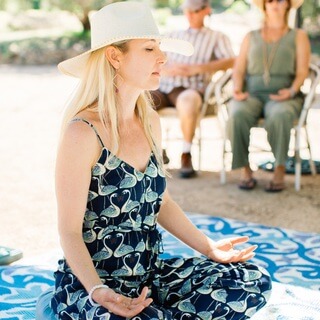
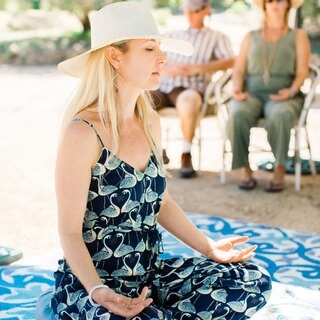
We can close our eyes and we'll practice a very simple,
Sweet sitting meditation.
Taking a breath with each bow,
Coming back to remember.
So let's just go ahead and settle into the body in this moment.
Feeling where your body touches the ground.
Feeling where the body touches the air.
The sounds around you.
And maybe even the taste in your mouth,
The lingering taste of all your past experiences.
All of your past experiences that come to shape this present moment.
And how your experience in this moment will shape the next moment.
So you can pay attention to the breath and just notice the breath,
How it wants to settle.
So giving it permission to settle at whatever pace.
Or length.
Frequency that it wants to settle at,
The depth it wants to settle at.
Just inviting your breath.
And there's some simple gathas or mantras that can be helpful.
When we sit in meditation to start our practice and one simple meditation is just breathing in,
I have arrived.
Breathing out,
I am home.
Breathing in,
I have arrived.
Breathing out,
I am home.
Arrive.
And as you arrive home into your body,
Into your breath,
Into this present moment,
You may feel sort of the urgency to escape or run away or the itchiness of settling,
You know,
Sort of like a fan that's turned off and starting to slow.
And just gently give yourself this opportunity,
This gift to retreat.
To step back for a moment and be here.
Give yourself that gift to just be here with your breath,
With your body,
With this community.
In this life.
Breathing in,
I have arrived.
Breathing out,
I am home.
Let yourself be at home.
And there's some qualities that you can invite into your practice.
One quality is spaciousness or openness.
Another quality is freedom.
So you may say,
Breathing in,
I am spacious.
Breathing out,
I am free.
Breathing in,
I am spacious.
Breathing out,
I am free.
Spacious.
Free.
And to truly let go into the meditation,
It's important that you feel safe.
And that you feel connected.
So maybe you can remind yourself,
Breathing in,
I am safe.
Breathing out,
I am connecting.
Breathing in,
I am safe.
Reading out,
I am connected.
Save.
Connected.
And so with this offering of these qualities.
Arriving home.
Spacious and free.
Safe and connected.
I'm going to be quiet for a little bit and let you practice your own retreat.
Bringing your awareness to your full experience.
Arriving home.
Spacious and free.
Safe and connected.
And if you notice that your mind is itchy or wants to go somewhere or there's a unsettled edginess,
And just welcome that into the space.
And breathe with it.
Breathing in,
I have arrived.
Breathing out,
I am home.
So can you be at home even with.
Unsettled.
Visitors or thoughts.
The more spacious you make it,
Breathing in,
I am spacious.
The more free you are from those agitations.
So the mind can be agitated and you can be free from that mind.
It's what you're practicing.
Breathing in,
I am spacious.
Breathing out,
I am free.
And when you experience that,
You can sit with yourself.
You experience safety.
In connection.
Breathing in,
I am safe.
Breathing out,
I am connected.
Just give yourself those gifts.
Arriving home.
Spacious and free.
Safe and connected.
Let yourself just take this time to retreat.
To be here.
And then we can close our meditation with an offering of metta,
A wish for all beings to experience this,
Maybe bringing to mind somebody who is needing some of this today.
Be somebody that you care about.
Group of people,
An animal.
But thinking about a particular person or group in mind and bringing them into your mind.
Into your heart.
And you can wish them.
May you feel at home.
May you feel at home.
May you be free.
That you'd be free.
And may you feel connected.
That you feel connected.
So sending them this wish.
And then sending this wish to our whole Sangha,
Practicing together.
May we all feel at home here.
Maybe feel free to be ourselves.
And made me feel connected.
Wishing that for our group.
When you're ready,
You can come back to the room here.