Hi team,
I have to talk about this somatic technique for releasing chronic body tension.
It might help with chronic pain as well.
It's called the 1% relaxation method and I have found it remarkably powerful.
I've experienced a lot of relief from my own chronic bodily tension over the last few weeks.
And because of just how astoundingly powerful it is for how simple it really is,
I just feel really called to share this because I know it's going to help a lot of people out there.
So this is the 1% relaxation method and I thought I would explain how to do it first of all so that as I continue to talk and explain why it works and a bit more about my background you can keep referring to it.
You can continually apply this micro dose technique this this micro dosing principle as we gradually gently but consistently release.
The tension.
In the body.
So the first thing to do is become aware.
Of their tensions.
That you carry in the body.
And where possible,
I know from experience that this is challenging.
But we're trying to become aware of it with neutrality.
Just be interested in the tension.
If we're frustrated.
And annoyed and angry.
At the tension.
It can actually make it worse.
It reaffirms the tension.
If we're angry and frustrated at our attention It increases the negative emotional charge,
Makes us feel more afraid of it.
Makes us feel even angrier towards it,
And that actually tightens the body up further.
It prevents the release of tension.
So instead.
.
.
Just do this now,
Become very aware.
Of your chronic tension.
Chronic pain also.
Whether that's a full body tension that you experience or you experience tension more localised,
So perhaps the jaw the temples.
The throat.
The chest.
Shoulders.
In the stomach,
The belly.
Around the hips.
Goodbye.
Just observing these areas.
And you might feel there's an intensity.
There is a real tight feeling like the body is clenching.
That's what it is.
It's like a gripping.
Clenching.
And ordinarily,
We might be a little frustrated by this,
A little annoyed and it's uncomfortable and painful.
And so we tried to force it.
To release.
We try to force it to relax.
We want it to relax the whole way.
But in this approach,
We're much more gentle.
Much more gradual.
You're simply aware of the area with total neutrality,
So there's no emotional charge to it at all.
Just observe it,
Just feel the tension,
It's intense.
Really intense,
Sometimes very vivid feelings.
But don't apply any emotion to it,
Just feel it.
And from that point.
You just ask your body.
Would you feel comfortable releasing a single percentage of that tension?
Just 1%.
That's all.
And it's relaxed.
Inquiry.
Compassionate and gentle encouragement.
We're not telling the body what to do or forcing it to do anything.
We're actually just observing the feeling in the body.
Just with curious interest,
Perhaps even amused curious interest.
Just noticing,
Wow,
Yeah,
There's an intense tightness there.
I wonder if I can just release this just by a percent,
Just tiny amount,
Tiny amount.
Try this.
Try this now.
Because it's only a percentage.
It's not we're not getting fireworks here It's not some profound,
Amazing full body relaxation.
We don't need to do all that.
It's just 1%.
That's it.
A micro dose of relaxation,
A micro dose of inner peace,
Almost homeopathic.
Tiny drop.
And if there is some release there,
We just,
Ah,
Yeah,
I can feel a slight.
Unclenching.
There's a release of the grip slightly.
Then don't do any more than that.
No forcing.
Just allow that percentage of relaxation to just be there.
And that becomes the new normal,
The new pattern.
That the body holds itself in.
Just leave it.
That's fine.
Still aware of that bodily tension.
But with neutrality still,
No anger,
No frustration,
No fear.
Even if it is painful,
Well.
.
.
Just neutral.
Pain doesn't necessarily mean damage.
Or harm.
Pain is just a signal.
And just experience that signal with neutrality.
And can another percentage be released?
So you might be starting to get an idea of how this 1% method works.
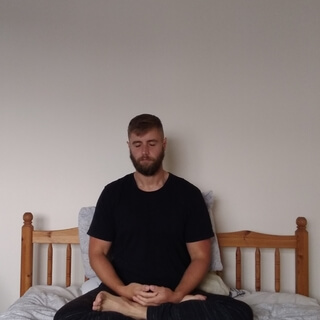
And you can do this as a focused practice,
Sat in meditation.
Just gradually trying 1% at a time.
And you will feel when the body has released enough and then it wants to stay in its tense pattern,
That's fine.
But I've actually found the most consistent benefit.
By applying this as a microdose throughout the day.
So whilst I'm waiting for the kettle to boil.
.
.
Whilst I'm driving.
.
.
Whilst I'm walking to the gym or even whilst I'm at the gym.
Just check in,
Check in with the body.
And just see.
Can I do this with 1% less tension?
Is my body.
Comfortable.
With just letting go of just that tight grip.
Doesn't want to let go all the way just yet.
It doesn't feel safe to.
That's the origin of this,
That's why your body isn't releasing tension.
It's braced up It's armoured.
It's armouring itself.
That's why it won't release all the way.
It doesn't feel safe to.
So by doing this just one gradual percent at a time you're reaffirming to the body that it is safe to do so.
Your nervous system,
Your limbic system.
Just gradually gets the message.
The danger has passed.
It is safe to let go,
But there's no rush.
You can let go in your own time.
There's no hurry.
We're actually encouraging safety in the body.
By ensuring the body's own natural wisdom.
Is the guide,
Is the teacher.
We're actually handing over to the body and say,
You teach me body,
You tell me what you feel safe with.
You tell me,
What do you teach me?
What do you feel safe with?
Are you willing to let go?
If not.
.
.
Then that's the way it is.
That's fine.
But if so,
Can we gradually do this?
And we find this when the body releases a percentage of that tension and it can feel for itself,
Oh,
There's no pain if I do that.
Nothing bad happens if I do that.
Then it learns that's the new level of tension that's safe,
Which is 1% less than it was before.
But it's learnt now,
Ah,
So it's safe to do that.
That's cool,
That's fine.
Groovy.
All is well.
It's alright.
It's alright.
And then you microdose so then you can forget all about it.
It's what I find quite useful.
Once I've experienced that percentage release.
Okay,
Feels a little bit a little bit less pain in the back less tension in the neck and jaw,
Less tension in the temples.
And now I'm just going to get on with whatever it was I was doing,
Driving,
Shopping,
Making a cup of tea.
Right,
Okay,
And then when I remember,
I might just be continuing about my day,
Feel something tightening up again,
Tensing up.
Wow,
There's that pain in my neck again.
Wow,
My back feels stiff.
Immediately recognizing we have a tendency,
A habit,
To go straight to frustration,
Straight to annoyance.
Straight to anger,
Straight to fear.
Those thoughts like,
Oh,
Not this again.
I thought I was feeling better with this.
I thought I was having a good day with this.
Why is my back hurting again?
How much longer is this going to go on,
Right?
If I notice I'm having those thoughts,
Now I'm retraining the habit.
Retraining the habit.
So that instead of going to frustrated and annoyed thoughts,
Going to.
.
.
Neutral,
Non-reactive curiosity.
Oh,
How interesting.
My back feels stiff.
I wonder what's happening in the environment that's making me feel unsafe.
How interesting.
And then just with that,
Again,
Micro dose,
Can I just release this by a percent?
Not going to try and relax the whole way,
Just 1%,
More than enough.
And it might just release a little,
The gut might release a little,
The neck might release,
Jaw,
Okay and just.
.
.
You can just take a deep breath there.
And then continue with your day.
Now naturally this gradually decreases the tension.
But what's really powerful as well is that it prevents going in the opposite direction.
Usually we tense up,
Clench up,
You feel pain in your back,
Your neck,
Your jaw,
Your head and you tense up further.
So then that increases the negative spiral,
The negative feedback loop.
You feel more tense therefore you feel more pain you feel more pain then you feel more tense This could have been going on for a long time.
Have some sympathy for yourself.
Some compassion.
It's been going on a long time,
Hasn't it?
Been a hard time for you.
So don't judge yourself for being in this cycle,
This exhausting,
Demoralizing cycle.
But now we're starting to.
Pull the pendulum back the other way.
Pull ourselves onto the side of relaxation.
Gentle,
Slow,
Recovery time.
You're safe now.
You're safe now.
The danger has passed.
Breathe 1% at a time,
Release,
Relax.
So essentially,
If we're feeling that chronic body tension.
And obviously it's always a good idea to see a medical professional just to rule out any underlying causes.
But it's known that what commonly causes it is long periods of stress and anxiety and painful emotional periods if there's been a lot of emotional turmoil.
Emotional difficulty.
Period of uncertainty,
Period of grief.
Period of stress,
Period of tension.
The body just activates its fight or flight response and keeps it activated.
Chronic.
And the fight or flight response is supposed to be an emergency system,
Very short term use.
But it's like your body keeps itself in that.
Closed,
Armoured.
Guarded,
Braced.
And that's why,
When we try to relax it the whole way.
.
.
It won't do it,
Or it relaxes a bit and then tightens back up again,
Relaxes a bit and tightens back up again.
I forgot to say it can also be tense if there's been a lot of physical pain for a long time.
The body's kind of holding itself it almost puts its own cast on things.
Because we evolved in a time we didn't have doctors and casts and.
.
.
Uh,
Like splints and stuff like that.
The body has its own natural mechanisms for locking everything down.
It's trying to keep you safe.
So that was,
That's what happened in my case.
I had chronic back pain for a long time.
That was really quite severe.
I'm not being dramatic when I say it was agonising at times.
And I was working as a personal trainer at the time.
I struggled through for a little while until it turned out I just couldn't continue working in the gym.
And that was my career.
I'd worked hard to get that career and that's how I was sustaining myself.
So because of that injury I could no longer engage with my profession.
I couldn't work.
I also had a lot of family upheaval at the time as well,
A lot of falling out.
And I'd already previously been recovering.
From narcissistic abuse as well.
So there's a lot of emotion,
A lot of physical pain,
A lot of uncertainty in my life.
And this went on for years.
And so thankfully,
Thankfully out the other side of it,
Or coming to the other side of it.
I found it really quite remarkable that my body was still holding itself tense and tight.
As though all of that stuff was still going on.
It's like my body remembers that time.
And is acting as though that period of time is still happening.
Even though I can see that it's not.
My brain knows that it's not,
But the tension was still there.
I was getting really frustrated,
You know,
I was trying all the stretching and the massaging and.
.
.
Looking up all these videos of what movements to do and everything I was even trying somatic techniques like TRE,
Trauma releasing exercise,
With mixed results,
Limited results.
And it wasn't until I found this 1% thing,
And like I say,
It's only just over the last few weeks that it really has,
Like.
.
.
It's been crucial,
So important,
Because I think what I was previously doing,
I was still in my old mindset,
Which is very black and white.
And very all or nothing.
That's like.
.
.
That's what I'm trying to soften.
It's something I'm trying to learn.
I'm working on that.
I'm just aware that my mindset and mentality,
Very all or nothing,
Very black and white.
Or as now.
It's actually,
I'm seeing that it doesn't always work like that.
When it comes to uh physical and mental health not always there's gray areas and sometimes we have to take a gradual approach rather than full frontal assault just gentle gradual one percent at a time And this stands to reason because.
.
.
If the The chronic body tension and pain has its origins in a feeling of Unsafety.
Feeling unsafe.
Feeling frightened,
The body itself feels frightened and afraid.
It's not going to respond well to more force,
More intensity.
It's not going to respond to a lack of compassion.
It's not going to respond to hurrying and rushing.
If the body is tightened up.
And locked up due to a sense of unsafety.
What is needed.
Is patience.
Wisdom.
Serenity.
Stillness.
That's what will encourage a sense of safety.
Come back into the body.
No hurry,
No rush.
All the time in the world.
And it really does have to be the body that leads the way.
Has to be.
Not the mind.
Because it's when the mind overrides.
The natural systems of the body,
That's when dysfunction starts to occur.
But if we lead body first.
And the body already knows how to heal itself.
How remarkable is the body!
How amazing is that?
It already knows how to heal itself.
It already knows how to regulate its own nervous system.
It already knows how to release tension.
I love this analogy in Zen.
Zockten specifically.
Of when a snake has tied itself into a knot,
Which it does sometimes,
Just through curling through the undergrowth and stuff,
Ties itself into a knot.
It knows how to uncurl itself.
It knows how to pull itself free,
And your body is just like that.
Your body is a natural organism.
Natural.
It has its own wisdom,
Its own intelligence.
All we have to do is send it the right signals,
Or sometimes just stay out of it altogether.
Not be so involved.
And that's what encourages the body to let go.
When we're less involved.
So that its own natural systems can restore balance,
Restore harmony.
Called homeostasis.
Scientific terminology returning to balance.
It's always seeking to do that.
And it knows how to do it itself.
We're just encouraging it along the way.
So when you're aware of your bodily tension with neutrality,
Non-reactivity.
And you're just assessing.
Is it willing to release?
Is it willing to relax?
You're demonstrating to your own body intra-personal communication.
You're communicating to your body that I'm not going to force you to do anything.
I'm not going to make you do something that's not safe.
We're not going to put ourselves in unsafe situations anymore.
Around unsafe people.
We're going to look after ourselves.
What we're going to do.
And part of that is learning to relax because we,
If you've noticed the curious thing For me,
It was like the back injury had long passed.
The back injury had been and gone.
But the pain was remaining.
But the pain was due to the memory.
It was psychological.
Which isn't to say that I was imagining the pain.
It was really there.
It was really painful.
The pain was an echo of the past,
A residue.
From that period of time when I was so unsafe,
Traumatised really.
So the body was acting as though this was still going on.
Like a soldier still fighting the war despite the fact ceasefire happened years ago.
There are cases like that.
The body keeps fighting.
Now we're just.
.
.
You can be like the general that goes to the soldier and says,
Stand down soldier.
Thanks for your work.
It's time to stand down.
So 1% at a time.
Try this.
You can try it in a focused meditation and through little micro doses throughout the day.
And remember it's gentle,
Gradual,
1% at a time.
Relaxed curiosity towards the body.
How interesting how tight this is,
Neutral,
Non-reactive,
No emotional charge.
And then be open.
Bee.
Willing to learn what the body is teaching you.
And be very compassionate in your encouragement towards the body.
When we ask it,
Are you willing to release your tension by just 1%?
Let me know how you get on team.
I hope some of that is useful.
Thank you so much for listening.
Take care,
Be well and stay present.