Hola.
Today I'd like to offer a brief meditation instruction for those who are new to meditation or those who are longtime meditators and just open to how different people approach it.
I'll go through three parts.
I'm going to go through our body,
Our breath,
And our mind.
And this is how I begin all of my own personal meditations.
And then I might move into other practices and guided meditations from an insight timer teacher or I might just sit in silence for a while after I kind of set up the body,
The breath,
And the mind.
So this will be pretty brief but we'll spend a couple minutes in each area.
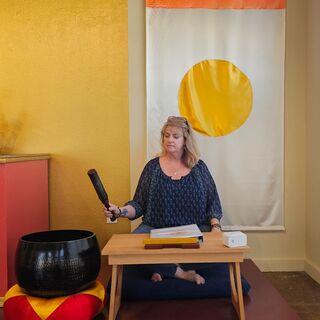
So I will ring the gong as an invitation to begin.
So kind of find your seat and I will ring the gong.
So we'll begin with the body.
Whether you are sitting on a cushion or sitting on your bed or in a chair.
You could be standing I guess.
You could be lying down.
But if you're sitting just notice that you have a straight back.
Not too straight,
Not too ramrod with your spine,
But a an upright and flexible spine.
You might want to move the spine around a little so you get that sweet spot where you're flexible but you have a backbone.
So we're trying to be not too tight,
Not too loose.
You want enough alertness that you are present for your meditation.
You're aware.
You're not trying to be take this as a nap time.
You're not trying to fall asleep.
But you're also not trying to be so perfect and ramrod about this that it's uncomfortable.
The whole point of meditation is to be friends with yourself.
So set up your body in a posture that feels comfortable,
Alert,
And friendly.
Move as needed until you find the sweet spot that feels right for you.
Eyes can be open or closed.
If your eyes are open,
Maybe have them not staring at anything in particular.
Just kind of a general loose gaze.
So we're really now focusing more inward.
We spend so much of our day looking outward.
So with these few moments,
Let's go inward.
So just start with a brief body scan.
Just starting from the top of your head.
Just notice if you have a headache,
If there's any tightness or tension around your face,
How you're holding your jaw,
Your teeth,
Your tongue.
Can you relax back the skin on your face,
Almost as if your head is on your pillow at night.
Notice your throat,
If it's tight.
Notice into your heart space,
If you feel open to what we're doing here.
Or maybe you walked into it with a bit of defensiveness or feeling shut down by something.
Whatever you find is allowed.
We're not trying to change anything.
We're just noticing what's here.
And then down into your belly,
Where we hold a lot of anxiety in our guts.
Just notice what your gut is telling you right now.
You're just listening in.
It's okay whatever you find there,
Because it is the reality of what's happening in the moment.
And then just noticing your limbs,
Your muscles,
The temperature on your skin,
How your clothes feel.
Just getting a sense of how your body is set up right now.
Appreciating the parts that are working well,
Giving you no trouble.
And then having a kind attention to the parts that feel a little bit painful or stuck.
Or maybe you need a little bit of a stretch.
Or maybe there's a chronic pain you don't feel like you could do much about right now.
But you see it.
I see you.
I see you left hip.
We're just bringing a kind attention to this.
Letting it be here,
Because it's here anyway.
And then let's move into our breath.
Once you've established your body posture,
You have a sense of your body.
So initially you can just kind of eavesdrop on your breath.
Just notice that you are being breathed.
You're not really even doing anything to make this happen.
Thank God we don't have to make it happen.
And then we have this added benefit where we actually can attend to our breath.
So this is up to you,
But if you would like to focus in on the inhale,
The pause,
The exhale,
And this little pause before you naturally take your next inhale.
And just see if you can be with that full cycle of breathing.
Just a couple rounds where that is where your attention is.
Just see how good that feels to actually take in oxygen,
To exhale fully,
To notice these little pauses.
And then your body will do the right thing and take the next breath with or without your help.
And if you'd like to play with that a little bit,
Maybe try elongating the exhale.
There's so many metaphors for this,
But I like to think of being on a wave.
So the wave,
Kind of,
I'm at the top of the wave with my inhale and then I'm riding that surfboard all the way to the shoreline until it naturally stops.
There's a bit of a pause and then the tide goes back out again.
So you're really with your breath.
And just notice what that does to your body.
Does it bring a sense of,
It could bring a sense of panic if you're manipulating the breath.
It could bring a sense of relaxation,
Some relief because you're taking a deeper breath perhaps.
But let it be whatever it is.
You might be congested,
Getting over something,
Have limited lung capacity,
But you are breathing or you wouldn't be here doing this.
So whatever your breath is doing,
Can we just notice that with a kindness and appreciation.
And by now you might notice that your mind has not completely shut off,
If you're anything like me.
So we are not trying to shut our minds off.
We are not trying to be heavy-handed and have no thoughts.
I think that's impossible,
At least for me.
So again,
We're trying to be friends with ourselves and maybe just kind of peek in,
Eavesdrop on your brain.
Notice the patterns of thought and generally they're going to be in the past,
In the future,
Or right now.
Most of us live in the past or the future.
So we're not getting mad at anything our brain is thinking,
We're just noticing.
Oh,
I see that I'm really hung up on a few things that happened from yesterday or recalling that movie from last night or that interaction I had with that person.
Okay,
I see you brain,
I see what you're thinking about.
Or I'm really worried about what is going to happen tomorrow or next week,
The groceries I need to buy.
Okay,
I see that you're in task mode or collateral damage mode.
Thank you brain.
Just knowing our brains are trying to keep us safe,
They're trying to entertain us,
They're trying to solve puzzles and figure out problems.
But we are not our thoughts,
We simply have thoughts.
So we're noticing the flow of those thoughts and then you're inviting your brain basically to kind of sit down.
Sit down comfortably,
Maybe off to your left shoulder.
Let your brain sit down.
It doesn't have to stop thinking because it can't,
But we could put it in the context of something bigger,
A bigger container.
And then we're inviting our attention to come back to something much more immediate in the room.
So where I am,
I can hear the air conditioning.
I feel the coolness of the air on my skin.
I hear some people out in the hallway coming and going.
I can smell my coffee that's getting cold.
I feel my feet on the carpet.
And then the most immediate is your very next breath.
The only one you can really take is this very next breath.
So just allow yourself to be with the next full round of breathing.
And if your attention starts to jump somewhere else in the past or the future,
We're not gonna get mad about that.
We're just gonna say,
Oh I'm just thinking.
Brain is doing what brains do.
Thinking.
So you can get the flavor of it or you can just label it as thinking.
Monkey mind.
Monkey swinging through the trees doing its thing.
And then you have that nice gentle invitation to come back to the present moment.
And maybe it's just for the very next breath and that's it.
And then you're off again.
Great.
Learning to be friends with yourself.
So after I have gone through body,
Breath,
And mind,
I just try to feel myself as a whole in the room.
Very simple.
Very sweet.
Just a person sitting here.
Not my ego.
Not my labels.
Not who I am to everybody.
Not what I need to do.
Just kind of a simple person sitting here with her heart beating.
Breathing.
Safe.
Safe in this moment.
I must be safe in this moment or I couldn't be doing this.
No one's chasing me.
I'm not bleeding from anywhere that I know of.
I'm safe right now.
Like what a privilege.
What a luxury.
In fact,
We're most always safe.
We think we're not.
When there's a crisis,
We deal with the crisis.
But the rest of it's like imagined crises.
And in the moment,
We're safe.
So allow yourself to feel that safety and that groundedness in this moment.
With your very next breath,
Feel the groundedness of it.
I'm here.
I'm okay.
I'm paying attention.
And the whole thing has an attitude of kindness and curiosity.
Nothing needs to be fixed.
We're just noticing with kindness and curiosity.
So just take note of how your body feels,
How you're breathing,
And what's happening with your mind right now.
I'm gonna ring the gong again.
Just listen until the end.
You can slowly open your eyes if they've been closed.
And then before you jump up and do your next thing,
Just stop for a minute.
Look around your room.
Take in the shapes,
The colors.
Take in how your body is feeling now.
Maybe some gratitude that you gave yourself this time to slow down.
Notice yourself.
Befriend yourself.
At least beginning to befriend yourself.
And just see if you feel like this was a worthwhile use of your time and your energy.
Slowing down for a few minutes a day to pay attention to who you are,
How you're feeling,
How you show up.
Reconnecting with your breath and your body and noticing your mind with kindness.
See if that's important to you.
See if it's worthwhile.
I appreciate you taking this time to just slow down for a minute and see who you are.
Be present.
We all benefit when each of us do this.
We all benefit.
So thank you for spending this time.
Take care of you.
It matters.
You matter.
Bye for now.