And so I come to you in the morning where my joints are a little bit achy.
As most people my age experience.
So this is a practice that you can do in the morning or just maybe when you're just kind of feeling kind of sticky.
And just need just a little bit of Just a little bit of stretch,
A little bit of movement,
And we aren't going to be standing up in this practice,
So no sun salutations.
And you also really don't even need any.
.
.
Props,
We're just going to just kind of move our bodies.
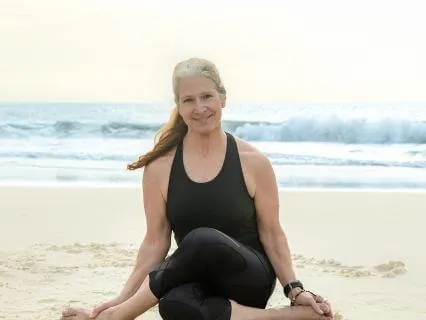
To surround your mats or your floor so you don't need a yoga mat or any specific yoga clothes.
I am in my pajamas.
So let's get started.
And just a comfortable seat.
And if your knees just feel kind of sticky or uncomfortable by sitting,
Then you can prop your hips up on a block or a pillow.
A pillow actually feels kind of nice.
First thing in the morning and just get a sense of and how your body is notice any any part of your body that is struggling with gravity.
I know for myself.
I always have to remind myself to lift.
But also notice how maybe you're like one hip might be pulling or maybe one shoulder might be hiking up.
Just take a moment to notice.
But also notice your back.
Are you sitting up straight or are you kind of curling?
Just see if you can introduce a little bit of lift.
So planting your sit bones,
Just in the bottom of the pelvis.
Into the floor.
And just feel.
The vertebrae just starting at the base of the spine feel the vertebrae each and every one as if someone is pulling to the top of your head.
And just notice.
Just even just that.
Little bit of guidance how your posture might change.
Just feeling that That lift,
Maybe your shoulders roll down.
And maybe your core engages a little bit.
Now keeping that that little bit of lift,
That kind of central channel.
As your anchor,
So anchoring down.
Through your seat and lifting through.
The top of your head,
Just begin to Just twist from one side to the next.
We'll just do a little bit of soft movements so it's not the top of your stretch.
We don't want to go too hard,
Especially in the morning or especially when you are really kind of stiff.
So just notice.
Just what happens when you have a little bit of.
.
.
Movement in the spine,
Some twists.
So nothing aggressive.
You You can pay attention to the breath.
Breath.
Practice can be in of itself.
And then next,
Just kind of.
.
.
Move over to your left and plant your hand your right hand in front of you just maybe pressing the knee down a little bit more.
And then the left hand is going to be behind you.
And just see what happens there when you just Stay in stillness.
And see if the left shoulder wants to open a little bit more.
And maybe the right shoulder opens a little bit.
So notice how we have this.
Internal rotation,
Maybe externally rotated using the hand to press the knee.
Is that knee is going to be kind of like a pole.
Just see if you can just gently twist a little bit more,
Just remembering the upward lift.
The crown of the head.
And just notice where in your body you're feeling that So lots of time over time,
My shoulder wants to roll forward as it feels strange,
Just slowly just let the right shoulder,
Relax a little bit.
And then release.
Let's do a few more twists.
Back and forth and just notice like one side of your body feels a little bit envious.
Let me just allow some blood to move.
And let's move over to the right side.
So the left hand just kind of presses.
Against the knee,
Not maybe down,
But maybe away.
And using the right hand behind you.
And just slowly allow your body to soften.
In this posture.
So left shoulder,
Again,
This is my bad shoulder.
So it's kind of opening up a little bit.
And then using the upper back.
To just allow a gentle pull.
And you'll also notice your right shoulder also getting a nice little awakening here as you also are just opening the spine to a little bit of movement,
A little bit of stretch.
Maybe you notice that you're able to take deeper breaths.
So remember that yoga isn't necessarily a workout.
It's mostly just a sense of awareness of how your body is in the moment.
And working through those little things.
Because sometimes those little kinks those little bits of tightness.
As you work through them they can allow you to do a little self-reflection.
And say,
Well,
What am I doing in my life that is causing this stiffness?
But also just these gentle stretches,
These gentle movements.
Allow you to be better prepared to face whatever comes.
At you.
In the day.
So now let's work with the hips a little bit more.
So we feel a little bit of hip motion.
So draw your fork with the left side first.
So what you'll do is you just kind of feel the hinge of the knee.
So just pulling the thigh towards you in a way.
And then just kind of pull it closer to you.
You can lean back a little bit so you can do this actually on your back.
And pull it close to you.
And that might actually feel good.
You flex and point your toes.
But you can also do it.
Standing up.
Are sitting up.
So.
.
.
Whether you're lying down or you are sitting up.
You want to grab the outside of your foot,
And you're obviously going to put a big bend in your knee.
And if you can't reach your foot,
Just maybe grab a belt or something or towel.
And just kind of feel this movement.
So you're just drawing.
On the outside of your ribs.
So this is kind of like a seated happy baby.
You can do this on your back.
And just feel that and then after a few movements just and find a hold.
And so,
You know,
The.
.
.
Especially when you're not used to this movement,
Sometimes we feel the need to strain.
But this shouldn't be a strain.
You shouldn't be gritting your teeth.
Or just kind of moving the body just a little bit.
Just to.
.
.
That feel.
Some of those little creaks.
And then release the left foot and then just kind of shake it out a little bit and just kind of bobble it.
If you're on your back,
You can.
Maybe do this.
With your legs straight.
As you remain on your back.
And then drawing the right foot in.
So again,
You can do this on your.
.
.
Back that feels good but just begin by just kind of bringing the psi in towards you.
And it's crazy because.
.
.
Even though this is.
Technically my good knee.
This is the need that hasn't had a lot of work.
I had a high school injury and I had two surgeries on it.
And of course 40 years later.
.
.
It's still the same.
Gives me a little bit of issues,
But.
.
.
This knee is the one that creaks.
And then just kind of draw the knee close to your ribs,
Your outer ribs.
You can do this on your back.
And just draw.
And the knee closer using.
Grabbing the outside of your foot.
And so probably you wouldn't be doing this posture.
Daily life.
But it's certainly something that these bits of stretches will help you as you walk.
Sit down,
Stand up.
Move from left to right just kind of helps.
Just eventually you settle into stillness after a little bit of motion.
And just notice if this hip feels a little bit tighter,
A little bit looser,
If this knee feels a little bit better.
And then release that knee and just kind of bobble your knees back and forth.
And then finally,
We're just gonna end with.
A loose version of butterfly position so This is Cobbler's Pose.
So obviously,
When your body is really,
Really warmed up,
You would draw the.
.
.
Heels as close in and then you pull and if that feels good then by all means do it.
But lots of times we pop ourselves into cobbler's pose without really noticing what the back is doing and how the inner thighs respond.
So your cobbler's pose can be more like diamond pose,
Which is what we do in yin.
But however the distance with the soles of your feet are too.
Your body.
Use your elbows.
To kind of prop you.
As you open up your chest,
So you're still kind of remaining.
A little upright.
So there's.
.
.
A little bit of a back bend.
As you puff up your shoulders and try to get your chest to move forward.
So that's our upper body.
And then just slowly try to move your belly button.
Towards you.
So lots of times we crouch over like this in cobbler's pose,
But just a little bit differently.
We kind of move forward with that little back bend with the upper back.
And just notice how.
You might feel a little bit less in your groin area.
And a little bit more of a stretch in your lower back and upper back.
So notice that little difference.
When you come with a little bit more of a flat spine or a little bit of a back bend.
And just feel how.
Eventually the body softens once it realizes that you're going to be here for a little bit.
Peace.
And then come up.
And then do your traditional cobbler's pose and see if it might be a little bit more accessible.
So this is where we do a little bit of a rolling in the spine.
And just notice that collars pose,
You'll feel a little bit more of a stretch in the inner groin.
But also maybe a little bit of a stretch in the outer hips.
So underneath here.
But you'll feel it wherever.
Your body needs it.
But just that.
Opening part when we had the spine a little bit more of a back bend.
We are introducing a little bit of separation in the vertebrae.
Because you know like when you've been sitting down for a long time you've been laying down your spine.
Just gets a little bit shorter.
And you actually are shorter in the morning,
But then eventually the spine loosens.
And you get taller.
And then let's slowly roll out.
Place your hands behind you.
And just kind of shake out your legs.
And then maybe you want to lift the hips just a little bit,
Not too much.
Digging your heels into the floor.
And then release.
So let's end this short sequence with a little forward fold and turn.
I always like to bend my knees just a little bit and place my my hands underneath my calves.
And just see if that works for you.
And what it kind of does is it gives my calves a little bit of massage.
And notice that my feet are flexed.
You're kind of digging your heels into your mat.
And you're leading with your belly rather than your shoulders or your head.
So your belly is just kind of resting on your thighs and always feels good sometimes if you Place a pillow.
Between your belly and your thighs.
And just notice the softness.
And your back.
Because it's not and extreme pose.
Just a little bit of.
Awakening.
Of those muscles and those joints.
You can kind of.
.
.
Windshield wiper.
And the feet,
The legs back and forth.
That feels good.
So this can be your Shavasana.
This could be your resting pose.
Or you can go into a Shavasana and that's fine,
Nothing wrong with that.
Or you can just kind of let all of this settle in for a moment.
And just notice maybe your body and mind are a little bit more relaxed.
Awake.
Again,
This is an invigorating practice.
It is more of a gentle way to practice.
Just kind of get the joints moving before we begin our day,
Or it's a good little soft practice for a recovery day like what I'm doing today.
Recovering from a hard weekend of movement.
So wherever you are in this world,
Have a peaceful day.
And just remember,
Whatever we cultivate on the mat,
We hopefully cultivate some peace,
Some joy,
A little bit of tranquility.
And we bring that from the mat into the world.
Take care.