So let's begin walking.
Hopefully it'll be in an area that you know pretty well,
Preferably out and back path.
It could just be around your neighborhood.
And just get a notice for how your body moves and also how your mental state is.
Get a notice for your breath.
Is it in your chest or is it deep?
Feeling the belly and then exhaling full.
So you can do this in different paces if you'd like.
We start by,
Let's start paying attention to our feet for a minute.
Just notice how each foot touches the ground and releases it.
Notice how the foot rolls,
Usually from the outside to the inside.
And then you push off with a ball of the foot.
Just notice if you're favoring one foot over the other,
Or maybe heel striking a little bit more with one foot versus the other.
Then we move for the next minute,
We'll move to our calves.
And so the calves sort of work with the feet.
And the feet help drive the muscles in the calves.
And the calves work as sort of shock absorbers to absorb the contact with the ground.
But they also work as a means of helping us push off with the back foot.
So pay attention to your calves.
And then we move up the body a little bit to our torso.
Pay attention to the feeling of the very top of your thigh.
There's a few muscles that attach from the top of the thigh to inside of your pelvis.
And just notice how they too will help in the pushing off of one foot and absorb the shock as the foot lands.
And so your hips kind of move back and forth.
They don't sway.
And then for the next minute,
We move to our hands.
And of course,
Our hands are extension of our shoulders.
And lots of times we're told to roll our shoulders back,
But then that puts us out of alignment with our walking body.
So take a look at your forearms and roll your forearms so they're slightly facing the sky,
But not so much.
Maybe just a few degrees off.
They're a little bit facing,
A little bit of an angle.
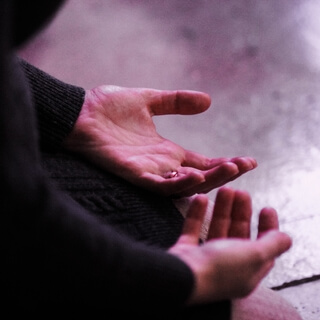
And so your hands are open and you can touch your fingers lightly with your thumb as if you're holding a potato chip.
And so for this final minute,
We do the integration as well as check in again with the breath.
And so notice that the chest might be doing a little bit more of the breathing than the belly depending upon how fast or slow you walk.
And we also integrate all of our movements together of the body and how everything works in sync with one another.
So we take a deep breath in and maybe sigh it out if we're walking slow.
And then we start over.
So we move again to our feet.
So check in with your feet.
Notice if one foot maybe points out a little bit.
Maybe you are a little bit more pigeon-toed or a little bit more of a duck walker.
Not that any of them are bad,
But just notice how that affects how you strike the ground with your foot.
So you're still trying best as possible to strike each foot with the same amount of pressure and just feeling that rocking from the outside to the inside of the foot as it pushes off.
And then we move to the calves again.
And then the calves again are helping propel you forward,
But also absorbing the shock.
And so notice how the calves help with the feet to raise the heel.
So as the legs move behind you,
The back leg will raise the heel and the calf will press and help drive you a little bit forward.
And so then we move to our hips again.
And the hips,
Just feel the pressing of the top,
The movement of the muscles in your leg and how that helps to shift your pelvis just slightly.
But also notice how your core is engaged.
So think about,
So think of like a corset,
But no compression here,
But imagine maybe a drawstring around the bottom of your ribs and how it might be drawing your ribs closer together and see if that makes you walk a little taller or run a little taller.
And then we look at our arms and our hands and notice,
So the hands will again be just not clenched,
Just slightly at ease,
But the forearms are open a little bit.
So that helps open the shoulders so you're not hunching.
And then the hands will,
And the elbows will move sort of in a straight motion.
So you'll want to refrain from moving,
Crossing your arms,
Your forearms from the plane of the center of the body.
And of course we return to our breath.
And always remember that your breath is very telling of usually your state of mind and the state of your body.
It might be a little faster right now after walking a few minutes.
Just take note.
And also just integrate all the parts of your body that you've paid attention to as we approach the turnaround point.
So take a moment to look around you and see if there's anything that you might not have noticed before in your surroundings.
Just take one note and then turn around.
And then we move back to our feet.
Notice if your feet are tired,
Whether it's you're walking at a slow stroll,
Maybe you're even walking a little faster in this moment.
Notice if your feet have somehow changed because sometimes what happens is as your muscles tense and as you get tired,
Sometimes you notice a little bit more tension in the feet because all of it is responding.
And then we move to our calves.
Notice maybe if one calf might be a little tighter than the other.
Notice it.
Just integrate the movement of the calves with the feet and how the heel comes off the ground,
The back foot,
The back heel comes off.
All of this is something that we learned so young and we make so many assumptions and very rarely do we pay attention to those subtle movements that all work together to move us forward.
And then we move to our hips and notice if you might have been slouching a little bit and hunching forward a little bit more.
And if you maybe notice that if you're at a faster clip,
You're probably leaning a little bit more forward than if you're walking slow.
If you're walking slow,
You're a little bit more upright.
But the faster you go,
The more you actually lean actually from the ankles rather than hunch over.
So there should be sort of a straight line between your heels through the hips,
Through the shoulders.
Notice how the hips will rock just slightly and then notice your shoulders and your arms and your hands.
Just feel that openness in your hands,
Your elbows moving slightly behind you and just notice the synchronization of your elbows,
Your hands with your legs and your feet.
See if you can relax your shoulders a little bit and just notice if they're hunching.
We hold a lot of tension in our shoulders and this at least will get a little bit of blood as you move around a little bit.
And then we do the integration.
So check in with your breath.
Notice what's around you.
Just notice the full synchronization when you just let it all go.
So you work,
Pay attention to the subtleties of each component of each part and then you see how each part when you trust and let go how everything will work perfectly.
And then we move again to our feet,
Those humble servants that don't get a lot of love.
They said that we invented shoes to protect us from the earth when we had expected the earth to have its own covering.
So we walk around with shoes to protect us from the elements.
And we do the same with our sense of resilience.
We wear our resilience to protect us from to buff it any of the thorns that might we might encounter in our path.
And then our calves,
They too,
They can help drive us or hamper our walk.
So your calves can,
If they're tight,
They can actually cause our feet to not finish their stride.
And even our shins,
If we bang around too much,
We can develop problems in our calves and our shins.
Just be mindful of how your body responds.
And then we move to our hips again.
Because if,
Just check in with your core,
See if you can feel the extension of standing tall with your ribs kind of,
Obviously you're not going to move your ribs,
But just get that feeling of a cinching of your ribs together to help extend you taller.
That puts a little bit of extension in the vertebrae at the back.
And just notice the top of the thighs and how those muscles will drive you forward and even the muscles in your backside,
All of those move together.
And even your obliques,
The sides of your body need to twist in order to propel you forward.
And then we move to our shoulders and our hands.
And then our hands always are open to receive.
And our arms,
We're not creating a barrier for others.
We're open,
Our shoulders are open to receive.
And then we come to the end of our walk and come to just continue to walk.
If you had been walking a little faster,
Be sure to slow it down and be sure to check in with your breath.
And always be aware of how when our mind wants to ruminate on so many things,
Wants to plan,
Wants to control,
It wants a demand on others,
All we have to do is come back to a mindful walking practice that we can do any moment of the day.
So wherever you are in the world,
Take your mindfulness,
Take the fruits of it,
Maybe a little bit of calm and extend that to those people that you might see the rest of your day and the rest of your evening.
Take care.