Welcome,
It's Amelia.
I wanted to answer a question and I decided I'll do it on a video because maybe some of you might also like to know more about this.
But the question was,
What are the half splits?
How do you get into the half splits?
And do you keep your hips in line with your knees or do you sit back on your heel in the half splits?
And I thought it also would be interesting to share because I also got another question.
Is the half splits a yoga pose?
And that was such a good question because maybe some of you have not heard it referred to.
As the half splits in the Sanskrit name.
Arda is half.
And Hanuman Asana.
So this pose is dedicated to Hanuman,
Who is a divine monkey god.
Asana means pose.
So the name of the half splits is Arda Hanuman Asana.
And then the full splits is Hanuman Asana.
And the reason why for the shape,
And then we get into the shape of a pose,
You'll have it in your mind,
Is because the divine monkey god Hanama took a great leap of faith from India to Sri Lanka to save Sita,
Who is the wife of Rama.
And you can read this in the Ramayana,
Going back into the origins of yoga and understanding the names of the pose.
I'll talk about it when we get into the pose.
Okay,
So first,
Let's go into the basic shape of the pose.
A lot of us will teach it as a transition coming out of a low lunge.
Low lunge,
You might have your right foot forward in this case.
And then your back knee is,
You know,
Roughly,
You can have it as,
You know,
Close as this were both or at 90 degrees if you want to with the front leg and the back leg,
Depending on how tight you might be feeling in the body.
And if you find that you're struggling to touch the ground,
Using blocks is a great option here.
Kind of tuck your toes and step your knee back.
Step your leg back and just see how that feels.
This is starting off in a low lunge first.
I'll just show you this because this is a pretty typical transition when we use the half splits.
The front foot is roughly at 12 o'clock.
You might be starting with 90 degrees.
This has to be exact.
It's not yoga perfect.
It's yoga practice.
But do notice if you're leaning a lot over to the left or leaning a lot to the right,
We are trying to keep the hip in line with the bones here in this true north alignment from the hip to the knee all the way down to the ankle.
And then imagine that there's this line that's lining up with the second toe right next to the big toe.
All right.
Again,
It's not perfect.
It's just a guideline just for you to check.
And then you might say you're down in the low lunge.
Inhale,
Exhale,
Shift back into the half splits.
That might be a cue that you hear from a teacher.
And let's say that you're here and your back is rounding a lot.
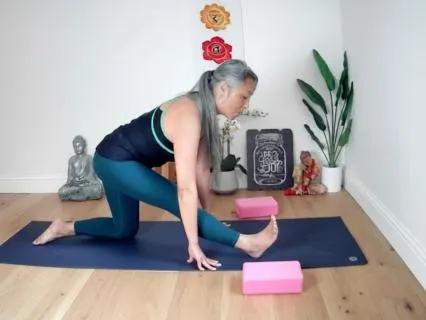
This is a great time to grab your blocks.
Go ahead and let that so then you can have your spine and you're you're not so cramped that you can't keep that breath keep that ujjayi breath going inhale through the nostrils Exhale through the nostrils and maybe you melt your chest down a little bit.
And just notice what you feel on the back of the hamstring.
The front ankle,
Sometimes I warm up and have students flex and point the ankle,
Then eventually ask them to leave that front ankle flexed.
Bring the toes back towards your face and just see how that feels.
We all feel these postures differently in our body.
You might start to feel it all the way from the glutes,
All the way down the hamstrings.
The more that you flex your front ankle,
The more you may feel it in the back of the calf.
You might feel all that.
And if you're not using blocks,
You know,
Maybe spider fingers.
So it's like a little,
Little tripod with your fingers.
Isn't it?
This is more of the traditional Ardha Hanumanasana,
The half splits with the hips.
Up in line with the knee.
You can see my hips are roughly in line with my back knee.
And the other variation,
Which is also very common,
You can go ahead and sit back on your heel.
Still flexing your ankle and then melting your chest in.
Coming up here in the original posture.
That I showed,
This can be a little bit more intense for various reasons,
Whether it's because you feel like you're struggling to tuck your hands to the ground.
Maybe you're feeling some effort in the arms and that's getting challenging.
And maybe it's just like really,
Really tight in the back of your hamstrings.
If you choose to come all the way back.
And sit back on her heel.
This is a different variation of pose,
But it doesn't mean that it's wrong.
Just know that you can also do this.
And then from here,
You can melt down.
So this might feel.
.
.
A little bit more relaxing.
Might feel a little bit more restorative.
We are still having an active front foot or ankle that's flexed.
We still have this,
And I can still feel it here in my hamstring,
But it does take pressure off that back knee.
If you're finding that the knee doesn't like to be down on the mat,
This is another option.
And then sometimes there's just the upper torso,
The arms aren't working so much because now the arms can be relaxed.
You don't have to be holding yourself up.
Here,
Like my arms are down.
From here,
If you want,
And if the body's warmed up,
You might slide all the way into Hanumanasana,
Which is the full splits.
I don't know if I'm all the way warmed up yet.
I don't know if you can see that there's space from the ground up to me.
If I'm not ready,
If my body is not ready yet to go all the way down,
A block.
Underneath my front hamstring.
Is a really nice option.
And then ideally,
We're trying to keep our hips square instead of,
Like for me in this case,
If my right leg is forward,
Then my hip wants to open up to the left.
Instead,
I'm trying to keep my torso forward.
You know,
Keeping my hips square and dropping down.
And then from here,
Maybe I would bow down over my front leg.
Alkarta Hanamasana or Hanamasana,
Thinking about the mythological significance of the pose.
The shape is because Hanuman.
The divine monkey god,
Took a leap of faith.
It is commemorating this great leap of faith.
There's a lot of flexibility that's required in this pose,
Especially if you get into the full pose.
And when you get out of it,
You just shift forward and then you can just slide.
You're right.
Foot back,
Your right knee back.
And if you want,
You can go ahead and do it on the other side.
Same thing.
It's a posture that shows up a lot as a transition pose.
It's a great warm-up for your hamstrings.
In the beginning of class,
Sometimes it can feel really tight because a lot of us are tight in the hamstrings.
But when we give our body time to relax those hamstrings or stretch out those hamstrings,
That can support the lower back.
If you're having any low back pain,
Sometimes it's partly,
Maybe,
Because the hamstrings are tight.
I hope that helped just knowing how you generally get into the pose,
Hips up that you can go ahead and set your hips back and take a seat and just learning a little bit about the origin of the name Ardha Hanamasana Half Sports.
All right let me know if you have any questions you can drop a comment you can reach out to me thank you for being here Namaste.