So in this session,
We're going to be talking about rooted in the here and now.
Which we hear about very often.
But in our normal daily lives,
We can very often get stuck living up in our heads.
Stuck in the past.
Worrying about the future.
And yeah,
Just being very much up in our heads.
Wasting energy,
And emotions on what What we only imagine will come true.
Not what is reality in the present moment.
So sometimes doing something like a really simple mindfulness practice using our senses.
Can be incredibly resourceful.
And help you to come back into the body,
Into the here and the now.
Into reality.
Which is changing moment to moment.
So a simple mindfulness meditation using our senses.
But even though it's simple,
And easy.
It's actually really profound.
So usually in our lives,
Our awareness is very much out in the environment around us.
And very much up in our heads.
In what we call monkey mind.
And when our monkey mind is going wild.
Is very much energy stimulated in the body.
There's tension in the body.
And we have a kind of emotional reaction.
To what's going on.
But our monkey mind actually needs something to do.
It's not comfortable just letting go and just being.
So doing mindfulness practices like this,
Using the senses is a very easy way to give that monkey mind a job to do.
And allows our system to really relax.
One of my.
.
.
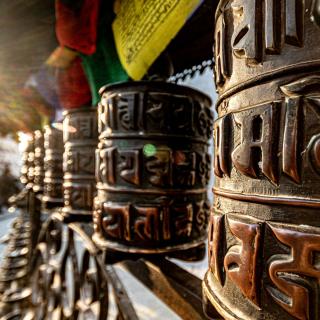
Tibetan teachers,
Mingyu Rinpoche.
He often talks about monkey mind.
And he sometimes jokes that we could try to give it a banana,
But that doesn't really help.
But training our mind like this actually starts to build the neuroplasticity in our brains.
And so when we come across some stress,
Or something going on in our lives,
We have something more resourceful to come back to.
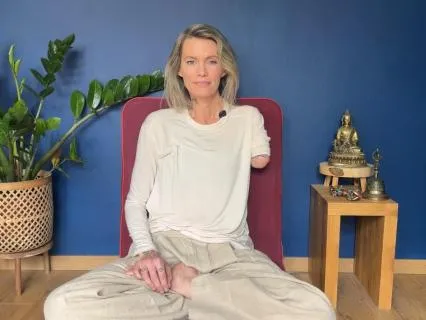
So I'm going to guide you in a mindfulness practice using our senses.
And coming back into the body.
To really give ourselves time to settle our nervous system.
To settle.
This practice can be done seated inside or lying down if you need to.
And it's really lovely to do it outside in nature.
So if you want to do that,
You've got a few moments to.
.
.
Get yourselves in the position that you feel comfortable.
And as you get comfortable,
Just give yourselves.
A few moments to arrive.
Here.
In this meditation together.
And before you close your eyes,
Just let your eyes stay open for a moment.
And have a gentle look around the room.
Or the environment that you're in.
Taking your time with it.
And notice that this is where you are right now.
You'll know it else.
Where your mind seems to be.
You're not away in what's going on in the head.
In the past or the future.
Right now,
You're right here.
So you're almost landing.
Here.
Feeling your body relax as you do that.
You could take a full breath in through the nose.
And let out a satisfying sigh.
Letting the shoulders drop down.
And as you look around,
Really notice your surroundings.
As if you're seeing them for the first time.
Try not to get pulled out to what's there.
Entangled in concepts or even labels or thoughts about what you see.
And just notice it.
Noticing the shapes.
The colours,
The light.
Textures.
Really noticing all the details.
And just being present with what you see.
And now just gently closing your eyes.
Your awareness.
Slowly drawing in.
Towards your body.
Towards your center.
And as you rest there,
Let's take a little time to really listen.
Listening to all the sounds you hear.
And letting the sounds come to you.
Again,
Try not to get drawn out to the sounds.
And the stories or labels connected to them.
Really taking your time to listen.
You might hear sounds that you're used to noticing.
You might hear sounds that you've never noticed before.
And notice how each sound arises.
Horses.
And disappears on its own.
And allowing your awareness now to draw in.
To noticing the taste in your mouth.
Maybe the warmth in your mouth.
Maybe you almost never taste the taste in your mouth.
Because you're so used to it being there.
I really taste it with a sense of bare awareness.
And as you breathe,
Notice anything you smell.
So each time you breathe in,
Really being aware of anything you smell.
Maybe you don't notice anything.
So each time you breathe in,
Really being present.
With that no smell.
Now begin to notice what sensations you feel.
In and around the body.
Maybe the temperature of the air.
Against your skin.
On your face and your hands.
The sensations of your clothes against your skin.
Becoming aware of any tension in the body.
And allowing that to soften and relax.
Notice the sensations of your body against the chair or the bed.
Or the cushion supporting it.
Wolf,
Your feet are on the ground,
Feeling earth against your feet.
Becoming aware of the warmth in your body.
Or maybe even the feeling of the aliveness.
In your body or your muscles.
And as you breathe in and out,
Noticing the sensations of the air.
In your nostrils and your throat.
And the movement of your chest and your ribs and your belly.
As you breathe.
Becoming aware of the small pause at the top of the in-breath.
And a deep,
Long pause.
At the bottom of the out-breath.
And finally taking a moment to notice how you feel.
In your body Do you notice any sense of calmness or stillness?
So this practice can be done anywhere,
Anytime.
If you get used to really tuning into the body and tuning into the senses,
You can do it when you're at the office.
Or stressful time with family,
Or whatever it might be.
A time when you just need a few moments.
To come back to your center.
And relax the nervous system.
I hope you've enjoyed this meditation together and I look forward to seeing you soon.