Hello everyone,
Welcome.
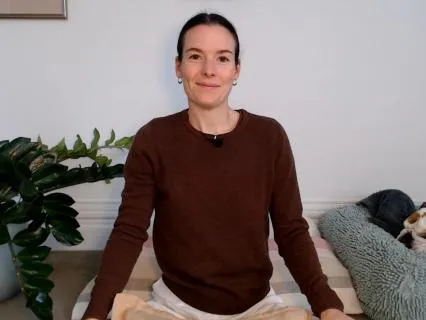
I'm Benita,
If we haven't met before,
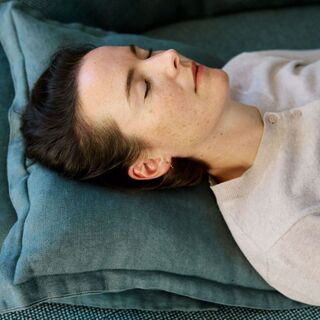
And this is my darling sweet girl,
Ginger.
We want to move through some breathing anatomy today.
And just as Ginger has demonstrated a big,
Luxurious breath in and sigh out,
We might begin our talk with exactly that.
So as you feel ready,
Finding a breath in gentle,
Soft through your nose.
Maybe rising the shoulders up towards the ears.
And sigh that breath out,
Release the breath through the lips.
Breathing this in.
Thing that we do over 22,
000 times every day.
Something that has such an emotional quality.
Our breath changes in response to how we might be feeling.
But equally how we're feeling can be.
Impacted,
Influenced.
By the way that we are breathing.
So there is this multi-directional,
Multi-dimensional component to our breath.
What I want to move through today is some of the key components.
The main muscles that are involved in breathing.
And this might be particularly useful if you are noticing chronic tension through the head.
Tops of the shoulders.
These muscles and places in our body that are tightening.
Irrespective of how much movement or stretching.
Or if you're lucky enough to get a massage.
These places.
Seem to spring back to their restriction.
So what we might start to dive into is how might our breath be influencing some of that tightness and stickiness?
And so our main breathing muscle is our thoracic diaphragm.
And it's located.
.
.
Deep inside,
It's really difficult to feel.
But just beneath the sternum,
This dome shaped muscle.
These ginger ears.
Showing us her sweet,
Sweet snoring.
And our diaphragm is the principal,
Primary,
Main breathing muscle.
Our diaphragm descends in this luxurious,
Elegant fashion as we breathe in.
And what that does is create space in the torso.
For our lungs to expand.
For the basket of our ribs on each side to widen and broaden.
Creating more space.
For our breath to flow and to dance,
To nourish all of ourselves.
So that downward movement of our diaphragm as we breathe in.
And it floats back up as we breathe out.
So essentially,
Breath is internal movement.
If the diaphragm for many reasons is limited in its movement.
It's not moving in this.
Spacious,
Expansive way.
Other muscles.
Have to do a bit more work to.
.
.
Help us to breathe.
So the other muscles that support our diaphragm.
Are the intercostal muscles.
That live between each of our ribs.
You might feel down from the shoulder girdle.
Under the armpit.
Around the side of the torso on both sides.
Feeling the basket of your ribs.
And the intercostal muscles are living between the ribs.
You sweet girl.
The abdominal muscles also support our diaphragm in breathing.
So our core,
Our center needs to be fluid.
Our bodies need to expand to make more space and room for our breath.
So you might take a pause and notice.
If you're wearing.
Often restrictive clothing and belts.
If there is a habitual pattern of sucking in the belly.
Squeezing through the core,
Tightening.
That engagement makes it near impossible for that movement to happen.
And so when these muscles.
.
.
Our thoracic diaphragm,
Our abdomen,
The intercostal muscles.
When they are not working as planned.
They were designed to,
For lots of reasons,
These upper secondary respiratory muscles.
Start to be overworked.
So moving through those.
Starting at the pecs at the front of the chest.
You can bring a little bit of massage to that part of your body,
Feeling any stickiness.
We have the trapezius.
The tops of the shoulders.
A place where I often feel a lot of tension.
And the scalenes.
Thin muscles within the neck.
That attach to the first and second ribs.
Of nestled underneath the shoulder girdle.
And the scalenes help to lift the first and second ribs as we breathe in.
And then we have the sternocleidomastoid,
Which I'm surprised I've managed to say correctly first time round.
But the sternocleidomastoid on both sides comes from the base of the ear.
Down the side of the neck,
Attaches to the clavicle on both sides.
You can see and feel this muscle if you gently turn to one side.
That these muscle groups the front of the chest.
The trapezius,
Tops of the shoulders.
And the scalenes and the sternocleidomastoid in the neck.
When our breathing muscles down here are not moving so much.
These are overworking.
And it can come out as.
.
.
Chronic tension.
Through the upper back and shoulders.
That stickiness.
Stagnation in that part of the body.
We might get headaches,
We might feel a lot of tension through the cheeks.
The jaw.
So instead of seeing these parts of our body that are tight,
And perhaps getting frustrated,
Trying to.
.
.
Hammer out that tension.
How might we start to support those muscles in creating a little bit of dissolve and ease?
By noticing the way that we are breathing.
And if there is one takeaway from this,
Tall,
It's that breath is movement.
Our diaphragm moving in this luxurious,
Elegant,
Graceful way downwards as we breathe in.
Floating back up as we breathe out.
Movement of our front body opening,
Expanding.
Side body widening and broadening.
Full,
Expansive,
Optimal breathing is all about movement.
How might I be limiting and restricting this movement that naturally knows What to do?
It's maybe getting trapped and contained by different habitual patterns we've accumulated over time.
And the wondrous thing is that these patterns in our breathing that we have learned and acquired over a lifetime perhaps,
They can be unlearned.
So we might take a couple of conscious spacious breaths to finish.
I could talk for hours about the anatomy of breathing.
But today just sprinkling in some of the main muscle.
Some of the places in your body you start to feel.
Might start to pay attention to,
To notice.
And we'll do three conscious breaths.
The option of a shoulder shrug together with me if you like.
Your breath in,
Gentle,
Soft through the nose,
Shoulders glide up any amount.
And maybe a sigh as you breathe out.
We'll do that two more times together.
Your breath in.
Shoulders float and glide up.
And releasing the breath maybe through pursed lips this time.
You One more.
Breath in.
Releasing breath out.
You Feeling that melting of the shoulders down your back.
Maybe really feeling that swell of the front body.
Out into the space around you and beside you,
Really feeling that whole body breathing.
Thank you so much for joining me and sweet snoring ginger.
Who's obviously been bored by our breathing anatomy today.
But I would love to hear from you,
Any explorations or inquiries you're meeting about your breath,
Learning about your breath.
And thank you so much for your practice.
You