Hello,
Welcome.
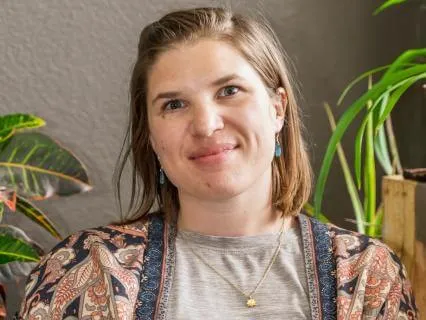
I'm Yaesha Bryan.
I'm a psychiatric physician associate,
Trauma-informed yoga teacher,
And chronic pain coach.
I've also walked my own path of chronic pain,
So if you're living in pain,
I truly understand how many layers of challenge that can create.
I hope that this talk offers you a new framework for understanding your pain and maybe even a glimmer of hope.
So let's talk about the science.
Science now tells us that many cases of chronic pain aren't actually rooted in tissue damage or a structural issue.
Instead,
They're caused by something called neuroplastic pain.
You may have also heard the term neural circuit disorder or nociplastic pain.
All the same thing just different names for the same thing all pain is generated in the brain however in the case of acute injury a cascade of events occur that informs the brain to generate the sensation of pain Let's take a look.
Let's consider an example.
So a cut to the arm.
The injury the cut causes damage to the cells.
This leads to a release of chemical mediators.
These activate sensory nerve fibers,
Which transmit signals to the spinal cord and then up the brain through something called the spinothalamic tract.
The brain receives this message in multiple regions,
But primarily in the somatosensory cortex.
This area of the brain helps us to interpret physical sensations and determine their location.
To recap,
An injury occurs,
There's a chain of events that lead to activation in the area of the brain that processes and registers physical sensation.
This is an example of an appropriate pain response.
But we know the brain can also generate pain in the absence of injury.
That's what we mean by neuroplastic pain,
The creation or persistence of pain without an injury or tissue damage.
The brain is generating a pain response without an acute cause or long after an injury has already healed.
Let's dive a little bit deeper.
Over the past decade,
Research has really shifted how we have come to understand chronic pain.
One study by Epcirian and his team followed people with new onset back pain,
Or fairly recent back pain development.
They scan their brains with an fMRI shortly after pain began and then again one year later.
Some participants fully recovered,
Others did not.
They remained in pain.
What they found was that those who had developed chronic pain The way that their brains processed pain shifted.
Their brain activity shifted.
So pain processing moved away from areas like the somatosensory cortex.
Which is responsible for handling physical sensation,
As we learned on the previous slide.
This is what we would expect to see in pain,
In acute pain.
But for those that were still in pain one year later.
Brain activity shifted to regions responsible for emotion,
Memory,
And learning,
Like the medial prefrontal cortex and the limbic system.
A second study went on to look at white matter structure,
Which tells us essentially how the brain is wired.
Incredibly,
Researchers were able to predict with 85% accuracy who would go on to develop chronic back pain based on brain scans alone.
So not looking at the severity of the injury,
Not looking at spine scans,
Just based on.
.
.
How the brain is wired which they assessed by looking at their white matter structure What they found was that the stronger the connection between areas like the medial prefrontal cortex,
The more likely pain was to persist and to become chronic.
These are areas that are deeply involved in learning and emotional processing.
So just imagine a brain scan being more accurate at predicting if you're gonna go on to develop chronic back pain than actually looking at the image of the spine itself.
So these studies and many more show us that chronic pain is often learned by the brain itself.
It also helps to explain why,
For many people,
Procedures that target the site of pain like the back,
The knee,
The ankle often don't relieve the pain.
To find true relief,
We really need to target the brain itself because that is where the pain is being generated.
If you are anything like me,
You might be thinking,
This may be true for some people,
But it's not true for me.
Most people with chronic pain feel exactly that way.
I did too.
But treating my neuroplastic pain has been the most helpful thing I've done for my pain journey so far,
Even more than surgical intervention.
And don't just take my word for it.
One study of 222 people with chronic back and neck pain found that 88% had neuroplastic pain.
88% of 222 people.
An additional 6% had a mix of neuroplastic and structural pain,
Meaning there was a neuroplastic,
A learned component,
But there was also a structural issue contributing to the pain.
So of these 222 people,
94% of them could have benefited from approaches that treat neuroplastic pain.
This is just a starting point.
For now,
I want you to know if you've been struggling with pain,
It's not your fault.
There's a biological story behind it and there is a path forward.
I'd love to keep walking it with you.
And thank you so much for being here.