Most meditation practices ask you to sit up straight,
Focus,
Maintain concentration.
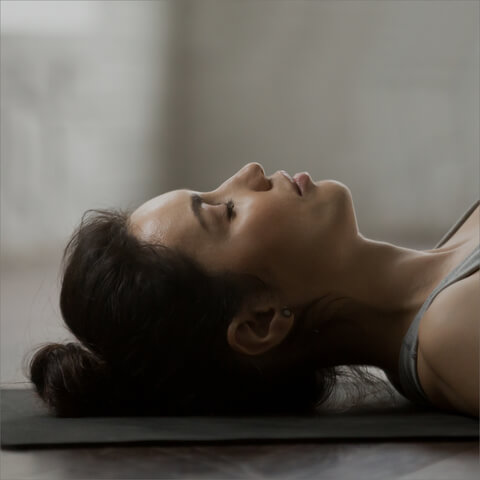
Yoganidra asks you to lie down and do almost nothing.
And that single difference changes everything.
Yoga Nidra isn't like other meditations.
You're not working,
You're not trying to maintain effort and focus throughout the practice.
You're not trying to get it right.
Yoga Nidra is completely passive.
Your mind always has a voice to follow.
It could be the body scan,
Moving through the palms of the hands,
Awareness of the soles of the feet or the space between the eyebrows.
It's like there's this thread that you can always hold onto and come back to during the meditation as you drift in and out of awareness.
So you're not alone to wrestle with your thoughts.
And there's absolutely nothing to achieve.
The instruction is to follow the voice,
That's it,
Which makes it really accessible,
Especially if you've tried other forms of meditation and you felt like you got it wrong.
In Yoga Nidra,
There is no way to do this wrong.
It's also not like typical relaxation either.
Yes,
It's deeply relaxing,
And there is more structure and intention than you would find in a relaxation exercise.
Yoga Nidra follows a distinct sequence.
Not every step appears in every session,
But there is a science,
And it's worth knowing that there's a layer upon layer that guides you through the mind-body system and into the rest state.
Digest state.
You don't need to understand the sequence in order for it to work,
But it's worthwhile knowing that this practice has great depth beyond relaxation.
There's nothing wrong with relaxation,
Of course.
Enjoy Yoga Nidra for that,
Too.
Most yoga nidra traditions also include sankalpa.
This is a short,
Heartfelt intention,
Something like,
I am at peace,
Or I am happy,
I have balance and harmony in my life.
Words that feel like something you're quietly moving towards.
And over time,
That's part of what makes a yoga nidra practice so powerful.
Now,
Yoga nidra isn't sleep either.
The name yogic sleep is a little misleading because yes,
You're lying down and you're still,
But the sleep is actually that threshold just before sleep where the mind remains softly aware while the body rests.
Completely.
And this is where Yoga Nidra does its deepest work.
Connecting you to intuition,
To creativity,
To insight,
And also giving you a quality of rest that you don't typically get with sleep.
I mean,
For example,
You may find that for a lot of us when we're sleeping,
There's tension.
You might be gripping your fists,
You might be grinding your teeth.
The mind is busy problem-solving and dreaming,
So it's far from quiet,
The mind.
And in Yoga Nidra,
You're deliberately guided to just release all of that,
The tension,
The thoughts,
The effort.
It's often more replenishing than sleep itself.
And if you do fall asleep,
This happens all the time,
That's okay.
It often means that the body just needed more sleep.
And with repetition it becomes easier to rest on the edge of sleep,
That aware and awake state.
Unless you actually want to use your energy deliberately to help you fall asleep,
And that's also okay.
And then one more thing worth knowing is that Yoga Nidra is cumulative.
So a single session gives you rest,
Deep rest,
And a regular practice,
Say,
Twice a week,
Once a week,
Twice a week,
Begins to quietly shape how you move through the world.
Not because you're trying to change anything,
But because during the Yoga Nidra,
You're creating conditions for change,
Which is what I love to refer to as Yoga Nidra beyond sleep.
Now the best way to understand all of this is to simply experience it.
So start with a short session,
Say 15 to 20 minutes,
Or if you like something even shorter,
My Nano Nidras here,
They're less than 10 minutes long,
And they work beautifully as a first taste of Yoga Nidra,
Or as a top-up in between those longer sessions.
So you can do those every day when a longer meditation is not available.
For the deepest benefit,
Generally,
A 45-minute session,
Say once or twice a week,
This could be a good rhythm to get into.
And if you'd like to understand the practice more deeply,
I lead a yoga nidra course right here on Insight Timer,
And I'd love you to join us.
For now,
Lie down.
Close your eyes.
And be open to what you find.
Happy Meditating.