So I was wondering.
.
.
Have you felt?
More empty after an hour of scrolling on your phone.
Than when you started.
Typically something which we experience probably on a fairly regular basis scrolling on the phone then just this feeling of emptiness which comes or vacuousness or dissatisfaction.
So in today's talk,
I wanted to talk about what in Buddhism they call the hungry ghost state.
And the hungry ghost is one of the six realms of existence.
That's described in traditional Buddhist texts.
Texts.
Encompassing the different I don't know,
States of being we can find ourselves in within the cycle of life and death.
And the hungry ghost state.
Is characterized by a being with a very big belly,
Is insatiable appetite.
But at the same time has an extremely narrow neck,
Like needle thin.
And has a great big mouth.
Desperately trying to eat things but just can't swallow anything.
So it kind of represents a state of constant hunger.
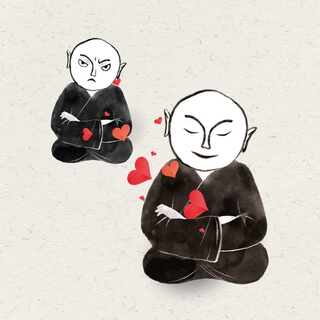
And a constant thirst we could see it really as representing the state of addiction.
And you know with our phones it's one of the places where we find ourselves most addicted these days.
It's not really about.
.
.
It's not necessarily about the content of what we're scrolling and watching and.
.
.
Trying to find,
It's really that state of wanting more never enough,
Never being satisfied So if you've been here before,
You're very welcome.
Glad to see you back.
If you're new here,
Then great that you could come and you found us.
My name is Mark Curran-Westmiquette.
And I'm a Zen teacher with the Zenways.
Sangha group.
Here we're based in London in the UK and you know we offer things very much worldwide these days.
With in-person meetings and online meetings.
So glad you could be here.
Today the plan is.
.
.
To do this talk.
And then we'll follow that with about 15 minutes of meditation practice.
Focusing on the theme of these hungry ghosts.
So the hungry ghost realm,
Part of the six domains of what they call desire in Buddhism,
The desire,
The round of rebirth,
Of suffering basically.
So we have the six realms.
We have the realm of what they call devas,
Which is basically gods.
Or you could say it's the heavenly realm,
Where everything is just easy and pleasurable.
Then they have the realm of what's known as the Assuras which could be translated in English as Titans or like demigods or something like that,
Where in this context it's the realm of anger.
Of jealousy.
And of pride.
Competition.
And then we've got the human realm.
The realm in which it's possible to Live a good life.
Maybe.
Live a spiritual life to reflect and gain insight into our beings and realise the truth of who and what we really are.
Kind of gain enlightenment from the human realm.
Ahem.
Then we have the animal realm.
Animals in this context,
Beings who act mostly out of instinct,
Suffering from ignorance and having no access to the kinds of insights which might lead to enlightenment or basically the end of suffering.
Then we have the fifth realm,
The realm of hungry ghosts.
The the the state of being,
Of desire,
Want,
And addiction.
And then.
.
.
We have the hell,
Hell realm.
And that might be an area of extreme suffering and deep pain.
In the traditional teachings,
They're seen as being places where we could end up in the next life.
You know,
If we live a good life here,
We're able to move upwards in,
You know,
Status or whatever.
And if we live a bad life or we do some bad things,
Then we can move downwards.
And I think that's It's not really the view taken with Zen.
I mean,
Really it's the human realm that's the place where we want to be because that's where we can realize the end of suffering.
If we,
You know,
If we decide to,
If we bring our attention to bear.
The other realms,
Even the heavenly realm,
I did a talk a few weeks ago where we were discussing this idea that heaven is the most dangerous place.
Because it's just so easy and pleasurable.
We get very stuck,
Like we don't need to do anything.
And then the other realms,
The realm of the Assuras,
The realm of being in anger and jealousy and pride and competition,
As much as the hungry ghost realm is very,
Very difficult and gets us very stuck.
The animal realm,
Where we just have no access to insight,
We're living very instinctually.
And then of course,
The hell dimension,
They're all really insane,
Seen as being Um.
.
.
Reflections about how states of being we can find ourselves in in this life.
We can live for a while in the realm of the assurers in that kind of jealousy and anger envy We can live for a period in this hungry ghost realm or any of the other realms really.
So they're just aspects,
I suppose,
Of our normal daily living and they can come up fleetingly or we can live for fairly,
In some cases,
Fairly long periods of our life in these kind of states.
Now if we look back into the Buddhist sutras.
.
.
And we find an example of.
A monk whose name was Moggallana and he was one of the disciples of the Buddha alive at the same time.
He was a very practiced student.
At the point at which he,
What they call,
Opened his eye,
Which he kind of realised enlightenment.
He was able to find his mother who had died in the realm of the hungry ghosts.
So in their tradition,
I suppose,
The hungry ghost is a being which is mostly invisible to normal life.
So he developed this power of being able to see the hungry ghost realm.
Now,
I would argue in these days,
We might see it as being,
Okay,
You can see people in the hungry ghost realm.
They're not invisible.
There are definitely people who live in this realm.
But anyway,
This is the story.
So he realised enlightenment and developed this power of being able to see these ghosts,
The hungry ghosts.
And he found his mother living in the hungry ghost realm.
Do you become a ghost?
And he tried to feed her,
You know,
Desperately hungry,
Tiny throat.
He tried to feed her,
But the food he offered turned into burning coal in her mouth.
The idea is that she had migrated into the realm of hungry ghosts because of some past stinginess.
She was a very stingy person when she was living as a human.
And poor old Magallana.
My mother found her.
I tried to feed her or offer her something but she just cannot swallow what I'm offering.
She was living in this place of constant hunger and thirst I think we can all resonate with having met people.
Or having been in that place yourself.
Maybe we could just take a moment and reflect.
Who in your life?
Feels like they've lived in this place.
Was living in this place.
Now there are many forms of addiction.
Addiction is basically the desire,
The want.
A pull towards us,
Taken to an extreme.
So we think mostly of chemical addiction,
Drugs and alcohol.
Caffeine and all that kind of stuff but actually I started today.
With this example of our phones.
Because our relationship to our phones so easily and so quickly it becomes one of the most.
One of the strongest addictions of our modern life you know if we're not turning to pharmaceuticals or drugs it's the phone we get so tied to.
And addiction to phones comes in lots of different forms as well.
There's the scrolling,
Maybe doom scrolling,
And that kind of never-ending feeling of dissatisfaction.
But there's also the cycle of what do they call it,
Reward,
The cycle of reward we get from when one of our partners excuse me,
What our posts get like.
And then,
Ooh,
Someone's liking my post.
Someone must like my life.
I want more of those likes,
So I start posting some more.
And I post videos of or pictures of myself doing certain things and I get responses from people and that sort of continues this fulfillment of getting temporarily satisfied,
A sense of reward,
You know,
When you see the pings or you get the notifications and that drives us to do more,
So it's another kind of addiction.
I mean,
There has been no technology.
.
.
Throughout the history of technology that's been so glued to us as a human.
Right?
I mean,
Where are we without our phones?
Can't even go to the toilet without taking a phone with you,
You know?
So deeply.
Connected to our physical body.
We've got the.
.
.
Relationship with this.
Image of a hungry ghost,
Right?
So when we're on the phone.
.
.
Normally are.
Whole view of reality.
It shrinks to a tiny view of just the screen,
A whole being and a whole.
.
.
Attention,
Everything is shrunk right down to the view of the screen in front of us.
Whatever it is,
6 or 7 centimetres of screen.
So there's this narrowing of our world.
And then,
Of course,
The technology itself is designed to be utterly bottomless.
There is no excuse to be bored.
Ever.
Because there is a constant and never-ending possibility of doing something on your phone.
So the whole idea of boredom seems to have evaporated in modern life,
Right?
If you've got even a 30 second spare window,
You just whip out your phone and start doing something on it.
So this infinite scroll,
It feeds this sense of greed or craving,
Creating this bloated belly,
This desperate need for blood.
Being hungry.
And then the notifications,
The pings or the likes or whatever it is.
You know,
The followers we get.
They're like the food which turns to coal when we put it in the mouth,
Turns to fire,
Right?
So it feels like it's going to be satisfying.
Then when we actually eat it,
It just evaporates.
There's nothing there.
It just destroys itself.
And then we want more.
That creates the thirst for the next hit,
If you like.
Or next cycle of suffering.
So within our relationship to the phone,
You could see the whole cycle of suffering.
Which plays out in any kind of addiction,
Whether it's to the phone or indeed,
You know,
To chocolate biscuits or to sugar or to,
You know,
Whatever it is we get addicted to these days.
Thank you.
We talk about in Buddhism the three poisons,
Which is greed,
Hate and delusion.
It's the reason why we suffer.
So the Buddha came up with this formulation of what we call the Four Noble Truths.
First of all,
That suffering is inherent to life.
Second of all,
We suffer because we want,
We push away,
Or we get deluded.
We have this greed,
Hate,
And delusion.
The greed,
The want,
The pull,
The hate.
The aversion,
The push.
And the delusion,
The confusion or misperception or misunderstanding.
So here we're very much,
The hungry ghost realm is very much the greed dimension of the three poisons.
For example,
We get addicted to sugar.
Because it's very.
.
.
It's so strong that it kind of overwhelms lots of other sensations.
We end up eating to feel numb.
Eating to cover up what's going on elsewhere.
Sometimes.
Or we get addicted to status,
For example.
Feeling high and grand.
Boosting our ego we get addicted to Wanting money,
Feeling rich.
Because that gets tied into our feeling of self-worth.
Like our net worth.
Equals self-worth.
Which is a delusion.
So the whole.
System of suffering comes down to really the belief that if I get this certain thing,
Then I'll be happy.
If I get more of that thing,
Then I'll really be happy.
This kind of future wanting,
Reaching out.
So a hungry ghost is a kind of.
.
.
Forward leaning energy.
It's leaning toward a future wanting.
And a hungry ghost can never.
.
.
Inhabit.
Now because now is inherently complete There is nothing more to add to now.
Now is absolutely clear.
Just the way it is.
The here and now is where we find the end of suffering.
So what do we do then?
What's the practice of how we deal with.
.
.
The Hungry Ghost State.
Well,
First of all,
It's the recognition.
We recognise that we are in a state of addiction.
Want.
And this can be actually a good part of the journey and can take a lot of work just to get to that stage.
It needs.
Reflection.
It needs awareness.
It needs a willingness.
And maybe even courage to look.
Because when we're in,
When there's a subconscious recognition that something isn't right I feel dissatisfied I feel.
Uncomfortable.
Then on the conscious level we can actually resist looking because I think sometimes We worry that if I do look there's going to be like a Pandora's box.
I just open the lid a little bit and all this kind of stuff comes out.
And I don't know where I'm going to be and it's just going to be awfully painful.
And we don't want pain,
Of course.
None of us want to feel pain,
So we resist it and we push it away.
And then we deny it and we repress it.
And years later.
We find ourselves in a terrible situation.
We've lived as a hungry ghost.
For years.
And that's very sad.
So the first thing is to bring the willingness to look and to bring the awareness.
And the presence to see how things really are.
You know,
Like in AA,
Isn't it?
The first thing you're supposed to do,
Isn't it?
To stand up and say,
Hi,
My name is Mark and I'm addicted to drinking.
It's the.
.
.
Not only inward.
Acknowledgement.
But it's the public and outward acknowledgement of where we are.
Is extremely powerful.
That's why they get people to do it in AA.
Hello,
My name is Mark and I'm addicted to using my phone.
Hello,
My name's Mark and I'm addicted to eating sugar.
It's quite a strong statement if we can have the willingness to look and to see.
There might be.
.
.
Realizations on the thought level.
But there might also be realisations that come from different places like I felt really dissatisfied which is kind of an emotion right I feel really kind of angsty I feel really like fidgety in my life you know I feel like there's just this constant feeling of reaching or wanting like my energy is going out that's what it is it's like it's I feel like I'm not grounded no energy is going out the whole time it might just be that when the craving comes,
For whatever it might be,
There's a physical reaction in your body like a tension or tightness might be in the throat,
The chest,
Might be in your fingers.
So little signs.
To look for.
To recognize when this craving,
So I think I would say we all exist in some state of minor addiction.
I think it's just,
You know,
In a sense,
The Buddha was saying,
You know,
First noble truth.
That suffering is inherent to life.
So you could say that,
Essentially,
That suffering is a minor state of addiction.
It might not be full-blown to the point which I will give up everything,
My relationship,
All my money,
My house,
Everything just to get that thing.
Which will be like at the extreme end.
But we all exist in a state of minor wanting.
Like that.
If I just get that.
.
.
I'll be better.
I'll be happier.
Because that's the way society is set out,
Right?
Advertising is designed to put you into the hungry ghost mind state.
Advertising specifically designed.
To get us to feel like we haven't got enough.
That if I buy that,
Then I'll be happy.
If I buy that,
I'll look like the person in the advert,
Happy and smiling and feeling good.
And I don't know about you,
But living in London.
.
.
You get hundreds and hundreds of advertising every day,
You know,
On the side of buses and the tubes,
You get it on TV,
You get it on YouTube.
You know,
It's everywhere.
And the cumulative effect of all this advertising is designed to tell you you're not good enough.
That if you just need one more thing and you'll be happy.
The cumulative effect of that is to put us in this minor state of addiction the whole time.
Gosh,
What a society we live in!
How did it end up like this?
Now the second step would be to.
.
.
Feed the ghost.
Taking the example of Moggallana back in the Sutras He opened his spiritual eye,
He realised enlightenment and developed the power of being able to see the hungry ghost realm.
And he found his mother there in this realm as a ghost,
If you like.
Desperately hungry.
And try to feed her.
He offered her some food and the food turned to fire basically in her mouth.
So try to feed a hungry ghost when they're in a state of addiction.
Is perhaps Very difficult.
Because their desire,
Their thirst is bottomless.
But also.
.
.
In a sense you're kind of compounding the pattern to begin with like I'm in a state of addiction I want to use my phone so if someone comes along and offers me more to look at on my phone or you can download this new app it delivers you Twice as much content,
Twice as fast.
Wow,
That's great.
Sounds wonderful.
It's going to really feed my habit.
My desire has become even further.
More bottomless,
But also that kind of attempt to feed it is playing into the pattern itself.
I'm not breaking out of the pattern,
I'm just getting further entrenched in the pattern,
Right?
I'm addicted to sugary biscuits or crisps or whatever it might be.
If someone comes along and offers you more of that,
What help is it?
So the Buddha,
In this example,
The Buddha said to Moggallana instead of trying to feed your mother this ghost.
Why don't you offer food?
Service.
To the Sangha.
Community of practitioners around.
Why don't you offer?
Why don't you give your generosity?
To the people around.
And that way it gains merit like there's a kind of positivity which comes from those kind of offerings.
And that positivity feeds the general sort of background of energy from which your mother can benefit from.
So it's a bit indirect.
But the idea is.
.
.
To feed a ghost,
A hungry ghost,
Really we do it through compassion and through generosity.
It's the exact opposite,
If you like,
Of addiction.
Addiction desperately wanting.
So we do the opposite.
We give.
We give.
We offer.
So there's a big thread in Buddhism about giving,
And the giving could be financial,
But it can also be lots of other ways.
We give energy,
We give attention,
We give our expertise,
We give teaching.
All sorts of ways of offering,
Giving.
And that way we We feed what needs to be fed in a very wholesome way.
So the story carries on and his mother was released from the hungry ghost realm and migrated into a better place.
Another dimension to this is what Zen Master Bankei,
Who was a Japanese teacher from a few centuries ago,
Zen Master Bankei called the unborn.
Now the unborn is a state.
Where we are simply well the unborn is a place and we say where things arise from,
Like the phenomena of our existence,
Our experience.
They arise and they pass,
Arise and pass,
Come and go.
The unborn is that kind of place behind.
The things that are arising and passing.
So you could say the unborn mind,
The Buddha mind,
Or the awareness mind,
Is.
Like a mirror.
And like all mirrors,
It simply just reflects what comes in front of it.
So it doesn't decide to reflect some things and not others,
Or distort the reflection of something because it doesn't like them.
Just reflects.
So our phone can just be reflected in the mirror,
So we just become aware of it.
And the impulse,
The craving,
Can also just be reflected in the mirror.
We just become aware of it.
Stop that,
It's not good.
We just notice.
This sense of addiction is just arising in our experience.
We notice,
Try not to judge.
And then we just let it pass and it's ready.
So we can stay in this place of flow of awareness and allow all these things to come and go and that's really where we come to the end of the suffering,
How we can bring suffering to an end.
The phone is just a tool.
There's nothing wrong or right about it.
There's nothing good or bad about a phone and about social media and emails and all the rest of it.
Just as much as a cake,
Or biscuits,
Or chocolate,
Or.
.
.
Money or any of it,
You know,
It's not inherently good or bad.
It's a tool.
They are.
Pieces of experience.
The suffering comes from our wish to have more of it.
The thirst or the hunger.
The want.
To the four noble truths that suffering exists we're all in this minor state of addiction and addiction comes from when we want or when we don't want pushing things away or when we get very confused and we're in a delusion.
And then the third noble truth would have said there is a way to bring this suffering to an end.
There is an end to this suffering.
And this end of suffering comes when we realise what is enough.
Basically when we come to this present moment here.
.
.
We inhabit this present moment and realize that everything is okay.
Right now.
There is nothing more we need.
This present moment is enough.
We are enough.
So I wonder.
The next time you reach for your phone.
Whether you'd be able to take a breath.
That itself is hard,
It's so habitual.
Reaching the phone.
.
.
We just take a breath before we do anything.
And ask.
Who is hungry?
And then just see what happens.
So I wonder,
As we come to the end of this talk,
If there's any.
.
.
Points or reflections or questions or resonances from that.
I would love to hear that in the chat.
It is very nice to feel each other's presence in the chat.
Just so that we can feel part of a community coming together to practice,
Rather than just people watching me giving this talk.
So please,
I'd love to hear from you in the chat,
Anything that's been coming up,
Anything you'd like to contribute.
And in the moment we'll just get ourselves ready for meditation practice.
We're going to do about 15 minutes or so together.
Well you might be typing or you might be just getting ready.
Settling yourself into a comfortable meditation posture.
Sitting up tall.
Tucking your chin down and in slightly.
Letting your eyes lower.
Maybe closing your eyes.
Turning your attention inside your body.
Noticing how you are.
Whether you're feeling heavy,
Boom.
Cool.
Whether you've got any areas of discomfort.
And I appreciate you may be watching this on your phone.
So how about.
.
.
Just open your eyes for a moment.
And look at your phone.
So we've got the screen,
But also the rounder phone,
What looks like the shape,
Size.
You could perhaps.
.
.
Reach out and touch it.
Move your fingers around the edge.
Maybe even pick it up and.
.
.
Feel the weight of it and how familiar it is in your hand.
Touch the screen.
Make something happen.
What is your relationship with your phone?
Gently putting a phone back down.
But keeping it in sight,
Keeping it close to you.
There's nothing inherently wrong.
Or write about your phone.
It's a tool.
Noticing a relationship to it.
As much as the phone.
Can be used to feed our bottomless thirst for content.
For likes.
Four.
Approval,
Social approval,
All sorts of things.
They can also be used for good.
For positivity.
For development.
As we're doing right now,
Right?
Watching this talk.
Practising together,
Joining together.
This wonderful tool.
The Insight Timer app.
YouTube.
Recordings.
To allow us all to practice.
To bring awareness to.
What's going on?
And to be together.
In our intention.
It's no use.
Thinking in the abstract about,
Oh,
The next time this happens,
Then I'll do that.
The next time I feel in need of a chocolate biscuit.
I'll make sure I'll only have one.
Or I'll make sure I'll put the biscuits away.
You know,
This is all abstract thinking.
Hypothetical.
This practice only really works in the moment.
Noticing right now and then making conscious choices about what we respond,
How we respond.
In this moment.
So I think the best use of our time practicing here is to offer generosity.
To see this space.
Meditation,
Practicing together.
As an offering of generosity.
To those.
Hungry,
Thirsty.
Elements of our being.
Have this attention.
Have this space right now.
Have my attention.
A hundred percent remembering the example of Moggallana.
Trying to feed his mother.
And the Buddha saying,
Don't feed her directly.
Offer.
Service,
Generosity,
To the community.
Cultivating this generous spirit.
Creating this space and time to be.
As generous as you can.
Right now.
Giving yourself.
Time.
I'm going to be quiet now.
So we can all just Orphades.
Space and silence.
And thus we come to the end of this practice time together.
So I just sway from left to right Taking a deeper breath if you like.
When you're ready,
Allowing your eyes to lift.
We offer the merit of our practice today to all beings.
May they be safe.
And well.
May they be content and happy.
May they find.
Realisation.
Thank you so much for joining today.
As always,
It's great to feel us coming together in a community and practicing.
So if you would like to offer a donation in exchange for today's teaching,
It's very easy.
You can click on the donate button.
So I'd love to see you again.
You can come back and join us.
That'd be lovely.
Otherwise,
I wish you a very good rest of your day and I'm so glad to see you.