So what is Zen?
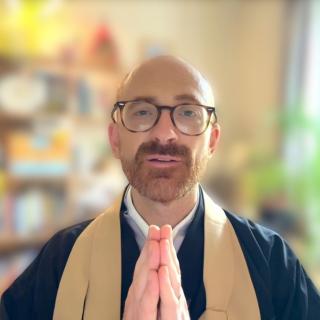
My name is Mark and I'm a Zen teacher with the Zenways community based in London,
The UK.
Zen is a school of Buddhism.
So like all religions,
There's many,
Many different schools within the religion itself.
I mean,
Whether you call Zen a religion or not,
Within the school of Buddhism,
Then we've got lots of subdivisions.
Zen is a school of Buddhism which comes from Japan.
And then has moved its way into the west here but before Japan it traces its roots back to China where they called it Chan.
So Zen is the transliteration of Chan and Chan is the transliteration of the Sanskrit word dhyana.
Dhyana means meditation.
So Zen is a school of Buddhism which emphasizes meditation or particularly what you find when you do meditation.
So there are other schools of Buddhism which might emphasise maybe like analytical debate.
Reading the sutras,
Reciting the sutras,
Might be offering or dedication of service or,
You know,
Giving food or generosity.
So different schools of Buddhism have emphasized different things but Zen particularly emphasizes what we find through meditation.
So in Zen they're called Zazen.
Zat means sitting and Zen meditation,
Jhana,
Meditation.
So what do we find when we do meditation?
So the point of meditation is to inquire into the nature of our relationship with this,
With our experience.
So if we can hold our attention on just looking at this at what is in front of us in our experience our mind our body our sensations then we can look at what is what is me who am i what is my relationship with this and we start to see with a little bit of practice and a bit of time and we start to see that actually what we perceive was being a separate me in this outside universe kind of blurs a little bit.
So we just start to get a sense of like,
Well,
Actually,
There's,
There is no me that I can find anywhere.
Like if I just look,
Look,
Look,
If I take off all the layers,
There's no sort of nugget of me that I can find.
All we can find is change.
All we can find is experience in continuous flux,
What the Buddha taught impermanence.
We have this constant change.
So we start to see ourselves as almost like an energy,
As like a wave,
A vibration,
If you like.
Like existing within this universe.
And the sense of separation dissolves until we realize,
Ah,
I'm actually.
.
.
Not just component of this universe.
I am this universe manifesting in this particular body right now.
And that can change everything.
That moment of realizing what they call the non-dual perspective or oneness is what they call Kensho.
Kensho,
Seeing your true nature,
Waking up to your true nature.
So my teacher's teacher in Japan would often say the first priority in Zen is Kensho.
The second priority is Kensho and the third priority is Kensho.
Realizing your true nature.
That is the direction of them.