The world’s largest free audio library for everyday wellbeing
Sound-Based
Anahata Nada meditation is a classical Nada Yoga practice of sitting quietly and listening for a subtle, spontaneous inner sound, using it as a single anchor for attention.
Last Updated
4 Jul 2026
We are still reviewing this page. Our research team checks every technique page for accuracy and evidence quality before final release. Details may change as that review completes. The evidence badge shows our current reading of the published research.
RECOMMENDED DOSE
No direct dose-response literature exists for Anahata Nada (inner sound) meditation. This is a conservative introductory dose based on general practice conventions for seated sound-focused meditation. No direct dose evidence; editorial synthesis.
A typical established-practice level for meditation once the technique feels familiar. No study reports a specific session length or frequency for this technique, so this guidance reflects general practice conventions rather than trial data. No direct dose evidence; editorial synthesis.
A maintenance dose for committed practitioners, consistent with common daily-meditation conventions. No long-term dose-response study for this technique supports a specific duration or frequency. No direct dose evidence; editorial synthesis.
Session length
Session length: 5–10 minutes
5
MIN
How long each individual practice session should last from start to finish.
Frequency
Frequency: 3–4 days
3
DAYS
The number of days per week to fit a session into your routine.
Session length
Session length: 15–20 minutes
15
MIN
How long each individual practice session should last from start to finish.
Frequency
Frequency: 4–5 days
4
DAYS
The number of days per week to fit a session into your routine.
Session length
Session length: 30 minutes
30
MIN
How long each individual practice session should last from start to finish.
Frequency
Frequency: 7 days
7
DAYS
The number of days per week to fit a session into your routine.
About this card. No direct dose-response literature exists for Anahata Nada meditation; these figures are editorial starting points based on general meditation practice conventions and should be treated as such. These recommendations are not a substitute for personalised guidance from a qualified practitioner.
Quick answers to what people most often ask. Each card links to the deeper section below.
evidence
No study has tested Anahata Nada meditation directly, so evidence comes from related practices. Research on inner silence describes people feeling greater control over their thoughts, EEG studies show meditation produces measurable brain-activity patterns, and relaxation-response work links contemplative practice to reduced stress-related signaling. Traditional support still outweighs scientific measurement for inner-sound listening.
Read moregood for
Anahata Nada meditation suits people drawn to quiet, inward practice who want to feel less gripped by racing thoughts or more settled in attention. It gives a crowded mind a single simple task: listening for a faint inner sound. It is supportive inner quiet, not a treatment for anxiety, trauma, or mood disorders.
Read moresafety
Most healthy adults can practise Anahata Nada meditation safely as a low-risk, settling activity. People with trauma histories, acute anxiety, or a tendency to feel detached should keep sessions short and seek support, since sustained inward focus can stir restlessness or unexpected emotion. Those with tinnitus should take care, as listening closely may amplify internal ringing.
Read morehow it works
Anahata Nada meditation works mainly through attentional anchoring: resting focus on one subtle target, a faint inner sound, so attention stops jumping to worries. Research on related silence-focused practice found people needed less effort to stay attentive over time. A slower thread is the body's rest-and-settle response, linked broadly to reduced stress-related signaling.
Read moreAnahata Nada meditation is a classical Nada Yoga practice of sitting quietly and listening for a subtle, spontaneous inner sound, using it as a single anchor for attention.
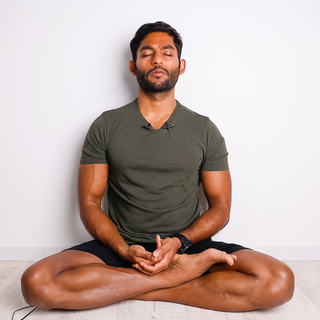
You sit in silence, often using shanmukhi mudra, the fingers gently closing the ears, and turn attention inward toward a spontaneous sound that arises without any external cause. Attention rests on this faint tone and follows it through progressively subtler layers, from pulsing and ringing toward a fine, continuous sound, held as one sustained focus. Sessions are quiet and seated, with no instruments or recordings, so the whole practice is inward listening.
Anahata Nada meditation is not external sound healing with singing bowls, gongs, or recorded tones; here the sound is endogenous, arising inside without any instrument. It also differs from guided visualization or mantra repetition, since the object is a spontaneous inner sound rather than an imagined image or a spoken phrase. Though grouped under Sound Healing for browsing, it is a focused-attention meditation from Nada Yoga, not a passive receptive treatment.
Not to be confused with
Tinnitus
Tinnitus is a persistent ringing or buzzing tied to hearing or neurological changes, a medical symptom rather than a meditation. Anahata Nada is a chosen practice of listening inward; new, one-sided, or distressing ringing should be checked by a clinician, not treated as practice.
External sound baths and sound-healing sessions
Though it is filed under sound healing, Anahata Nada is not a gong bath or singing-bowl session. Those deliver audible external sound to a passive listener; this practice closes out external sound to attend to a spontaneous internal one.
Binaural beats and brainwave entrainment tracks
Binaural beats and entrainment tracks feed engineered audio through headphones to nudge brain rhythms. Anahata Nada uses no device or external audio at all; the sound is internally arising and the work is attentional, not technological.
Chanting and mantra repetition
Chanting and mantra repetition produce a sound the practitioner makes. Anahata Nada listens for a sound that arises without being produced, so it is receptive rather than vocal or self-generated.
Anahata Nada meditation appears to work mainly through attentional anchoring, the act of resting focus on one clear target so it stops jumping to worries and distraction. Listening for a faint inner sound gives attention a single subtle object to return to, and in research on a related silence-focused practice, people reported needing less effort to stay attentive as their practice deepened (Ben‐Soussan et al., 2020). A slower second thread is the body's relaxation response, the quiet settling that comes with sustained stillness; studies of relaxation-response practices broadly, not inner-sound meditation specifically, link this settling to reduced stress-related biological signaling (Bhasin et al., 2013), (Dusek et al., 2008).
Listening for a faint inner sound gives attention one subtle target to rest on, and holding that single focus leaves less room for the mind to wander into worry. In related silence-focused meditation, practitioners reported needing less effort to stay attentive as their practice deepened (Ben‐Soussan et al., 2020).
The bodily changes tied to this practice have mostly been measured in related meditation, not in inner-sound listening itself, so the picture is indirect. EEG comparisons of meditators and non-meditators show distinct brain-activity patterns during meditation, a sign that this style of focused attention engages measurable neural change rather than merely passing the time, though the finding concerns meditation broadly and not Anahata Nada (Davis et al., 2026). The same silence-focused research also linked deeper reported quiet to microstructural change in the left uncinate fasciculus, a white-matter pathway connecting emotional and memory areas of the brain (Ben‐Soussan et al., 2020). In relaxation-response practices generally, studies have measured a quieting of inflammation-driving signaling governed by NF-κB, which practitioners may feel as the body carrying a lighter, less braced load (Bhasin et al., 2013), (Dusek et al., 2008).
After time in quiet, the body can feel like it is carrying a lighter, less braced load. In related relaxation-based practices, NF-κB, the molecular switch that turns on genes driving inflammation and the stress response, has been measured to quiet down (Bhasin et al., 2013), (Dusek et al., 2008), but this has not been measured during inner-sound meditation itself, so it is inferred from those adjacent practices rather than shown for Anahata Nada directly.
After deep, settled rest the body can feel restored rather than run-down, a felt hint of mitochondrial function, how efficiently your cells turn fuel into usable energy. This has not been measured during Anahata Nada meditation itself; the signal is inferred from relaxation-response research, where sustained relaxed states are linked to more active energy-metabolism and mitochondrial genes (Bhasin et al., 2013), (Dusek et al., 2008).

Limited–Emerging evidence to date supports Anahata Nada meditation mainly for the felt experience of inner quiet. Time spent listening inward is often described as helping people feel less caught up in their own thoughts (Lehmann et al., 2018), and focusing on a single subtle target may help attention settle with practice (Ben‐Soussan et al., 2020). What is not yet supported is anything firmer: there are no randomized trials, no systematic reviews, and no direct measurements of this specific technique, so it should not be framed as a treatment for any diagnosed condition.
No study has yet tested Anahata Nada meditation directly, so the current picture is built from research on related practices. Qualitative work on inner silence describes people feeling a greater sense of agency over their own thoughts (Lehmann et al., 2018), EEG studies show meditation produces measurable brain-activity signatures (Davis et al., 2026), and relaxation-response research links contemplative practice to shifts in stress-related gene activity (Dusek et al., 2008). The main limit is directness: these findings concern meditation and silence broadly, not inner-sound listening, so for this technique traditional and contemplative support still outweighs scientific measurement.

0
Meta-analyses
0
RCTs
0
Systematic reviews
0
Observational
6
Pilot
Studied populations
Outcomes measured
A study of different cognitive states for meditators and non-meditators with the use of multiple classification indices derived from the PSD of EEG data and lessons learned about cognitive states and the nature of intelligence in minds and machines
2026
Finding: This study recorded brain activity with EEG while meditators and non-meditators moved through several mental tasks, from solving math problems to watching video, and found that meditation produced a distinct pattern of brain activity unlike the other states. For someone practising, it's a sign that meditative attention isn't just subjective rest; it engages measurable, characteristic changes in how the brain works. That said, the study looked at meditation broadly rather than inner-sound practice specifically, and it described these patterns without reporting the size of the effect, so it can't tell you how much Anahata Nada in particular changes anything.
See full citation in referencesThe search for inner silence as a source for <i>Eudemonia</i>
2018
Finding: This is a theoretical paper rather than a hands-on trial, so it measures no outcomes; instead it argues that spending time in inner silence can help a person feel more free in relation to their own thoughts, feelings, and actions, and can make it easier to step back and shift where attention rests within the flow of the mind. For someone drawn to inner-sound practice, that offers a plausible reason why quiet, listening-inward sessions might leave you feeling less swept along by mental chatter and more able to choose your focus. Because the work is conceptual and reports no data on people actually practising, treat it as an idea worth exploring rather than proof that the technique delivers these effects.
See full citation in referencesAnahata Nada meditation comes from classical Nada Yoga and related yogic contemplative traditions, and is described in the Hatha Yoga Pradipika as a graded path toward absorption, or samadhi, through sound (Gulerī, 1987). These roots help explain the practice's form, the silent posture, the optional closing of the ears, and the graded listening for progressively subtler sound, rather than proving any clinical effect.
For most healthy adults, sitting quietly and listening inward for a faint inner sound is low-risk and usually feels settling. A few situations call for care, and because research directly on inner-sound meditation is limited, these are cautions drawn from practice rather than documented risks. Sustained inward attention can occasionally stir up unexpected emotion, or leave the body restless and jittery instead of calm. Listening closely for faint internal sensations can also sharpen awareness of ringing or pulsing until it feels unsettling rather than soothing, especially for people who already notice tinnitus, the ongoing ringing or buzzing that some people hear with no outside source. And if softly closing the eyes or ears leaves you feeling disoriented, treat that as a signal to ease off.
People with a trauma history, acute anxiety, or a tendency to dissociate, to feel detached from the body or surroundings, may find that prolonged inward focus intensifies distress rather than easing it, so shorter sessions and added support are wise. People who live with tinnitus should also take care, since listening closely for internal sound can amplify that ringing or pulsing uncomfortably. Anyone using this practice alongside treatment for a mental-health condition should coordinate with their clinician. These are cautions grounded in experience rather than trials, since no safety research specific to this technique yet exists.
Sitting quietly and turning attention inward is usually settling, but for people with a trauma history, acute anxiety, or a tendency to dissociate — to feel detached from the body or surroundings — prolonged inward focus can intensify distress rather than ease it. Start with just a few minutes, leave the eyes softly open if closing them feels disorienting, and stop to feel your feet or the seat beneath you if distress arises. If you are in treatment, practise alongside a clinician you trust and let them know you are using this technique.
| Technique | Best for | Use with care | Evidence strength | Distinction |
|---|---|---|---|---|
| External sound healing (sound baths, singing bowls, gongs) | Group relaxation and a passive, receptive experience where an external soundscape carries the session. | If the goal is training sustained inner concentration, an external soundscape gives attention less to actively hold. | emerging EVIDENCE | Sound baths and singing-bowl sessions work with audible sound made outside you, washing over the body as you receive it. Anahata Nada reverses this: you close out external sound and listen inward for a faint tone that arises on its own, using it as a single anchor for attention. |
| Mantra meditation (japa) | People who find a repeated word easier to hold than a barely-there sensation and who want a portable anchor. | emerging EVIDENCE | Mantra practice anchors attention on a sound you generate, a word or syllable repeated aloud or silently. Anahata Nada anchors on a sound you do not make at all, so the effort is receptive listening for a spontaneous inner tone rather than active repetition. |
It is the anahata nada, or "unstruck sound", a subtle inner tone you listen for in progressively finer layers, from pulsing or ringing toward a single continuous sound. In classical Nada Yoga it is described as arising on its own, without anything striking together to make it.
+
The inner sound is the anahata nada, or "unstruck sound", a faint internal tone that the tradition says arises on its own without any external cause. Practitioners sit quietly, sometimes gently closing the ears, and follow the sound inward through finer and finer layers, often first noticing pulsing or ringing before it settles toward a steadier continuous tone. This is a classical Nada Yoga description drawn from texts such as the Hatha Yoga Pradipika rather than a clinically measured phenomenon, and it should not be equated with tinnitus or read as a treatment claim.
Real, in the sense that matters here. Anahata Nada meditation asks you to attend to faint internal sounds, ringing, pulsing, or a fine tone, that are usually genuine perceptual experiences masked by daily noise, not something you invent. Traditionally these are called the "unstruck sound"; if ringing is new, one-sided, or distressing, treat it as a possible medical sign and check with a clinician.
+
Real, for practical purposes. The practice is defined as quietly listening for a subtle inner sound and using it as an anchor for attention, so what you notice is a genuine internal perception being attended to rather than an invention of the mind. This is a contemplative, source-context framing; it does not claim a measurable external source for the sound. One distinction matters: the intended experience is different from tinnitus, the ongoing perception of a sound with no outside source, so any new, one-sided, or distressing ringing is worth checking with a clinician rather than treating as practice.
The subtle inner sound at the center of this practice, said to arise spontaneously without anything striking together to make it. Practitioners listen for progressively finer layers, from pulsing or ringing toward a fine, continuous tone.
The branch of yoga that uses sound as the path of meditation. Its inner-sound form trains attention by listening for internally arising sound rather than by working with the breath or a spoken mantra.
A hand position in which the fingers gently close the ears, and sometimes the eyes and nostrils, to shut out external input and turn attention inward toward internal sound.
In yogic tradition, a state of deep absorption in which attention becomes fully unified with its object. Classical texts describe inner-sound listening as one graded route toward it.
Keeping attention resting on one clear target so it stops repeatedly jumping to worries or distraction; here the anchor is the faint inner sound, which tends to feel like fewer spiraling thoughts and an easier time staying present.
Focused-attention regulation in which a single object is used to reduce mind-wandering; also described as focused attention or attentional selection.
The ability to sense faint signals from inside the body, such as pulsing, warmth, or tension. Attending to inner sound can sharpen this inward sensitivity, which often shows up as feeling more embodied and noticing stress earlier.
Interoception, the perception and interpretation of visceral afferent signals.
A bundle of nerve fibers linking emotion and memory regions of the brain. In a study of a silence-focused practice, structural change in this tract tracked with reported experiences of inner silence and with less attentional effort.
J. J. Joshua Davis, Florian Schübeler, Ian J. Kirk, Robert Kozma (2026). A study of different cognitive states for meditators and non-meditators with the use of multiple classification indices derived from the PSD of EEG data and lessons learned about cognitive states and the nature of intelligence in minds and machines. https://doi.org/10.3389/fnsys.2025.1718733
Cited in: Research, What happens in the body
Olga V. Lehmann, Goran Kardum, Sven Hroar Klempe (2018). The search for inner silence as a source for <i>Eudemonia</i>. https://doi.org/10.1080/03069885.2018.1553295
Explore guided sessions to deepen your Anahata Nada Meditation (Inner Sound) technique.
| Outcome | Effect size | 95% CI | N | Comparator | Source |
|---|---|---|---|---|---|
| differentially expressed genes vs controls | reported significant; p<0.05; shared p<10^-10 | — | — | — | Dusek et al., 2008 |
The research is useful for setting expectations, but study methods and participant groups vary. Treat the findings as general guidance rather than a promise about any single session, and not a replacement for clinical care.
Relaxation Response Induces Temporal Transcriptome Changes in Energy Metabolism, Insulin Secretion and Inflammatory Pathways
2013
Finding: Comparing people who regularly practise relaxation-response techniques, such as meditation, against non-practitioners, this study found meaningful differences in how hundreds of genes were switched on or off, with lower activity in stress and inflammation-related pathways and higher activity in genes that help cells produce energy. Both seasoned practitioners and those who had only recently learned the technique showed these shifts, hinting that the body's calm response may leave a measurable imprint fairly quickly. It is worth being clear that this pattern reflects relaxation practices in general rather than inner-sound meditation specifically, and a snapshot of gene activity is not the same as treating or preventing any disease.
See full citation in referencesCorrelates of Silence: Enhanced Microstructural Changes in the Uncinate Fasciculus
2020
Finding: In this study of a silence-based meditative practice, people who reported richer experiences of inner silence also showed subtle structural differences in a brain pathway that links emotion and memory, and they described needing less effort to hold their attention as practice continued. For someone drawn to inner-sound meditation, this hints that resting attention on a quiet internal focus may become easier and feel less effortful over time. It's worth being clear about the limits, though: this was a related silence practice rather than inner-sound meditation itself, and the findings are early correlations rather than proof that any single technique reshapes the brain or sharpens focus.
See full citation in referencesGenomic Counter-Stress Changes Induced by the Relaxation Response
2008
Finding: This study compared people who regularly practise relaxation-response techniques with those who don't, and found that the practitioners showed activity changes across thousands of genes, with lower activity in stress- and inflammation-related pathways and higher activity in the genes that power the body's energy-producing machinery. In practical terms, the kind of deep, settled state that meditative practice can produce may reach all the way down to how cells manage stress and energy. Worth knowing: this is a general pattern seen across relaxation practices rather than proof about inner-sound meditation specifically, and because it compares existing practitioners to non-practitioners rather than tracking one group over time, it points to an association rather than a guaranteed effect.
reported significant; p<0.05; shared p<10^-10
Because the practice asks you to attend closely to faint internal sound, it can heighten awareness of tinnitus — the ongoing ringing or buzzing some people hear with no outside source — rather than soothe it, especially when shanmukhi mudra closes off outside sound. Keep sessions short, leave the ears open, and stop and ground yourself if the ringing intensifies. Treat any new, one-sided, or distressing ringing as a medical signal to check with a clinician rather than a focus for practice.
Sustained inward attention can occasionally stir up unexpected emotion, or leave the body restless and jittery instead of calm. Treat this as a signal, not a test: open the eyes, feel your feet or the seat beneath you, and pause. There is nothing to gain from pushing through distress. This is a caution drawn from practice rather than a documented risk, since research directly on inner-sound meditation is limited.
If softly closing the eyes or ears leaves you feeling disoriented, treat that as a signal to ease off. Leave the eyes softly open with a low, unfocused gaze, and skip the ear-closing posture entirely if it unsettles you. The aim is inward listening, not shutting the senses down, so staying visually anchored keeps the practice grounding.
Anahata Nada meditation is best approached gently, as a quiet inward listening rather than a search for a particular sound, in a spot where you can settle without needing to move or stay alert. A sensible starting format is a brief seated session in a supported posture, with the option to keep your eyes softly open if closing them feels disorienting. Let the practice stay short and comfortable at first, and treat any restlessness or unsettling sensation as a cue to ease off rather than something to push through.
Begin with just a few minutes of quiet listening and lengthen sessions only as the practice feels comfortable. Starting small lets you notice how inward attention sits with you before committing to longer stretches.
Sit somewhere you will not need to move suddenly, so that if the body grows heavy and still you can rest without concern. A steady, supported seat lets attention turn inward without the body having to work to hold you up.
If closing the eyes feels disorienting, leave them softly open with a low, unfocused gaze. The aim is inward listening, not shutting the senses down, and staying visually anchored keeps the practice grounding.
Shanmukhi mudra — resting the fingers lightly over the ears to turn hearing inward — is optional. Never press hard, and skip it entirely if closing off outside sound sharpens ringing or pulsing in a way that feels distressing.
If restlessness, unexpected emotion, or an uncomfortable focus on internal sensations arises, open the eyes, feel your feet or the seat beneath you, and pause. There is nothing to gain from pushing through distress.
If you are managing trauma, anxiety, or another mental-health condition, or are currently in treatment, practise alongside a teacher or clinician you trust and let them know you are using this technique.
This information is educational and is not medical advice. This practice is not a substitute for professional care and should not replace prescribed medication or treatment for any medical or mental-health condition. If you are managing a health condition or taking medication, talk with a qualified health professional before changing your practice. If you are in distress or crisis, seek professional support.
| Focused-attention breath meditation | Beginners who want a concrete, always-available anchor and the broadest base of supporting research. | moderate EVIDENCE | Breath-focused meditation rests attention on the physical sensations of breathing; Anahata Nada rests it on a subtle inner sound instead. Both train the same core skill of returning a wandering mind to one chosen anchor, differing mainly in which anchor is used. |
| Trataka (yogic gazing) | Practitioners who concentrate more readily with a visible external focus than with sound. | emerging EVIDENCE | Trataka is the sister concentration practice in Hatha Yoga, but it fixes attention on a visual point such as a candle flame with open eyes. Anahata Nada turns the same graded-concentration approach toward hearing, closing the eyes and often the ears to follow inner sound. |
Not proven, but promising for gentle settling. No study has tested Anahata Nada meditation directly, so it isn't validated as a treatment. Related meditation and inner-silence research suggests it may help attention settle and ease the sense of being caught in your thoughts (Lehmann et al., 2018), (Ben‐Soussan et al., 2020).
+
Not proven. There are no randomized trials, systematic reviews, or direct measurements of Anahata Nada meditation itself, so it cannot be presented as an established treatment for any condition (Davis et al., 2026), (Lehmann et al., 2018), (Ben‐Soussan et al., 2020). What the wider evidence points to is suggestive rather than confirmed: focusing on a single subtle target may help attention settle with practice (Ben‐Soussan et al., 2020), and time spent in inner quiet is often described as helping people feel less caught up in their own thoughts (Lehmann et al., 2018). For this technique, traditional and contemplative support still outweighs scientific measurement.
Possibly, though this is a plausible mechanism rather than a proven effect. Listening for one faint inner sound gives attention a single anchor to rest on, which research on related focused-attention and inner-silence practices links to feeling less caught up in your thoughts (Lehmann et al., 2018), (Ben‐Soussan et al., 2020). Responses vary, and it is not a reliable fix.
+
Possibly. The mechanism is attentional anchoring, resting focus on one clear target, the subtle inner sound, so attention stops jumping to worries and distraction. In research on a related silence-focused practice, people reported needing less attentional effort as their practice deepened (Ben‐Soussan et al., 2020), and qualitative work on inner silence describes a greater sense of agency over one's own thoughts (Lehmann et al., 2018). This support is indirect, drawn from adjacent practices rather than trials of inner-sound listening itself, so treat it as a promising mechanism, not established fact, and expect individual responses to differ.
No study has scanned the brain during inner-sound meditation itself, so the picture is indirect. EEG research shows meditation broadly produces distinct brain-activity patterns, and silence-focused practice has been linked to white-matter changes and less mental effort (Davis et al., 2026), (Ben‐Soussan et al., 2020).
+
The brain changes tied to this specific practice have not been measured, so the picture is indirect. EEG comparisons of meditators and non-meditators reveal distinct neurophysiological signatures during meditation generally, indicating that this style of focused attention engages measurable neural activity (Davis et al., 2026). Separately, research on a silence-focused practice linked deeper reported inner quiet to microstructural change in the left uncinate fasciculus, a white-matter tract connecting emotion and memory regions, alongside reduced attentional effort (Ben‐Soussan et al., 2020). These findings concern adjacent meditation and silence practices, not Anahata Nada itself, so they should not be read as proof of any brain-level or clinical effect for inner-sound listening.
Use care. If you live with tinnitus, the ringing or buzzing you hear with no outside source, listening inward for faint internal sound, especially with the ears closed, can amplify it uncomfortably. Keep sessions short, skip the ear-closing posture, stop if it worsens, and have any new or one-sided ringing checked by a clinician.
+
Use care. No research has tested inner-sound meditation directly in people with tinnitus, so this is a practice-informed caution rather than a cleared safety verdict. Because the practice asks you to attend closely to endogenous sound, the internal ringing or pulsing that arises within, it can heighten awareness of tinnitus rather than soothe it, particularly when shanmukhi mudra closes off outside sound. The practical safeguards are to begin with only a few minutes, leave the ears open, stop and ground yourself if the ringing intensifies, and treat any new, one-sided, or distressing ringing as a medical signal to check with a clinician rather than a focus for practice.
Use care. For most healthy adults it is low-risk, but prolonged inward focus can intensify distress, restlessness, or dissociation, feeling detached from your body or surroundings, if you have a trauma history or acute anxiety. Keep sessions short, keep an eyes-open option, ground yourself, and coordinate with a clinician. No safety research on this specific technique exists.
+
Use care. Sitting quietly and listening inward is usually settling, but attending closely to internal sensations can heighten anxiety, restlessness, or dissociation for some people, especially with trauma histories or acute distress. As a practice-informed caution rather than documented safety evidence, start with just a few minutes, leave the eyes softly open if closing them feels disorienting, and stop to feel your feet or seat if distress arises. This is not clinical clearance or a substitute for care; if you are in treatment, practise alongside a clinician you trust.
Start with just a few minutes. Begin with a short spell of quiet inward listening and lengthen sessions only as the practice feels comfortable. This is a practice-informed suggestion, not an evidence-based dose, since no study has tested an optimal duration for inner-sound meditation.
+
Start with just a few minutes. Begin with a brief period of quiet listening and build up gradually, letting you notice how sustained inward attention sits with you before committing to longer stretches. Treat difficult feelings, such as restlessness or unexpected emotion, as a signal to open your eyes and pause rather than push through. No trial has tested this technique directly, so there is no clinically validated minute count, and any specific number is a gentle starting point rather than a proven target.
That's normal. The inner sound often stays hidden beneath everyday noise at first and tends to become easier to find with repetition, not on a first attempt. Keep sessions short, sit in a quiet place, and let attention rest gently inward rather than straining to hear.
+
That's completely normal, and it isn't a sign you're doing it wrong. Many people hear nothing distinct early on; the faint ringing, pulsing, or high tone usually surfaces gradually as attention settles with repeated practice rather than arriving fully on a first try. Practical steps that tend to help are starting with just a few minutes, sitting somewhere quiet and stable, and optionally resting the fingers lightly over the ears, a posture called shanmukhi mudra, without pressing hard. Treat any restlessness or strain as a signal to ease off rather than a test to push through. This is practice-informed guidance, since no research has studied inner-sound listening directly.
The direction of the sound. Anahata Nada meditation is inward, receptive listening for a faint sound that arises on its own, used as a single attentional anchor. A sound bath delivers audible external sound, such as singing bowls or gongs, that you receive passively.
+
The core difference is where the sound comes from and what you do with it. In Anahata Nada meditation you sit quietly, often gently closing the ears with shanmukhi mudra, resting the fingers over the ears, and listen inward for a spontaneous "unstruck" inner sound, using it as one sustained focus. A sound bath is the reverse: external instruments wash audible sound over you while you receive it. Both sit under sound-based practice and both rest on emerging, limited evidence, with no direct head-to-head comparison, so neither should be read as more effective than the other.
The body settling into a calm, low-arousal state that is the counterpart of the stress response, felt as slower breath and a less braced body and associated with restful physiology in meditative practice.
A classical yoga text that describes listening for the inner unstruck sound as a graded path toward deep meditative absorption.
Manoj Bhasin, Jeffery A. Dusek, Bei‐Hung Chang, Marie Joseph, John W. Denninger, Gregory L. Fricchione (2013). Relaxation Response Induces Temporal Transcriptome Changes in Energy Metabolism, Insulin Secretion and Inflammatory Pathways. https://doi.org/10.1371/journal.pone.0062817
Cited in: How it works, What happens in the body
Tal Dotan Ben‐Soussan, Fabio Marson, Claudia Piervincenzi, Joseph Glicksohn, Antonio De Fano, Francesca Amenduni (2020). Correlates of Silence: Enhanced Microstructural Changes in the Uncinate Fasciculus. https://doi.org/10.3389/fpsyg.2020.543773
Cited in: Benefits, How it works, Research, What happens in the body
Jeffery A. Dusek, Hasan H. Otu, Ann L. Wohlhueter, Manoj Bhasin, Luiz F. Zerbini, Marie Joseph (2008). Genomic Counter-Stress Changes Induced by the Relaxation Response. https://doi.org/10.1371/journal.pone.0002576
Cited in: How it works, Research, What happens in the body
Candradhara Śarmā Gulerī (1987). A critical survey of Indian philosophy.
Cited in: Roots and tradition
Editorially curated. Tracks are not themselves clinically studied; evidence on the page applies to Anahata Nada Meditation (Inner Sound) as a technique.
Beginner content for Anahata Nada Meditation (Inner Sound)

★ 4.8
·
Guided
·
10 min
Emma Maidment
How hard is Anahata Nada Meditation (Inner Sound)?
Anahata nada meditation is a higher-cognitive variant inside Nada Yoga and should sit above the simpler listening rows.
3
Mental Effort
3 / 4
▾Emotional Depth
1 / 4
▾Physical Intensity
1 / 4
▾Prior Knowledge
2 / 4
▾